🪰 When You Watch a Sitcom, You’re Hearing Dead People
THE BUZZ
- Your comfort show may have some lingering company.
-
A well-timed chuckle became a valuable commodity.
-
One man had a box for that.
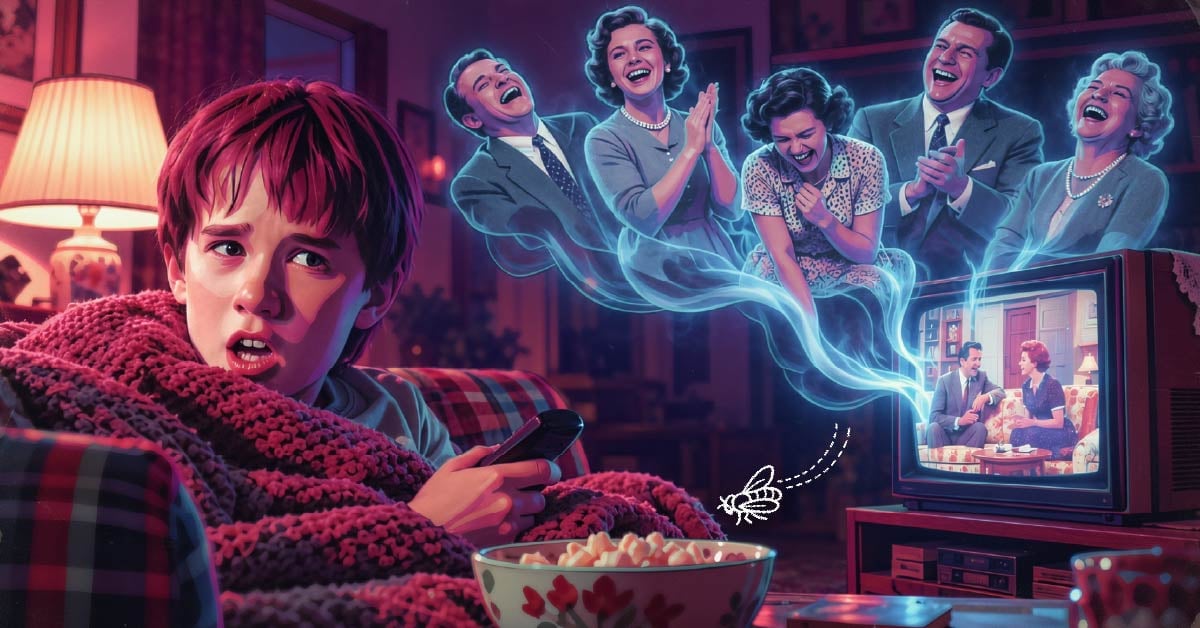
We all love a good sitcom. There’s nothing like coming home after a long day, getting all snuggled up on the couch with something yummy and putting on a nice mindless sitcom. And that comforting roll of laughter in the background? *chefs kiss*
But you know, speaking of that laughter… turns out it’s a bunch of dead people. Yeah, that’s not so comforting.
Logically, we know that when we’re watching a show from the 70s, a lot of the actors and the audience are probably no longer with us. But it’s a little eerie to think that the familiar laugh track we hear is the laughter of folks who have long since passed. However, the story behind the infamous sitcom laugh track is even more interesting than it being just a bunch of dead people. Turns out there was an entire secret system behind this laughter, complete with a literal chuckle instrument that played the laughs like an organ. Just a tad creepy.
To begin the descent down this rabbit hole is a video from Treehouse Detective. It makes some sweeping claims about one group supplying all sitcom laughter, but the most interesting part is the man at the center of this mystery: Charles “Charley” Douglass. He was literally the “King of Laughter” back in the day…
@treehousedetective All sitcom laughter is one group of people who aren’t alive #film #tv #television #filmhistory #sitcoms ♬ original sound – Treehouse Detective
The Audience Was Being Difficult
There’s one big problem with a live televised audience: they’ve got opinions.
Oftentimes, people in the audience might respond less enthusiastically than the show’s producers would’ve hoped. Then there’s always that one idiot who keeps laughing for virtually no reason while you’re trying to listen to the dialogue. Laughter can be funny like that.
So to help make audience reactions more reliable and standardized, Douglass used a method dubbed “sweetening,” which is where he would add additional recorded laughter where the producers wanted more. Recorded reactions like this also made it possible for a show to basically fake that they had a live studio audience. could also provide the audience sound for a show made without a crowd.
Really, the whole term “sweetening” sounds pretty endearing. It makes it sound as though a sound engineer was gently sprinkling little bits of sweet sugary laughter throughout a dull bit of a show.

A Keyboard Full of Strangers
The Laff Box was an actual machine, with recorded reactions available through its controls. Inside the example later demonstrated on Antiques Roadshow were tape loops. Just imagine the convenience back then of being able to reach for the sort of laugh a scene needed, rather than hoping some yahoo in the audience supplies it.
Douglass could play those reactions into a soundtrack. In the WNYC retrospective, sound veteran Leo Chaloukian described him holding a button for the response he wanted, releasing it, and moving on to another. A crowd’s enthusiasm was no longer necessary.
A lot of us think of the laugh track as one irritating sound pasted after every punchline, or it’s something so familiar that it really just fades into the background. So it’s crazy to think just how much went into operating this machine and the choices one had to make about when a reaction should begin, how long it should last, and how much amusement the moment could reasonably support. It was literally a symphony of laughter, and Douglass was that era’s Beethoven.
Somebody at the controls had to imagine an audience that wasn’t there and give it believable manners. A modest joke needed a modest response, while a bigger laugh had to leave room for whatever happened next. Apparently, even imaginary people required direction.
Too much laughter could be a big red flag and draw too much attention to the machinery. Then a ruckus of laughter arriving in the wrong place would just make everything feel off. The operator’s expertise was best on display when the crowd was just there and no one had to wonder where it came from.
Hollywood’s Most Guarded Giggle
Douglass was super protective of his equipment and methods. The PBS appraisal describes him bringing the machine into a studio, doing the work, and taking it away without allowing people to inspect its contents. Sounds like he might’ve been a tad paranoid.
His reputation was a big deal too. Chaloukian recalled that producers wanted Douglass even when others tried to imitate his machine. Knowing how to build a box was one thing; being the person everyone trusted with the soundtrack was valuable in its own right.
But it wasn’t just Douglass running the laugh game in Hollywood. He had some competition. In his Television Academy interview, Carroll Pratt describes working with Douglass, then developing an updated laugh machine with his brother and establishing Sound One in the 1970s. So the family didn’t maintain the uninterrupted monopoly into the 2000s described in Treehouse Detective’s TikTok video.
So, About the Dead People…
Already, to be 100% honest, not every laugh track you’re hearing is a bunch of dead people. Unfortunately, when you watch a sitcom, the credits don’t tell you when the track was recorded, who supplied it, or whether those people are still alive.
Some audience sound belongs to the performance being filmed. Even nowadays, shows like The Big Bang Theory were filmed before a live studio audience, and other laughter was supplied or supplemented during editing. Those approaches can overlap, which makes “real audience or laugh track?” a less tidy question than it would seem.
The eerie part is what happens once the finished soundtrack exists. A rerun preserves the reaction as well as the joke. Somebody who laughed during a recording decades ago could have died while that moment of amusement continued to accompany the show.
But we don’t need to identify every voice to just quietly acknowledge that that chuckle in the background is someone who’s 6 feet under. Think about how casually we encounter old recordings of people speaking or singing… laughter is really no different.
But it doesn’t feel a bit like one of those “Oh shit” realizations because we rarely think of the audience as part of the cast. They’re just these anonymous people, who are just there whenever we press play, with none of the biographical information that might remind us time has passed for them too.
A Little Company for the Couch
There’s also a surprisingly cozy side to this.
In WNYC’s piece, sound designer Steve Lee suggested that a movie theater already gives viewers other people to share the joys of cinema with. But then someone watching something in their living room may have a much smaller crowd or no crowd at all. That’s where the laugh track comes in and gives us something we all aparently need: human company.
You know, a familiar sitcom already has all those warm, fuzzy feels. You understand the rhythm, expect certain behavior from the characters, and don’t need to spend the first twenty minutes figuring out who’s plotting against whom.
And that background laughter can become part of that comfort. Of course, it can also sound like a roomful of people being way over the top about a joke that barely deserved an exhale.
There’s a peculiar intimacy in spending years hearing strangers laugh. We never learn their names or find out what happened after they went home, but their amusement becomes part of a place we visit for comfort. They can feel familiar without ever becoming people we know.
That’s what’s really more interesting than the argument over whether laugh tracks are annoying. A background sound can become part of the feeling of being home, even when its original home was somewhere else entirely.

The Laughing Box in the Storage Locker
After all that secrecy, the Laff Box’s later public appearance had a wonderfully nonchalant debut.
Some guy acquired a storage locker containing household goods and an unusual device he almost threw away. But then he had a change of heart and brought it to Antiques Roadshow, where the program identified it as Douglass’s original Laff Box. His assessment of the object before doing some research was considerably less enthusiastic:
“I was actually going to throw it away because it just didn’t look like it had any value.”
PBS’s 2010 appraisal put its value at $10,000. Seriously, I bet that guy is happy he didn’t heave it into the trash.
The People Who Never Knew They Were Regulars
The machine gets the attention because someone built it, protected it, and found a way to make it useful. But we’re forgetting the folks who supplied its raw material.
An audience member doesn’t have to do anything grand to leave something on a recording. Chuckling at a joke is enough, and once that moment becomes part of a soundtrack, it can travel into rooms that person will never visit and reach viewers who weren’t even there for the original performance.
This might sound a little flowery, but it’s like their laughter transcends time and space. It’s kind of beautiful when you think about it.
So, the next time you’re plopped on the couch and an old sitcom’s audience erupts, I suspect you’ll listen a little more closely. Somewhere inside that familiar noise may be a person who had a good afternoon and left a tiny piece of it running.
THE LANDING
Your comfort show may be haunted, but the ghosts seem to be having a good time.
STAY CURIOUS
Three more stories worth your curiosity.

 Have You Noticed Every House in Movies Looks Like an Airbnb Now?






Post Comment