🪰 Netflix Just Realized That Binging 12 Episodes in Your Jammies Has Lost Its Luster
THE BUZZ
-
Our relaxing weekends now come with a deadline.
-
There’s something to be said for anticipation.
-
The pressure is reaching Netflix’s executive suite.
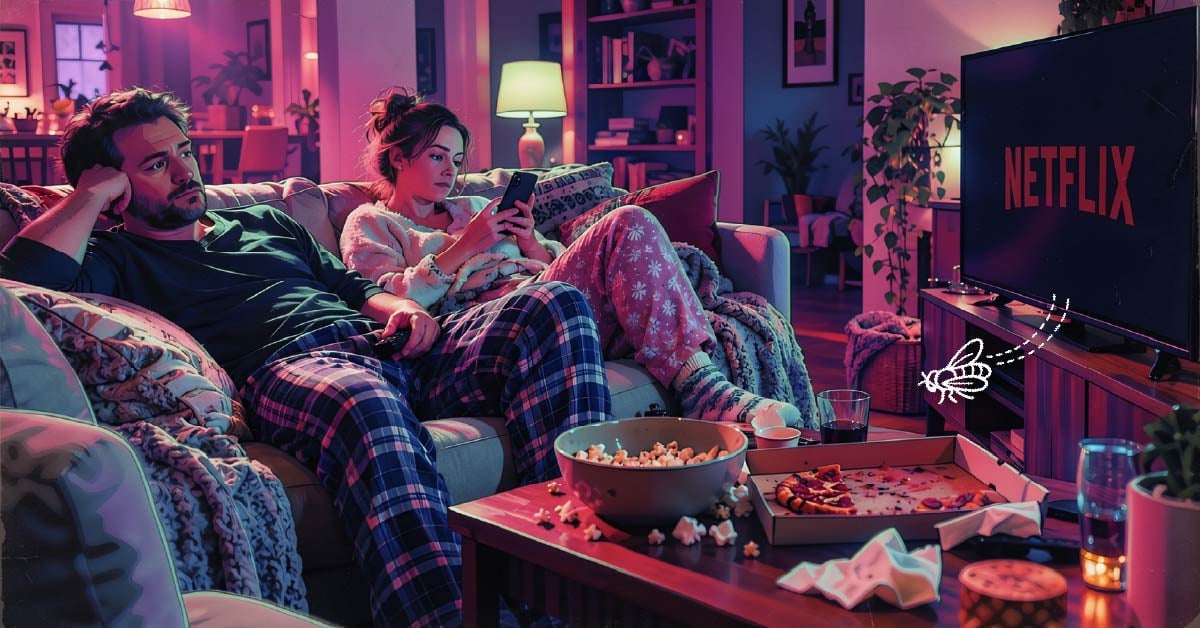
We all love a Saturday where we sit in clothes that we wouldn’t be caught dead in outside, plant ourselves on the couch, make a yummy little snack, and find something good on the ol’ TV. It’s a tradition as old as time… or perhaps as old as our latest streaming addiction.
For a while, Netflix was the service that not only kicked off this addition, but even as streaming services continue spawning every day, it’s remained a constant in many people’s living rooms. There’s really nothing like that moment where an entire season would pop up on your screen, ready to be consumed. If an episode ended with somebody opening a mysterious door, we could find out what was behind it before the snacks ran out.
Then the whole “Netflix and Chill” started becoming less relaxing and just a tad bit more stressful. Once you’ve finished a series, boom, there’s another one waiting for you… luring you in with its slick trailer.
There’s also this whole “peer pressure” element, because now, just entering a conversation about shows is a minefield where everyone has to avoid spoilers at every turn.
Then there are the suggestions—oh lord, don’t even get me started on the suggestions! It seems like any time you bump into a friend, they’re recommending at least five other series for you to watch, which you then have to add to your ever-growing list. And you can’t not watch these shows, because what the heck else will you have to chat with your friends and family about?
Creator Aria Velz explores the streaming boom and its slow demise, tracing Netflix’s binge model back to its early originals in 2013. Shows like House of Cards and Orange Is the New Black helped make a whole season arriving at once feel like an event. Her whole video makes one really pause and consider if Netflix and similar streaming services have become more of a curse than a blessing.
We miss having a week to be completely wrong
There’s that classic phrase “Absence makes the heart grow fonder,” and it’s not just true for romance but also for television. Anticipation is real, and without it, things tend to lose their luster.
Just a small, suspicious glance before the closing credits could keep us all on the edge of our seat for weeks. We would then spend the week building theories, talking about possible plot lines with friends… and by the time that episode came out, hunches would either be confirmed or denied. But honestly, even if we were way off, being wrong was part of the fun.
With a full season just sitting there waiting, the anticipation is pretty much gone. The only time you’ll sit and wonder what’s going to happen next is while you’re emptying another bag of potato chips into your bowl. So, we get the satisfaction of knowing sooner, but it just doesn’t hit the same. A cliffhanger has a feel when it has to survive until next week.
The original TikTok video also points to these shorter, more condensed seasons. It connects the binge model to the preference for compact runs of six or eight episodes. It’s honestly crazy to see how much the whole “binge format” has influenced television, and it definitely makes you wonder if we’re heading in the right direction with our entertainment.
But honestly, not just our entertainment, but our dependence on it.
Netflix is having this argument too
Apparently all of this doubt around the binge format has made its way to the O.G. binge machine: Netflix.
The Wall Street Journal reports that executives are debating changing the timing of episode releases to improve engagement.
Additionally, executives have debated whether to change the release cadence of certain shows to improve engagement, according to people familiar with the matter. Netflix typically drops all the episodes of a season at once, while many competitors release new episodes weekly. Sarandos has resisted the change. Netflix data shows that members prefer an all-at-once binge versus a weekly cadence, according to the company.
But more than just debating the release schedule, Netflix has been doing some major internal restructuring, including a sudden layoff of content chief Bela Bajaria and film chief Dan Lin.
It abruptly replaced content chief Bela Bajaria last week just hours after a layoff of 1,000 employees that she helped engineer. By Monday, film chief Dan Lin lost his job, too.
The ousters of two of the company’s top creative executives are a sign that the streaming giant’s leaders feel the service needs to overhaul its content offerings.
Co-Chief Executive Ted Sarandos had complained internally for months that Americans were spending less time watching Netflix and that the service was short on new hit shows, people familiar with the matter said. He also has told colleagues that he wants the company, which has experimented with everything from videogames to podcasts, to strengthen its core TV and movie offerings.
On Tuesday, the company is set to deliver its third-quarter earnings and try to answer Wall Street’s questions about its strategy.
Problems at the company that ushered in Hollywood’s streaming revolution have been building for a year as it has struggled to come up with hits on the level of “Stranger Things” or “Squid Game.”
The same report says co-CEO Ted Sarandos has resisted a change, and Netflix maintains that its data shows members prefer having a season available all at once.
So, it seems that Netflix is at a bit of an impasse… one where the audience wants things one way, all while the company is desperately trying to steer the ship over choppy waters.
The trouble has reached the office
But it’s not just top brass that’s getting the axe at Netflix. Nope. The company’s latest overhaul has thousands of employees packing up their cubicles, and apparently there could be more to come.
On October 12, ZeroHedge covered a report that Netflix was preparing to cut about 5% of its workforce. It also reported that shares were down 42% over the preceding year at that point, and the company overall is facing an unfortunate combination of lower engagement and rising competition.
The company had about 16,000 full-time employees at the end of last year, so a 5% cut would mean roughly 800 jobs. It is not yet clear which departments would be hit, TheWrap reported. Netflix’s last major round of layoffs came in 2022, when it cut hundreds of jobs amid slowing growth and subscriber losses, per Reuters; it also laid off a small number of product team employees in February, TheWrap noted.
The reported cuts follow a rough stretch for the stock. Shares were trading at $70.96 Friday morning, down 42% over the past year, 22% year to date and 30% over six months, according to TheWrap.
Last month, HSBC and Wells Fargo both downgraded Netflix over engagement – with HSBC’s Mohammed Khallouf moving the stock to Hold from Buy and cut his price target to $76 from $96, citing YouTube’s growing living-room presence and Netflix’s falling share of U.S. TV time. Wells Fargo’s Steve Cahall cut his rating to Underweight from Equal Weight and his target to $57 from $80, citing “worrying” engagement trends.
Nielsen’s July Gauge put Netflix at 7.8% of U.S. TV viewing against YouTube’s 14.2%, TheWrap said. Reuters said the company is navigating a more competitive streaming market as media companies consolidate and YouTube takes a growing share of viewership and advertising spending.
Now, don’t get it twisted: Netflix still has a substantial business. The Journal describes continued revenue growth alongside concerns about engagement.
But still, the gap between what people want and what keeps them hooked is an ongoing problem for the streaming giant.
Now our binge comes in installments
The original TikTok video points to split releases for shows like Bridgerton, Stranger Things, and Love Is Blind as examples of Netflix adjusting its approach. It’s basically like we get a little appetizer and first course, but we still have to wait for the main meal.
But this is a tactic that’ll maintain subscribers for a month or perhaps two. The funny thing about humans is that we can easily lose interest, so that span between the first half of the meal and the second leaves plenty of time for us to either forget about the main course in general or, worse, finish the meal somewhere else.
Look, the so-called “downfall” of Netflix, or the binge format, doesn’t mean we’ll never pass a weekend in stained sweats, watching television like a zombie. But they could be fewer and further in between.
The data doesn’t lie. People aren’t as engaged as before, and even though we might want to sit and consume an entire series in one go, that still doesn’t mean it’s the best model for the company moving forward.
THE LANDING
For better or worse, it looks like the days of “Netflix and Chill” are over…
STAY CURIOUS
Three more stories worth your curiosity.





Post Comment