🪰 McMansions: How America Got Hooked on Fake Wealth and Really McCrappy Houses
THE BUZZ
-
Fancy stone out front. Cheap vinyl out back.
-
Those ridiculous roofs can cost a fortune to fix
-
We made neighborhoods uglier trying to look richer
Remember when a perfectly nice three-bedroom house with a backyard, a garage, and a little white picket fence was considered the American dream?
Well, somewhere around the late 1980s, Americans decided that wasn’t good enough anymore.
Suddenly, everybody wanted to live like European royalty.
And I’m not talking about actual royalty, with their magnificent estates, centuries-old architecture, and beautiful grounds. I’m talking about the kind of McRoyalty you’d find at a suburban strip mall, wearing designer knockoffs and financing a BMW they can’t afford.
Enter the McMansion.
You know these houses, right? You’ve probably driven past entire neighborhoods filled with them, staring in disbelief at those enormous, mismatched monstrosities that look like somebody gave a five-year-old access to an architectural design program and said, “Do your best work!”
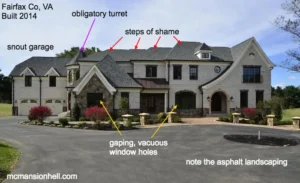
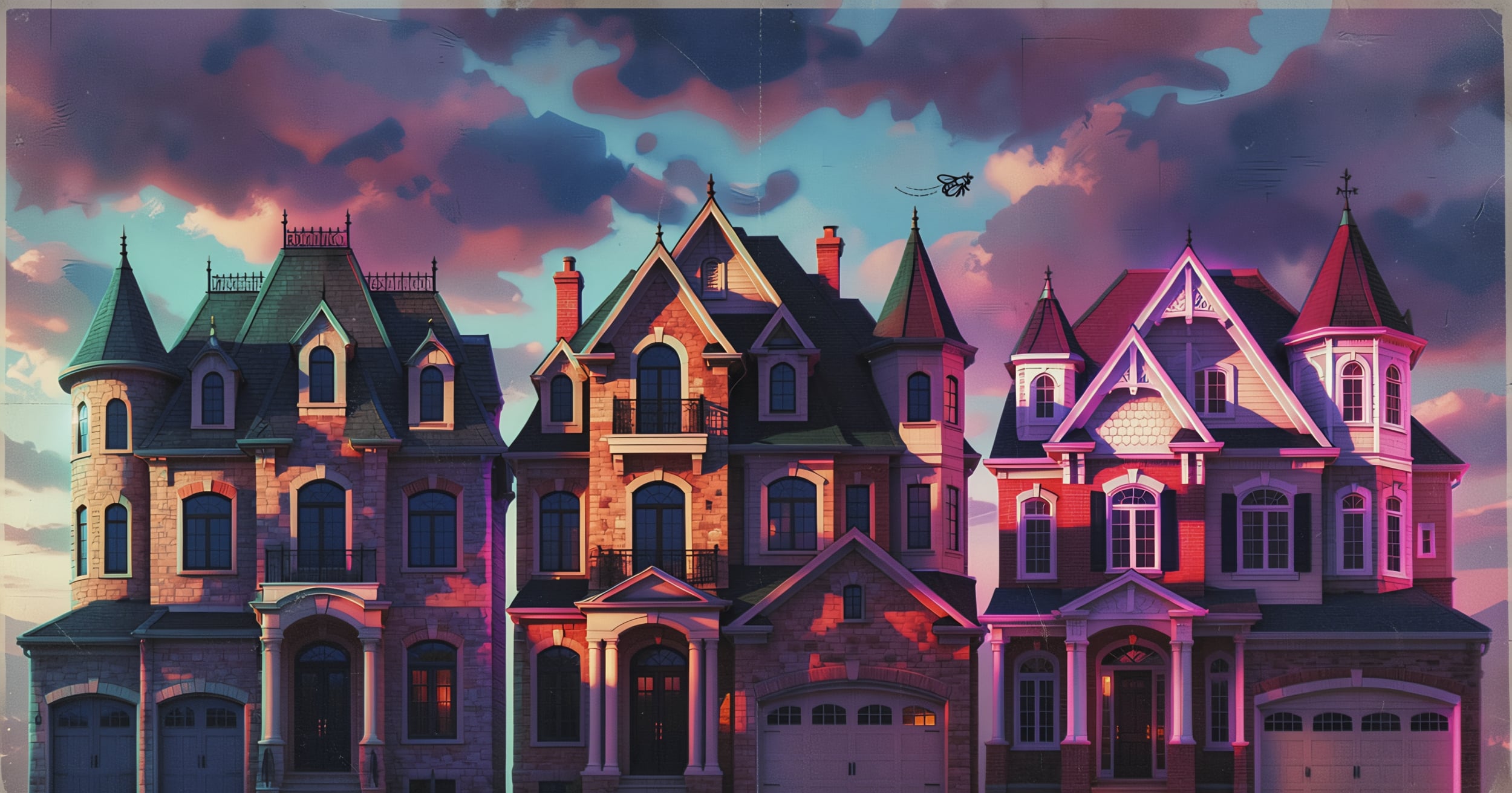
They’ve got gigantic columns, ridiculous rooflines, windows scattered around like somebody put on a blindfold and just hurled them at the house all willy-nilly, and these goofy-looking grand entryways that look like they really wanted to belong at Buckingham Palace…
Yes, Buckingham Palace if it were built by a contractor who got a fifty percent-off deal on vinyl siding at Home Depot.
And for a while, Americans absolutely LOVED these things… like, a to-the-moon-and-back kinda love affair.
The bigger the house, the more successful you appeared. Never mind whether you could actually afford to maintain the damn thing or whether half the rooms were sitting empty. Who the hell cares, you had 5,000 square feet, a three-car garage, and a foyer large enough to hold a royal coronation. Surely everybody driving past would assume you were loaded to the rafters.
But as these oversized suburban castles began aging, something really unpleasant started happening.
Americans discovered that pretending to live like aristocrats came with some very real bills, and a lot of these supposedly luxurious homes weren’t nearly as luxurious as they appeared to be.
And the damage extended way beyond the homeowners.
Entire neighborhoods were transformed into sprawling collections of oversized, architecturally confused houses that ate up so much land, stretched infrastructure, and managed to eliminate much of the charm that made traditional American neighborhoods so homey and appealing in the first place.
So how did we get talked into this ridiculous idea, and why did an entire generation become convinced that living in a mass-produced imitation of a French château was the ultimate measure of success?
Well, we’ve got quite a story here… buckle up, guys.
WELCOME TO THE ARCHITECTURAL CIRCUS
Before we get into the financial headaches, we need to appreciate just how magnificently ugly some of these houses actually are.
Because a McMansion is much more than your run-of-the-mill big house.
There’s a very particular kind of architectural insanity involved with these things… from mismatched windows and comically ridiculous rooflines to enormous entryways designed to impress absolutely nobody who actually understands real architecture.
This next video gives us a quick tour of the features that make a McMansion a McMansion.
And once you see all the telltale signs, you’ll start spotting these monstrosities everywhere.
WHO THE HELL DESIGNED THESE THINGS?
Good Lord, the rooflines deserve a full psychological evaluation.
Have you ever noticed how some McMansions appear to have about fourteen different roofs fighting for control of the same building? I sure do, and I’m not some well-versed character when it comes to architecture.

But you don’t have to be. There’s some random little peak over the garage, another one over the bedroom, a giant triangular thingamabob over the foyer, and a few decorative dormers that look like they were added because somebody stumbled into a pile of leftover roofing materials.
And the windows! Don’t get me started.
One side has some gratuitous huge arched window, the next has three little rectangles, and somewhere near the roof there’s a mysterious porthole that serves no purpose whatsoever.
But my favorite feature has to be those towering front entrances with those gigantic columns.
What exactly are we celebrating here? Is Julius Caesar on a chariot heading into the subdivision?
Because from as far as I know, behind those over-the-top columns, there’s a perfectly normal suburban family trying to figure out why their electricity bill is $800 bucks a month.
And that’s the fundamental problem with the McMansion… the cost to maintain them.
These houses were designed to create the appearance of wealth, but without the craftsmanship, proportions, or thoughtful architecture that makes genuinely beautiful homes worth admiring and paying for.
Which makes you wonder how this whole bizarre trend got started in the first place.
Well, for that, we need to revisit one of America’s favorite national pastimes.
Trying to look richer than the neighbors…
WHEN KEEPING UP WITH THE JONESES REQUIRED A THREE-CAR GARAGE
By the 1980s, America was changing.
We’d entered the era of conspicuous consumption, when success increasingly meant showing everybody exactly how rich you were.
Big cars, expensive clothes, fancy vacations, and enormous houses became wonderful ways to announce that you’d made it.
Meanwhile, developers were discovering that cheaper building techniques, standardized floor plans, expanding suburban developments, and readily available financing could make enormous houses accessible to buyers who previously would’ve considered that kind of luxury completely out of reach.
And boy, did they take advantage of it.
Why settle for building somebody a perfectly lovely, high-quality 2,000-square-foot home when you could offer them 5,000 square feet, with cheaper materials, a dramatic staircase, and an entryway inspired by the Palace of Versailles?
Never mind that Versailles took decades to build and employed some of Europe’s finest craftsmen… your suburban version could be finished with mass-produced components and a perfectly respectable collection of construction shortcuts.
That’s why the name McMansion was inevitable.
Just like McDonald’s mass-produces a version of the traditional hamburger, developers began mass-producing oversized homes that borrowed the vibes of expensive estates without delivering the same quality.
And the customers couldn’t get enough of these knock-offs. Because who wouldn’t want to tell their friends they’d just bought a 5,000-square-foot house?
The actual experience and expense of living in all that space was apparently something Americans worry about later.
ARCHITECTS HAVE SOME THOUGHTS ABOUT THIS MESS
Now, I know what you’re thinking… I’m just being a cranky architectural snob, right? But actual design professionals have been criticizing these things for eons.
The folks at Mitchell Wall Architecture & Design have laid out exactly what separates a genuine luxury home from one of these mass-produced suburban palaces.
And their assessment is pretty brutal.
It turns out that adding a bunch of expensive-looking architectural features to an enormous house doesn’t actually make it good architecture.
Who knew?
McMansions are overly large and opulent mass-produced homes that lack architectural cohesion. Previously regarded as status symbols, these homes are now fading into history as clichéd reflections of new wealth.
Homeowners are shifting their priorities: where square footage once reigned supreme, today’s buyers are gravitating toward modern home architecture that emphasizes quality over quantity.
The professionals at Mitchell Wall Architecture & Design couldn’t agree more with this decision.
Why Are McMansions Bad?
Let’s be honest—McMansions are a prime example of bad residential architecture. They lack the thoughtful planning that true architecture demands.
Criticized features include their oversized proportions in relation to the neighborhood, low-quality building materials, and odd placement of doors, windows, columns, terraces, and porches.
What’s more, a poor mix of historic architectural styles contributes to its odd appearance. Cookie-cutter designs, small yards, closely packed neighbors, and multiple garages nearly as large as the homes are common. Expensive brick or stucco is often used on the front of the house, while the sides and back are typically finished in low-cost vinyl siding.
The Rise and Fall of McMansions
McMansions first appeared in the 1980s to provide a luxurious housing experience previously only available to high-net-worth individuals. The rooms are big and the ceilings are high. Cheap materials and poor construction make it easier to obtain spacious foyers, huge staircases, walk-in closets, and enormous master bedroom suites.
They remained popular through the 2000s up until the financial crisis. As the American economy suffered from the 2008 subprime mortgage crisis, images of foreclosed McMansions became reminders of what could happen when people try to live beyond their means.
YOUR CASTLE HAS A VINYL BACKSIDE
Okay, that last part about expensive brick and stone on the front, with cheap siding covering the rest of the house, absolutely kills me.
Imagine buying a supposedly luxurious estate, only to discover that the impressive stone façade facing the street is the house equivalent of wearing a designer jacket with Walmart sweatpants.
From the curb, you’re practically a Rockefeller, right? But walk around back, and suddenly you’re shopping in the clearance aisle at Lowe’s.
It’s the “mullet” of houses. All regal in the front, peasants in the back.
And that’s what I find so hilarious about this whole concept. These houses were literally designed around what other people would see, rather than what the owners would actually experience.
The expensive-looking features went where the neighbors could admire them and be super jealous, while the crappy parts were tucked out of sight. Honestly, it’s architectural catfishing. But developers knew that consumers were willing to pay the big bucks for the “appearance” of luxury. And in no time flat, the race was on to build bigger, gaudier houses… royal estates on a Home Depot budget.
And unfortunately, there’s a pretty significant difference between a house that looks impressive during a twenty-minute real estate tour and one that’s actually enjoyable to own for the next thirty years.
THE HOUSE THAT ATE THE ENTIRE BACKYARD
Another thing that drives me nuts about McMansions is how ridiculously oversized they can be for the lots they’re sitting on.
You’ll drive through a neighborhood and see these enormous houses practically shoulder to shoulder, with barely enough room between them to squeeze a hedge trimmer. What happened to the backyard?
Remember when suburban homes had actual yards? Places where kids could play, families could barbecue, and the dog could run around without crossing the neighbor’s property line? Those were the days.
Apparently we traded those things for an extra living room nobody uses and a gigantic primary bathroom big enough to host a small wedding reception. Oh, and the garages deserve a special mention.
Some of these houses have garages so freaking enormous that they practically dominate the entire front of the property.
Instead of seeing a welcoming porch, a front garden, or a charming entryway, you’re greeted by a massive row of garage doors.
It’s like living in an fancy storage facility.
And when entire subdivisions are built this way, the look can be pretty damn depressing.

Street after street of nearly identical oversized houses, each trying desperately to look more impressive than the one next door.
All that money spent trying to create the appearance of grandeur, and the neighborhood ends up looking completely soulless.
But the architectural ugliness is only part of the story.
Because once these suburban castles began reaching middle age, the financial consequences started piling up.
WHEN YOUR FAKE CASTLE STARTS FALLING APART
One of the biggest selling points of the McMansion was the idea that you were getting an enormous, luxurious home for a relatively attainable price.
And for a while, the fantasy was working like gangbusters.
But what happens when these houses reach twenty or thirty years old and all those elaborate, goofy roofs, oversized windows, and expensive-looking finishes begin needing repairs?
This next video takes a much deeper look at the McMansion boom, the economics that made it possible, and the enormous costs that come for you when a cheap house built to impress starts showing its age.
It’s also fascinating to see how the McMansion craze affected the neighborhoods surrounding these homes.
Because the consequences weren’t limited to people who bought one.
THE AMERICAN DREAM CAME WITH A VERY EXPENSIVE WARRANTY
Now, this is where the McMansion fantasy really starts falling apart.
The developers weren’t building these enormous houses because American families desperately needed another 2,000 square feet of living space. They’d figured out that square footage was something that lit up buyers’ eyes immediately.
A customer might not know much about insulation, waterproofing, structural engineering, or the quality of the materials hidden behind the walls. But they absolutely understood the difference between a 2,500-square-foot house and a 5,000-square-foot house.
And when the larger one came with those Greek and Roman columns, an absurdly dramatic entryway, and a bathroom the size of your first apartment, the sales pitch practically wrote itself.
The trouble was that all this extra house came with extra expenses, especially when builders prioritized appearance and size over quality.
Complicated roofing systems needed a lot of maintenance. Enormous windows are expensive to replace. Cheap exterior finishes don’t age gracefully, and oversized interiors need some serious heating and cooling.
Then came the 2008 housing crisis, which exposed just how fragile the financial arrangements behind some of these supposedly luxurious lifestyles had become. Suddenly, the enormous suburban estate wasn’t necessarily looking like such a brilliant investment after all.
And today, some of those first-generation McMansions are old enough that buyers have to think seriously about what it costs to keep them standing upright.
Which brings me back to my favorite architectural disasters…
Those ridiculous roofs.
YOUR ROOF LOOKS LIKE A MOUNTAIN RANGE. GOOD LUCK FIXING IT.
I genuinely don’t understand what possesses somebody to design a roof with so many competing angles.
Have you ever looked at one of these things and wondered whether the architect was being paid by the triangle?
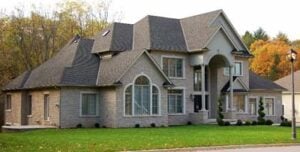
The problem is that all those peaks, valleys, and intersecting sections create more places where water has to be carefully directed away from the house.
And when the flashing, seals, or roofing materials begin falling apart, finding and repairing leaks can become a complicated, expensive mess.
On a simple roof, water has a pretty straightforward path to the gutters. But on a poorly designed McMansion roof, it might have to navigate something like the Rocky Mountains before finally dripping its way off the building.
And if water gets into the wrong places, particularly around badly installed exterior finishes or vulnerable wood sheathing, you’ve got the potential for some serious damage.
Now, I’m not suggesting every McMansion is secretly rotting from the inside out. Construction quality varies, and plenty of large homes are perfectly well maintained… I get it. But the combination of excessive size, complicated design, and bargain-basement construction can create some really icky surprises.
Because it’s not fun to discover that your giant luxury estate needs tens of thousands of dollars in repairs because somebody thought it would look fabulous with seven different roof peaks.
Suddenly, that well-built, charming little brick ranch down the street doesn’t seem so peasant-like after all.
And if the maintenance costs don’t get you, trust me, the utility bills probably will.
CONGRATULATIONS! YOU’VE GOT A FOYER THE SIZE OF AN AIRPORT TERMINAL
And I need to talk about those enormous two-story entryways for a minute.
Because I’ve never understood the appeal of walking into a house and immediately finding myself standing beneath a ceiling three stories above my head.
What exactly am I supposed to do with all that space?
Host a circus?
Install a trapeze? Oh, and yes, some people have actually done something like this.

I’d probably stick to hanging a chandelier so enormous that I need to rent industrial equipment to dust it off.
But seriously, those grand foyers were one of the defining features of the McMansion era, and I understand why developers loved it. Because the moment potential buyers walked through the front door, they were greeted by an enormous, dramatic space that made the house feel expensive.
But after the novelty wore off, homeowners were left with a gigantic volume of air that still had to be heated and cooled.
And that can get mighty expensive.
Large open spaces require thoughtful climate-control design, especially when warm air collects near the ceiling while the people actually living in the house are sitting way below.
And then when you add in oversized rooms, cheap insulation, and those absurdly enormous windows, the heating and cooling bills can become quite a spectacle of horror.

And for what? So you can enjoy the privilege of having an entryway large enough to impress a European monarch? And that’s praying the monarch doesn’t notice the really cheap trim and vinyl siding.
But the expenses of McMansion living didn’t stop at the property line.
The neighborhoods came with their own enormous price tags.
THE SUBURBAN NEIGHBORHOOD THAT LOOKS LIKE A GIANT PARKING LOT
Here’s something most buyers probably didn’t consider when they were admiring their brand-new suburban castle.
Somebody has to maintain all those roads, water pipes, sewer lines, and other public infrastructure serving these enormous royal developments.
And when subdivisions spread outward across miles of once undeveloped land, providing those services can also become really expensive.
At first, things can look wonderful for the local government. They love it when developers build brand-new communities filled with expensive homes, residents move in, and property tax revenue starts flowing. But decades later, the roads need repaving, underground pipes need replacing, and public infrastructure starts showing its age.
In sprawling, low-density neighborhoods, maintaining infrastructure over the long term can become really challenging because everything is spread across so much space.
The financial burden can be pretty big.
And then there’s the question of what these developments actually did to the traditional American neighborhood. Think about the classic suburban streets of the 1950s and 1960s, with modest, high-quality homes, front porches, sidewalks, trees, and actual space between the houses.
There was something inviting about those neighborhoods, right?
McMansion developments replaced that atmosphere with a Stepford wife vibe, complete with the enormous garages and gigantic houses squeezed onto small lots and streets designed only around cars, not people.
The front porch, once a place where neighbors might sit and chat, became a much smaller, decorative architectural stoop.
Somewhere along the way, the front porch got swallowed up by a three-car garage, and a lot of the neighborhood charm went out the door with it. You could live next door to somebody for ten years and recognize their garage door before you’d know their face. Hell, you probably know what kind of car they drive better than you know their name.
Quite the upgrade, huh?
AND NOW GOOD LUCK SELLING YOUR SUBURBAN PALACE
Here’s where the McMansion craze gets really costly.
Many of the people who bought these enormous homes during the 1990s and early 2000s are now empty nesters.
Their kids moved out, retirement is inching closer, and maintaining 5,000 square feet of house doesn’t sound as fun as it did when they were 38.
So they decide to sell.
And depending on the location and condition of the property, they might find out the next generation of buyers isn’t as excited about the idea of owning an oversized suburban estate.
Because younger buyers are dealing with a completely different housing market.
Between expensive mortgages, property taxes, insurance, utility bills, and maintenance, owning an enormous house can be a serious financial commitment. Especially when the house needs a new 7-peak roof, several replacement windows, and an HVAC overhaul.
Of course, plenty of large suburban homes remain desirable, and a well-maintained McMansion in a strong housing market can still command a substantial price… but the old guarantee that bigger automatically means better isn’t holding up in many cases.
And there’s something kinda poetic about this whole thing.
For decades, Americans were sold the idea that success meant buying as much house as possible. Now some are discovering that they’d rather have a smaller place that doesn’t require a second mortgage every time the roof springs a leak.
Which brings us to an interesting change in residential architecture.
APPARENTLY, BIGGER ISN’T ALWAYS BETTER
After years of enormous foyers, oversized kitchens, and more bathrooms than anybody could reasonably need, some homeowners are beginning to reconsider what actually makes a house desirable.
And the answer increasingly has less to do with impressing strangers and more to do with how the space works for the people living there.
Because having more square footage doesn’t necessarily mean having a better home.
Today’s homeowners are turning away from oversized houses in favor of ones that are more efficient, livable, and aligned with how they actually use the space. This preference reflects broader trends in modern residential architecture, which favor practicality and intentional design over unnecessary scale:
Efficient Use of Space: Floor plans are planned around function, with fewer unused or oversized rooms.Sustainability: Smaller footprints translate to lower energy costs and less of an environmental impact.Customization: Layouts and features tailored to the homeowner’s needs beat cookie-cutter designs any time.Aesthetic Harmony: Clean lines, functional flow, and purposeful materials create homes that look and feel good to live in.
MAYBE WE DON’T NEED OUR OWN PERSONAL VERSAILLES
You know, there’s something wonderfully refreshing about this idea of quality over quantity.
Maybe the ultimate luxury isn’t having a gigantic house with seven bathrooms, an elaborate staircase, and a formal dining room that gets used twice a year. Maybe it’s having a beautiful, comfortable home that’s actually designed around the way you live.
And before anybody gets too excited, I’m not suggesting we all move into those ridiculous 82-square-foot tiny homes attached to pickup trucks, either.
We already explored that particular housing nightmare… check out our homepage.
But surely there’s some reasonable middle ground between living inside a camper and maintaining a suburban palace the size of a motel.
A well-built house with thoughtfully designed rooms, quality materials, and enough space for a family to enjoy life sounds pretty damn luxurious to me.
Especially if you can spend your weekends doing something fun, not repairing the sixteenth decorative roof peak.
And perhaps that’s the biggest lesson from the entire McMansion craze. We became so obsessed with the appearance of wealth that we started confusing enormous houses with genuinely good ones.
AMERICA’S GREAT BIG FAKE ARISTOCRATIC DREAM
Looking back, the McMansion might be one of the funniest architectural expressions of American consumer culture we’ve ever produced.
Here we were, a nation built around the promise that ordinary people could achieve a comfortable, prosperous life, and somewhere along the way we decided that prosperity ought to look like a European aristocrat’s country estate.
Except most of us weren’t European aristocrats.
We’re regular Americans with mortgages, car payments, jobs, kids, and absolutely no need for a two-story foyer inspired by a royal palace.
But developers understood how our brains worked perfectly. They knew that people wanted to appear successful, and they found a remarkably profitable way to manufacture that appearance. All they had to do was slap a few cheaply made impressive columns on the front, throw in an enormous staircase, and mix together some slightly European architectural styles, and suddenly you’ve got a castle fit for a king.

Well, a king whose castle has vinyl siding and a thirty-year mortgage.
The saddest part is that all this pretend grandeur came at the expense of things that actually make a home wonderful. Good construction, sensible design, comfortable living spaces, and neighborhoods with personality and community.
And maybe that’s why I’m glad to see some buyers reconsidering the whole bigger-is-better philosophy. Because there’s nothing wrong with wanting a beautiful home or enjoying the rewards of financial success. But building an enormous imitation mansion just so the neighbors think you’re rich?
Good Lord, what a ridiculous way to spend your money.
THE LANDING
America tried to buy itself a little aristocracy and ended up with a whole lot of vinyl siding.
STAY CURIOUS
Three more stories worth your curiosity.

 Can the NFL Protect Players’ Brains Without Making Them Look Like Extras From Spaceballs?





Post Comment