🪰 Growing Up in the ’70s Didn’t Exactly Prepare You for Whatever This Is
THE BUZZ
-
Growing up with a comments section really changes things.
-
Imagine parenting provided by only streetlights.
-
Could managing everything actually make growing up feel harder?
Try to imagine explaining a family location-sharing app to a mom in 1976 who just told three children to go outside while she puts on her “stories.” But what’s the worry? After all, she knows roughly which neighborhood they’re in, and at some point, these kids are gonna get hungry and scamper home.
Simpler times right?
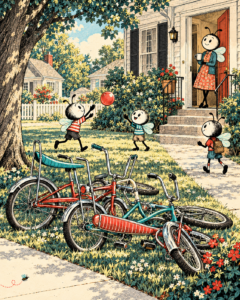
If you grew up in the ’70s, that whole parental/child arrangement probably sounds more familiar than alarming. Finding your friends might involve looking for a pile of bicycles, and any change of plans could happen without anyone notifying six adults.
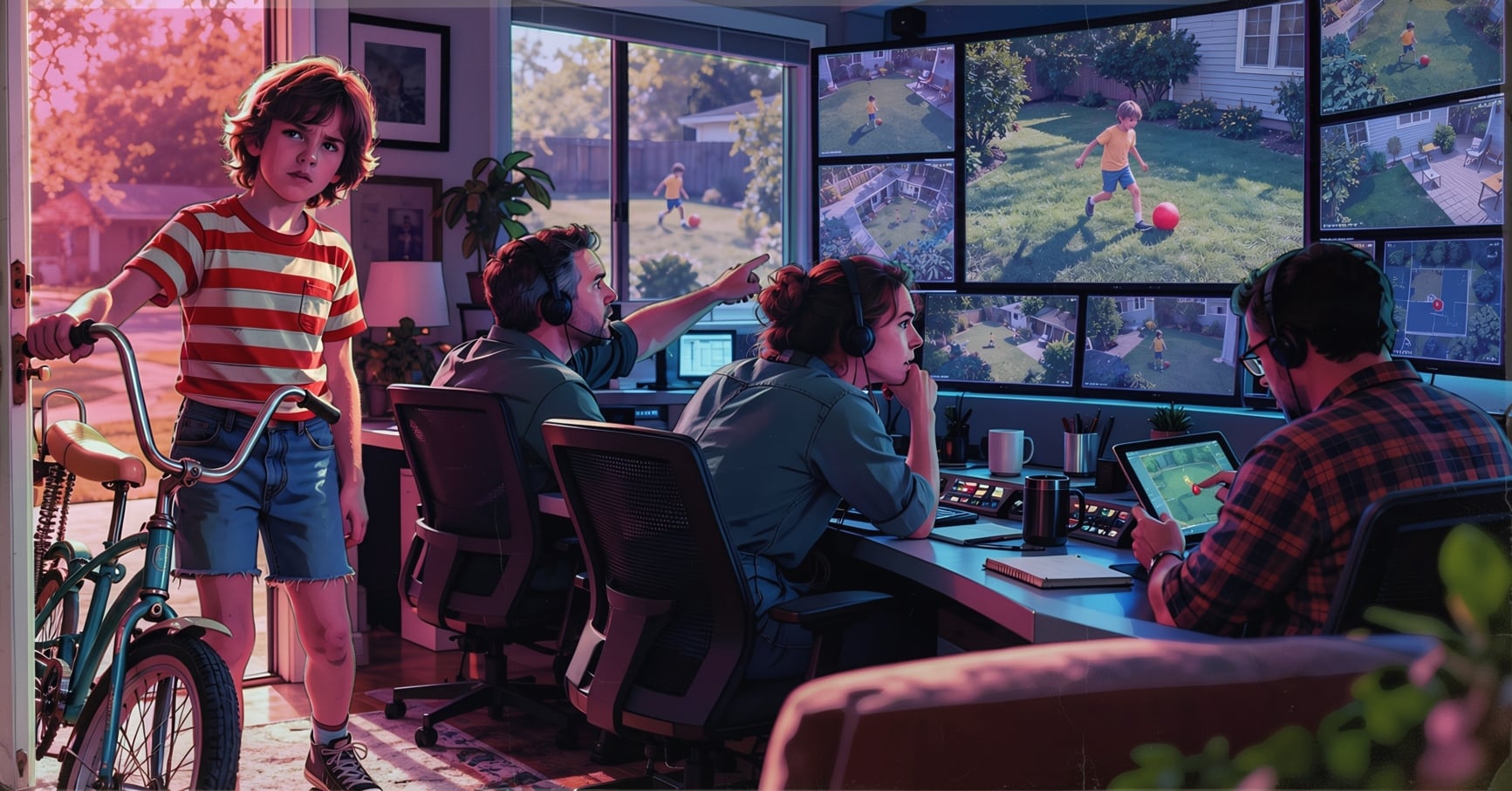
Now, just missing a text message could lead to the FBI standing on your lawn.
Honestly, it’s a super bizarre concept to anyone whose childhood afternoons contained several hours of being entirely unavailable. Watching young people navigate that constant contact, alongside so much anxiety, raises a question worth sitting with: how did growing up become quite this exhausting?
This comparison is highlighted extremely well in Koo Psychology’s YouTube video, The Psychology of People Who Grew Up in the 1970s. It explores why that earlier childhood can leave adults, or more specifically Gen X, feeling out of place now.
The part that really sits with you is the idea that society actually gave children real autonomy. If you’re bored, go find something to do. If you’re hungry and no food is around, run to the closest convenience store and get something. All of these seemingly simple things trained a generation how to function on their own.
Why Does Growing Up Look So Exhausting Now?
For an adult who grew up knowing how to function on their own, today’s conversations about anxiety can sound practically like a foreign language. A worry that might once have been brushed aside now has taken center stage, and practically everyone is talking about “anxiety” and all the stuff that comes with it.
But this isn’t just looking at younger generations and assuming they’re stressed out. The CDC’s figures speak for themselves and show that anxiety is clearly on the rise.
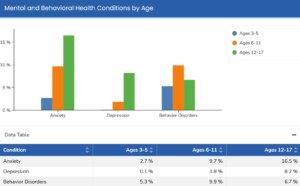
Anxiety problems, depression, and behavior disorders are the most commonly diagnosed mental disorders in children. Based on US data from 2023–2024:1
- 11% of children ages 3-17 had current, diagnosed anxiety (10% of males and 13% of females).
- 4% of children ages 3-17 had current, diagnosed depression (3% of males and 5% of females).
- 8% of children ages 3-17 had current, diagnosed behavior disorders (10% of males and 5% of females).
Among adolescents, mental health, substance use, and suicide are concerns. Data obtained directly from youth can tell us more about the scope of these problems.
Among US adolescents ages 12-17 in 2021-2023:3
- 20% reported symptoms of anxiety in the past two weeks.
- 18% reported symptoms of depression in the past two weeks.
Among US high school students in 2023:4
- 40% reported persistent feelings of sadness or hopelessness in the past year.
- 20% reported seriously considering attempting suicide in the past year.
- 16% reported making a suicide plan in the past year.
- 9% reporting attempting suicide in the past year.
- 22% report drinking alcohol in the past 30 days.
- 17% report using marijuana in the past 30 days.
- 4% report misusing prescription pain medication in the past 30 days.
- 10% report ever using illicit drugs.
Now, it’s important to note that those are reported symptoms, rather than 100% confirmed diagnoses. But regardless, the numbers are pretty staggering.
“I’m Bored” Was Basically Volunteering for Housework
Back in the day, announcing boredom within hearing distance of a parent was a major gamble. There’s always a lawn to mow, garbage to take out, or dishes to do… so finding something to do outside the house was basically survival for a kid growing up in the 70s.
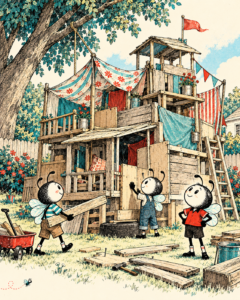
These kids practically grew up outside, forced to entertain themselves, and give them enough time, and they’ll have a fort whipped up in no time. Literally, these kids were building themselves homes.
In contrast, a 2014 study of children aged six and seven examined how kids are spending their time and how it’s related to their ability to direct themselves.
However, it is less clear how children’s experiences relate to their development of self-directed executive functioning, where they must determine on their own what goal-directed actions to carry out and when. We hypothesized that time spent in less-structured activities would give children opportunities to practice self-directed executive functioning, and lead to benefits. To investigate this possibility, we collected information from parents about their 6–7 year-old children’s daily, annual, and typical schedules. We categorized children’s activities as “structured” or “less-structured” based on categorization schemes from prior studies on child leisure time use. We assessed children’s self-directed executive functioning using a well-established verbal fluency task, in which children generate members of a category and can decide on their own when to switch from one subcategory to another. The more time that children spent in less-structured activities, the better their self-directed executive functioning. The opposite was true of structured activities, which predicted poorer self-directed executive functioning. These relationships were robust (holding across increasingly strict classifications of structured and less-structured time) and specific (time use did not predict externally-driven executive functioning).
As it turns out, giving kids less stimulation actually helps build their confidence and ability to take action and fulfill themselves.
Who would’ve thunk it? Allowing your kids to just be and not hovering over them 24/7 has its benefits.
When Did Childhood Acquire a Management Team?
You know, speaking of helecopter parenting, this applies to more than just supplying entertainment to your kids. Yep, it bleeds into nearly every aspect of theirs and your life. Just take an afternoon out. Something so simple becomes a huge production for the parents, like arranging locations, explaining the rules, and immediately inserting themselves whenever there’s a disagreement or things become uncomfortable.
Talk about exhausting. Not just for you, but for the kids too. You’re stressed, and as a result your kids are stressed too, just feeding into this never-ending anxiety loop.
Obviously, it’s understandable that as a parent, you want to plan for everything to go smoothly, but just consider the child who doesn’t get to experience being uncertain and finding their own way through it, building real skills. Because honestly, how much reassurance can substitute for the memory of having done something yourself?
Researchers Peter Gray, David Lancy, and David Bjorklund examined the decline of independent activity in a 2023 commentary in The Journal of Pediatrics. Their argument concerns the lack of opportunities children have to develop those experiences nowadays.
A major category of independent activity, especially for young children, is play. Research, aswell as everyday observation, indicates that play is a direct source of children’s happiness. In onestudy, for example, 6-8-year-olds were asked to depict activities that made them happy, with theresult that almost all the depicted activities were identified as play.23 Reviews, including one thatis part of an official statement by the American Academy of Pediatrics,24 have summarizedevidence for the value of play in promoting children’s mental wellbeing. Similarly, a recentreview of research on the effects of adding more recess time in elementary schools revealedconsistent findings of improved social and emotional wellbeing with no loss and sometimes gainin academic performance.25 Less well known and discussed, however, is evidence that children’splay-like activity appears to be most satisfying and to fit most closely with children’s ownconcept of play when it occurs away from adult oversight and intervention
Gray also explores the lack of more traditional, exploratory playtime in this TEDx talk. Again, another useful way to question how much room children get to run their own lives.
At Least Your Awkward Phase Didn’t Have an Audience Counter
I think the glaring elephant in the room here has to be social media, because obviously, children growing up in the 70s didn’t constantly have the pressures of having their entire lives blasted online.
Just take a moment to go back to your social media-free childhood and imagine saying something embarrassing at school. No biggie really, maybe a bit of laughter around the lunch table, but not much else beyond that. But in the world of social media, everything is broadcast online, even the most mundane things. So instead of that dumb thing you said losing interest by fourth period, it’s online getting reactions. It just sits there haunting you for way longer than it needed to.
What an exhausting existence for someone so young, heck, it’s tiring even for an adult. But imagine growing up with all the hormones, insecurities, and social pressures that you normally had and then multiply them by 100 with social media.
It’s a constant drain on your attention, psyche, and just overall emotional well-being. And this isn’t just talk, the numbers from Pew Research Center’s 2025 report backs it up:
Still, teens are growing more wary of social media for their peers. Roughly half of teens (48%) say these sites have a mostly negative effect on people their age, up from 32% in 2022. But fewer (14%) think they negatively affect them personally.
- More teens report spending too much time on social media: 45% of teens say they spend too much time on social media in our current survey, up from 36% in 2022.
- Girls’ experiences on social media skew more negative, at times: Teen girls are more likely than boys to say social media hurt their mental health (25% vs. 14%), confidence (20% vs. 10%) or sleep (50% vs. 40%).
- A majority of teens see social media as a positive space for friendships and creativity: 74% of teens say these platforms make them feel more connected to their friends, and 63% say they give them a place to show off their creative side.
- Teens and parents have different comfort levels talking about teen mental health: 80% of parents say they’re extremely or very comfortable talking to their teen about their teen’s mental health. Smaller shares of teens (52%) feel the same way.
- Social media as a mental health resource: 34% of teens say they at least sometimes get information about mental health on social media.
But as you can see from the study above, social media isn’t all negative. It’s a place where some kids can find their own specific social circle, expand their creativity, and even seek out resources to help with their mental well-being.
So, social media alone isn’t necessarily to blame, but it’s clearly a contributing factor, and don’t underestimate how much it’s changed the stakes for normal life as a kid.
Again, going back to our 70s kids, they were just able to leave the house and enjoy an afternoon without constant notifications and pressures to perform online.

Now, growing up in the 70s wasn’t all perfect sunshine and rainbows, because having a complete lack of parental authority has its negatives too. But perhaps the pendulum has swung a little too much in the opposite direction, and maybe we need to find a middle ground here.
Not one where you’re completely ignoring kids, but not one where you’re constantly breathing down their neck.
The key here is allowing kids, or just people in general, to become capable through experience. You can support your child without jumping in and managing as many factors as possible. Let them lose, let them get frustrated, sad… whatever it is. The goal is that they’re working through it on their own, not while holding Mommy and Daddy’s hand.
THE LANDING
“Be home for dinner” is starting to sound like a remarkably efficient childhood policy.
STAY CURIOUS
Three more stories worth your curiosity.






Post Comment