🪰 The World Has Given Us Emotional Support Buttons

THE BUZZ
- We’ve all been pressing buttons with unearned confidence.
- Apparently, our fingers have a placebo habit.
- We’ve all mistaken a “click” for actual authority.
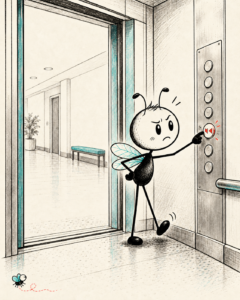
I don’t think there’s one of us reading this article who can’t say we haven’t pressed the elevator’s “close door” button without the utmost confidence that we were literally controlling this little metal box of transportation.
Then if the doors hesitate, we press it again, because perhaps the first attempt lacked conviction.

Eventually the doors close, and we all accept our small victory of once again being the masters of the universe. We control metal boxes with our fingers! HUZZAH!
Meet Your Emotional Support Button
Welcome to the word placebo button: a button you can press even though it has no effect on the system it appears to control. That satisfying little press gives all of us humans something to do while the system carries on with its own plans.
In CNN’s report on these controls, Harvard psychologist Ellen Langer explained their appeal.
They’re sometimes called “placebo buttons” – buttons that are mechanically sound and can be pushed, but provide no functionality. Like placebo pills, however, these buttons may still serve a purpose, according to Ellen Langer, a Harvard psychologist who pioneered a concept known as the “illusion of control.”
“They do have a psychological effect,” she said in a phone interview. “Taking some action leads people to feel a sense of control over a situation, and that feels good, rather than just being a passive bystander.
“Doing something typically feels better than doing nothing.”
To be totally honest, I think a lot of us can relate to this in a big way. Just standing there waiting leaves us all at the mercy of some machine. Thus, pressing a button lets us all imagine we’re working together. We’ve all become a valued member of the elevator team.
But it’s not just elevators that we think we’ve controlled. Nope. Turns out the world is full of tempting little buttons that do absolutely nothing except sooth our need for control. BRIGHT SIDE’s 6 Buttons That Actually Do Nothing explores all of these placebo buttons, including crosswalk buttons, elevators, and thermostats.
The Crossing Has Its Own Schedule
A pedestrian crosswalk button really does feel like a direct line to the traffic lights. Like, “Hello! I’ve arrived, I’d like to cross, and I’ve formally submitted my finger.”
@coolguyz.online don’t even get me started on the self checkout machines @BENNY BALL @RyanTheLeader @Matt Shaver @Sven Johnson #crosswalk #crosswalkbutton #comedy #sketchcomedy
But surprisingly, some crosswalks already include a walking phase in their regular cycle. The U.S. Access Board explains that at these locations, pedestrians don’t need to press a button to get the WALK queue. It just happens automatically, without any of your input.
However, not all buttons are created equally, and some buttons can do some useful work, although they’re not going to make that light change any sooner. New York City’s accessible pedestrian signals provide sound and vibration to communicate when the walking phase begins. Not exactly groundbreaking, but hey, it’s something.
The Elevator Has Heard Your Concerns
The close-door button practically invites impatience. Its little arrows make an extremely clear promise, which the doors then appear to consider at leisure.
But the reality is that the delay is required, for you know… “safety reasons.”
The U.S. Access Board’s elevator guidance states:
“User activation of door close (or automatic operation) cannot reduce the initial opening time of doors (3 seconds minimum) or the minimum door signal timing (based on 1.5 feet/s travel speed for the distance from the hall call button to car door centerline). When doors automatically reopen due to a detected obstruction, they can begin to reclose when no longer obstructed. The 20 second minimum pertains to the length of time the sensory reopening device remains effective, not necessarily the length of time doors remain open.
The guidance also says pressing close can’t shorten the required opening and signal timings. That gives people time to reach and enter the elevators, including people who may need a longer time to move.

So yeah, us pressing it six times is therefore just an expression of personal urgency, which the elevator is under no obligation to share.
The Office Thermostat Peace Treaty
Few objects carry more office politics than a thermostat. One coworker is dressed for an Arctic expedition while another appears to be experiencing a private summer.
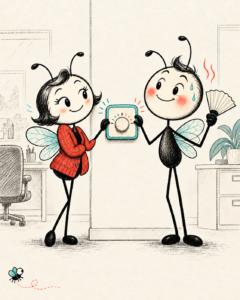
A dummy control offers a deeply cheeky solution: let someone adjust the dial without adjusting the building.
In a 2003 ACHR News report, HVAC instructor Greg Perakes talks about installing a thermostat that hissed but wasn’t connected to the equipment it appeared to control:
“I worked at the [retailer] at [a shopping mall] and we had an employee that always complained of being hot,” recounted Greg Perakes, an HVACR instructor in Murfreesboro, Tenn. “Our solution was to install a pneumatic thermostat. We ran the main air line to it inside of an enclosed I-beam. Then we just attached a short piece of tubing to the branch outlet (terminating inside the I-beam without being attached to any valves, etc.).”
The employee “could adjust her own temperature whenever she felt the need,” Perakes said, “thus enabling her to work more and complain less (as could we). When she heard the hissing air coming from inside the I-beam, she felt in control. We never heard another word about the situation from her again. Case solved.”
That’s quite a customer-service strategy. But I think we’d all be more impressed if we discovered that sound effects had resolved our request for a cooler room.
Other thermostats provide real but restricted control. Honeywell Home, for example, has commercial settings that lets folks change the temperature temporarily before the programmed schedule resumes.
But keep in mind that a setting that expires is different from a disconnected dial. Thus, we shouldn’t accuse every hotel thermostat of fraud just because it refuses to turn the room into a meat locker.
A Few More Ways to Feel Involved
Turns out these placebo buttons aren’t just limited for us impatient simpletons.
Sound engineers have their own version: the DFA fader, an apparent volume adjustment that leaves the sound unchanged. A small 2017 Audio Engineering Society study found that verbal suggestions could influence perceived loudness. Apparently, simple human reassurance is required in the world of sound engineering as well.
Then, moving back to public transportation, London’s Jubilee line used to off humans another mundane form of “control.” Its passenger-operated door mode wasn’t something that was typically used, so in 2018, the operator began disabling interior door buttons and removing exterior ones. Essentially, London’s trains decided that the illusion of control was over.
Then we’ve got the famous slot-machine stop buttons, which can make people think they’re hurrying along the result of their gambling but are basically doing zilch. Then England comes back into the picture again when Britain’s Gambling Commission prohibited slam-stop features in regulated online slots in 2021, citing concerns including an illusion of control. Turns out the U.K. isn’t a big fan of these placebo buttons…
So while I think we can all see the appeal of these buttons, the maddening reality is that they still do essentially nothing.
They just exist in our world as some type of adult coping mechanism. Something to give us just the smallest feeling of control in an otherwise hectic world.
However, I suspect we’ll all still press them. Knowing all of this has certainly made us more informed but definitely not any more patient.
THE LANDING
The button may be disconnected, but we all remain deeply committed to the relationship.
STAY CURIOUS
Three more stories worth your curiosity.

 The Sneaky Way All-Inclusive Resorts Make Their Money





Post Comment