🪰 How The NFL Hides Player’s Injuries From You
THE BUZZ
- The violence is obvious; the consequences aren’t
- Injuries disappear from view frighteningly fast
- Football’s future may depend on looking away
I love football.
Which is exactly why this is an uncomfortable blog for me to write, but stick with me.
Anybody who watches football knows that the NFL sells us speed, strength, impossible catches, bone-rattling hits, and athletes doing things with their bodies that most of us couldn’t survive. The violence is woven into the spectacle, and we all know that.
But have you noticed that it’s pretty rare for you to ever see that violence actually break somebody?
A player goes down, the stadium gets quiet, and for a few seconds the whole illusion cracks open, no pun intended. Suddenly, that helmet isn’t part of a uniform anymore. There’s a person inside it who might be seriously hurt, and everybody watches and waits.
Then television does something very interesting… every single time.
The camera moves.
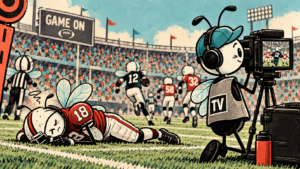
We start getting crowd shots, other players, the booth, and replays from other games around the league. Eventually, we’ll also get a commercial or two. We see the crowd.
And by the time we return, the injured player is gone, and the game is back on.
I started paying attention to that rhythm after watching a video about how football broadcasts handle injuries, and once you notice it, it’s hard not to wonder whether we’ve built an entire viewing experience around seeing the violence while keeping its consequences just far enough away so we don’t freak out.
THE HIT IS PART OF THE SHOW. THE AFTERMATH ISN’T.
This first clip points out how the NFL viewing experience is remarkably good at shifting our attention away from injured players almost as soon as they go down.
The basic pattern is easy to recognize once it’s pointed out to you. It’s like they have a playbook or something.
A player gets hit and doesn’t immediately get up. For a few seconds, the whole show changes because now everyone is looking at the actual cost of the game.
That’s usually when the camera starts looking somewhere else.
When the game returns, the player is gone, likely in a very covered-up medical tent or headed to the locker room, and the visual reminder of what just happened has disappeared with him.
The commentators will probably acknowledge the seriousness of the moment, but football has another game to play. The conversation naturally drifts toward what the injury means for the lineup, the playoff race, fantasy teams, or the betting markets.
That’s the part of the video that’s a bit unsettling.
Nobody has to announce, “Okay, stop thinking about the injured human now.” The fine-oiled machinery of the game does it for us.
There’s more in the clip about how replays, commentary, and the rhythm of a live broadcast can turn injuries into another piece of the football product, and it’s worth watching because it’s quite a well-rehearsed show.
@popdetective This is how the NFL distracts viewers to conceal the severity of injuries during game broadcasts. #football #sports #masculinity #NFL #fantasyfootball
Fans aren’t heartless. Quite the opposite. You can hear a stadium change when somebody is badly hurt.
The problem is that football can’t stay in that moment very long because they don’t want you realizing just how dangerous the game can be, and also, the next snap is coming.
That creates this strange split-screen reality where the violence can be replayed in slow motion, analyzed from six angles, and part of the spectacle, while the real-life human cost gets moved where nobody can see it.
The hit remains entertainment… but the injured player is an update.
THE BLUE TENT MAY BE THE PERFECT SYMBOL
And there’s something really neat and tidy about the sideline medical tent.
Yes, it’s there for legitimate medical evaluation, obviously, but visually it also creates this boundary between what the audience sees and what happens next. A player can limp inside looking shaken, hurt, or disoriented, and suddenly he’s gone from view, and everybody turns back to the field.
And maybe some fans wait for a little graphic to pop up telling them whether he’s questionable, doubtful, or out.
That style is very useful for football, especially when nervous Nelly moms are watching with their young sons. But it’s also really clinical.
A blown-out knee becomes just roster info. And a concussion is all about availability… the whole point is that somebody’s body is reduced to whether he can play next week or not.
That’s an awfully tidy way to package something that can be anything but tidy for the person living through it.
THE BODY KEEPS THE SCORE
The second clip gets into another part of this that probably doesn’t get nearly as much attention as it should: football injuries don’t necessarily happen as isolated events.
They accumulate. What I mean by that is a player may come in on Week One totally healthy, leave with a bruise or tweaked ankle, play through it the following week, compensate for it somewhere else and over time become a slightly diminished version of the athlete who started the season.
By Week Three or Four, this guy’s body has been collecting receipts, and payments are comin’ due.
This video dives into an early-season wave of injuries and asks why so many recognizable players seem to be getting hurt.
One of the explanations could be conditioning, particularly the enormous gap between preparing for football and actually playing football.
You can run, lift, and practice, but none of that recreates the speed, contact, and exhaustion of a real game.
NFL players don’t start every Sunday at 100 percent. One week it’s a sore ankle, the next it’s a tight hamstring, and then somebody rolls up on your leg, and now you’re compensating for three different things at once. By the middle of the season, a lot of these guys are basically playing hurt in one way or another.
Basically, the point of this is NFL players aren’t just getting hurt in dramatic freak moments. They’re slowly worn down.
So, instead of seeing a collection of unrelated names with hamstrings, knees, shoulders, and ankles beside them, you start seeing a season physically accumulating on the roster.
Football asks human bodies to do something incredibly violent over and over again while still performing at an elite level.
And eventually that bill shows up.
THE INJURY YOU CAN’T SEE
Broken bones and torn ligaments are easy to understand because they’re visible.
Brain injury is much more frightening.
A player can walk away from a hit. He can finish the game. He can retire years later, but the damage might still be there.
A recent report on C.T.E. makes the long-term cost of all those hits pretty damn brutal.
A new study released on Tuesday brought even more unease to the many parents who are either considering putting their child in tackle football or who already have a child in the sport.
According to that study of hundreds of cases over a recent six-year period, at least one in four of all the people who have played in the N.F.L. might expect to end up with chronic traumatic encephalopathy, the degenerative brain disease thought to come from repeated hits to the head in contact sports. The disease, known as C.T.E., can cause behavioral changes, rage, memory loss, depression and advanced dementia.
The new information added yet another layer of fear, uncertainty or guilt — sometimes all three — to parents who have, sometimes reluctantly, let their children play tackle football.
Matthew Sager, a psychiatrist from Madison, Wis., said he saw the study and briefly imagined asking his son, August, to quit the sport. It didn’t seem plausible: August is a high school senior.
“If he was 14 and debating what he should do this fall, I think it would be a much different conversation,” Dr. Sager said. “But he’s got three months of this sport left and, theoretically, I’m thinking, how much more damage could this do? But you know, I don’t know.”
After seeing the latest data, Dr. Sager said he felt some guilt for letting his son play. In the last several years, he and his wife had tried to do everything they could to protect August on the field, including buying a $700 helmet that they thought would protect his brain.
And this ladies and gents is a problem. Because the NFL doesn’t begin with the NFL…
It begins with kids.
FOOTBALL NEEDS THE NEXT GENERATION
Professional football needs generation after generation of children who want to become football players… most won’t, but they have to want to.
The NFL needs boys falling in love with football early, whether they’re playing peewee, Friday-night high school games, or eventually college ball. That connection sticks. Years later, when they have families of their own, Sunday football isn’t just something on TV. It’s something everybody gathers around because it’s been part of their life for as long as they can remember.
That childhood attachment means everything to the NFL, and the league can’t survive without it. So when parents start questioning what years of football might do to their kids’ bodies and brains, this becomes a much bigger question about who will still be playing, watching, and loving this game twenty years from now. That’s how the NFL sees it.
Parents are being asked to make decisions about tackle football while researchers are still trying to understand what repeated impacts might mean decades later. And that puts the NFL in an incredibly awkward position.
The league needs people to believe football is getting safer while knowing damn well that the hard tackles, huge hits, and danger are part of what makes fans love it.
But at the same time, it can’t make football look so dangerous that parents decide their eight-year-old should play baseball instead.
And honestly, it’s getting to be one hell of a balancing act.
THIS ISN’T REALLY ABOUT WHETHER FOOTBALL IS “BAD”
Football can be thrilling, strategic, communal, and beautiful to watch while also doing terrible things to human bodies.
Both can be true at the same time. And that tension is actually what makes the sport so interesting to watch and worth debating about.
I don’t think fans need to pretend the sport is harmless in order to love it. But we should probably notice when the entertainment machine makes it really easy to forget there’s a real person lying underneath the pads, and his tendons might be hanging on by a thread.
The broadcast can move on in thirty seconds. The player’s body doesn’t get that luxury.
Maybe football’s strangest magic trick is how quickly something horrifying can become ordinary. I’m not sure the NFL needs us to ignore injuries completely… it might just need us to forget them quickly enough so we keep watching.
THE LANDING
The injury may last a lifetime; on television, it only has to last until the next snap.
STAY CURIOUS
Three more stories worth your curiosity.





Post Comment