🪰 The Sneaky Way All-Inclusive Resorts Make Their Money

THE BUZZ
- That unlimited buffet has a dirty little secret.
- Your third poolside cocktail? They’ve already budgeted for it.
- The biggest resort profits happen before you arrive.
I’m convinced there’s a certain type of person who books an all-inclusive vacation, and right away, it’s like they’re training for Olympic gold. They’re determined to eat, drink, and lounge their way through every penny they paid, and then some… preferably while wearing a wristband that gives them unlimited access to some bartender named Juan.
And I respect the commitment, truly. You’re gonna milk that resort for all it’s worth.
Because there’s something really satisfying about ordering another piña colada without reaching for your wallet. Hell, you can have breakfast twice, load up on seafood like you’re a fisherman from Nantucket, spend the afternoon drinking something weirdly blue, and still have room for a steak dinner. Meanwhile, you’ve barely ventured beyond the same three acres of beachfront paradise.
Now THIS is livin’.
At some point, usually around cocktail number four, you start wondering how the hell these places stay in business.
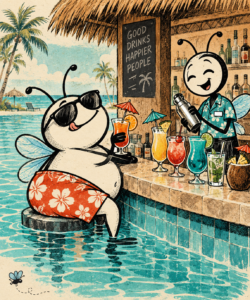
I’ve always assumed there was some clever accounting going on behind those swaying palm trees, but I had no idea how elaborate the whole operation really was.
Because while you’re congratulating yourself for getting your money’s worth, the resort has already calculated how much you’re likely to eat, what you’ll drink, when you’ll get tired of both, and how much more money it can squeeze out of you before your flight home.
And the really fascinating part is that some of the biggest players in this business have figured out how to make money from the whole operation without even owning the resort…
Welcome to the wonderfully sneaky world of all-inclusive vacations.
THE ALL-INCLUSIVE ILLUSION: WHO’S REALLY WINNING?
When you book an all-inclusive resort, you’re basically gambling, right? You’re placing a bet against the hotel. You’re betting that you’ll consume enough food, alcohol, entertainment, and amenities to justify the enormous price you paid upfront.
The resort, meanwhile, is betting you’ll behave like a relatively normal human being and do nothing of the sort.
And that’s where the house has the advantage.
Think about the people you’ve encountered on vacation. It’s usually some guy who plants himself at the swim-up bar before lunch and doesn’t leave until he’s developed a personal relationship with the bartender. Meanwhile, his wife might spend half the afternoon reading a book, drinking bottled water, and maybe nibbling on some fruit here and there.
They’re both paying for the same vacation experience, but they’re costing the resort wildly different amounts of money.
Multiply that across hundreds of guests, and you start to see what’s going on here.
The resort doesn’t need to make money from every single guest. It just needs enough people consuming less than what they paid for to cover the few “Olympic wannabes” treating the seafood buffet like it’s their last meal on Earth.

And here’s something that should make every vacationer laugh: the resort actually benefits when you get lazy.
Sleep through breakfast? Lovely. Keep sawing logs, sir. That’s a meal you paid for but never ate.
Are you spending the afternoon napping instead of drinking? Even better.
Decide you’re too full for dessert? Somewhere in an accounting office, a tiny guy with a calculator is smiling.
The beauty of the arrangement is that you’re having such a wonderful time doing absolutely nothing that you probably won’t notice how much of your prepaid vacation you’re leaving untouched.
WHY COUPLES ARE A RESORT’S BEST FRIEND
There’s another clever little advantage hiding in the pricing.
Traditional hotels will mostly charge for the room. But all-inclusive resorts usually build their packages around the number of guests staying in that room.
And that’s also a pretty sweet arrangement for the hotel.
Think about it. A room occupied by two people doesn’t require twice the air conditioning, twice the electricity, or twice the housekeeping. The swimming pool doesn’t suddenly become more expensive to operate because your husband decides to do a bellyflop.
But that second person is still paying for an all-inclusive package, even though they’re sharing the same room.
Obviously, the resort has additional food and beverage expenses, but many of its biggest operating costs stay the same.
Suddenly, all those advertisements featuring happy couples sipping champagne in infinity pools make a lot more sense.

Romance is wonderful. But two paying customers sharing one king-size bed? Now we’re talking.
Now, I stumbled across a fascinating video that really gets into the nitty gritty of all-inclusive economics, and I have to say, it’s one of those subjects that gets more interesting the deeper you dive.
The video explains everything from the psychology behind unlimited buffets to the enormous financial deals happening behind the scenes at some of the world’s biggest resort companies.
Yes, it’s a longer watch, but it’s actually pretty darn entertaining, especially once you realize just how carefully these vacations are designed to separate you from your money while making you feel like you’ve gotten away with something.
We’re going to dig into the best parts below, but if you’ve ever booked an all-inclusive vacation, or you’re thinking about booking one, this is absolutely worth watching.
VIDEO INTRO: THE VACATION BUSINESS HAS A FEW SECRETS
One of my favorite things about this whole business is how brilliantly the resorts have turned spending money into something that feels like you’re getting things for free. Humans really are chuckleheads.
That little plastic wristband your sporting is a psychological magic trick.
You paid thousands of dollars months ago, probably while sitting at your kitchen table wondering whether you should splurge on the ocean-view room.
By the time you’re actually lounging beside the pool, the financial pain has faded into some distant memory.
Now, as you sit there being waited on hand and foot, everything feels complimentary.
You order another cocktail, grab some fries, and waddle through the buffet to investigate the dessert situation, even though you haven’t been hungry since last Tuesday. Of course, none of this stuff is actually free. You bought it all in advance.
But the resort has another advantage that most restaurants would kill for: it already knows roughly how many mouths it needs to feed.
Reservations tell management how many guests are arriving, how long they’re staying, and how many children are coming along. That makes it way easier to plan staffing, purchase ingredients, and estimate consumption.
Your neighborhood restaurant doesn’t know whether twelve people are about to walk through the door and order lobster or 2 people are coming in to split a tuna sandwich. An all-inclusive kitchen has a much better idea of what its upcoming week looks like.
And when you’re feeding hundreds of people every day, that predictability can save a mind-blowing amount of money.
THE BUFFET LOOKS EXPENSIVE. THE INGREDIENTS TELL ANOTHER STORY.
Oh, and this right here is probably my favorite little revelation.
When you’re standing in front of an enormous breakfast buffet, surrounded by fresh fruit, pastries, eggs, pancakes, sausages, and whatever mystery meat is getting a tan under that heat lamp, it really does look super expensive.
But the resort isn’t paying restaurant menu prices for that food.
It’s purchasing ingredients in enormous quantities, planning meals around predictable demand, and using many of the same basic ingredients across a whole slew of dishes.
According to the cost estimates in the video, a budget-friendly all-inclusive might spend about $28 to $36 per guest per day on food, while an upscale adults-only property could spend somewhere between $68 and $95.
That’s for an entire day’s worth of meals. Let that marinate alongside your $2000 vacation package.
And alcohol can be even more entertaining.
All those beautifully garnished tropical cocktails might look like something that’d cost $17 bucks at a fancy beach bar back home, but the resort is usually using inexpensive house liquor, mixers purchased in bulk, and enough ice to sink a fishing boat.
The actual beverage costs can be shocking low compared with what guests think they’re tossing down their gullets.
Which explains why nobody seems particularly alarmed when Uncle Fred orders his sixth rum punch.
The bartender knows something Uncle Fred doesn’t… that cheap house rum isn’t exactly bankrupting anybody.
THE FIFTH-DAY PROBLEM
Here’s another little twist I found absolutely fascinating.
Apparently, our vacation enthusiasm has an expiration date.
Those first few days at an all-inclusive can be an absolute feeding frenzy. You’re exploring the restaurants, trying every cocktail you can get your mitts on, investigating the snack bars, and figuring out whether the swim-up bar opens early enough to make you a breakfast bloody mary.
But eventually, something happens… you tucker out.

After several days of unlimited food and alcohol, even the most committed vacation glutton starts slowing down.
All of a sudden, sleeping until ten sounds way better than racing downstairs for another breakfast buffet. And a giant lunch seems like too much, especially when your swim trunks now feel like they’re three sizes too small.
So, on the fifth day, you’re kinda over the whole thing. And guess who loves that?
Yep. The resort.
You paid the same daily package price whether you ate everything in sight or spent six hours floating in the pool like a manatee.
I find that hilarious because the longer you stay, the more likely you are to become exactly the kind of low-maintenance customer the resort loves.
You’ve paid good money to reach the point where you’re too relaxed to consume what you purchased months ago.
We humans are so damn predictable.
BUT WAIT. THE “ALL-INCLUSIVE” PACKAGE HAS A FEW EXCEPTIONS.
Now we get to the part where the resort starts making a shit ton of money from you all over again.
Remember that wonderful feeling of having already paid for everything?
Well, apparently, the word “everything” has a few creative interpretations.
Yes, the regular drinks are included, but what if you’d prefer premium liquor?
Well, that costs extra.
Want the beachfront cabana you saw in the promotional photos?
Okay, open your wallet nice and wide.
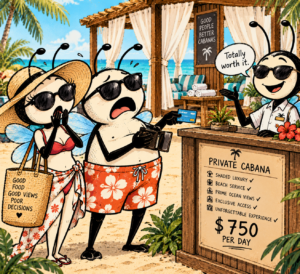
Fancy a room with a better ocean view, a private butler, a special dinner, or a relaxing spa treatment?
You can practically hear the cash register cha-chinging all over the place.
And some of these extras are really expensive.
The video walks through examples of ocean-view upgrades costing hundreds or even thousands of dollars over longer stays. Private cabanas can run about $125 per day, and the premium booze could add another $25 to $60 per person, per day.
But here’s why this works so beautifully.
You’ve already committed a huge chunk of money to this trip, and now you’re standing in paradise. Are you really going to spend the next seven days staring at the parking lot because the ocean view costs another few hundred bucks?
Maybe.
But a lot of people won’t.
And resorts know it.
The entire upgrade system is built around offering you an experience that feels just a little more special than the one you’ve already paid for.
The basic vacation gets you through the front door… the fancier version keeps your credit card busy.
THE EXCURSION DESK: YOUR WALLET’S SECOND VACATION
Have you ever noticed how many all-inclusive resorts are located miles away from any sort of civilization?
You’re surrounded by gorgeous beaches, tropical gardens, and perfect landscaping, but if you want to explore the actual country you’re visiting, you will probably need a vehicle and a hefty amount of adventure.
Most vacationers arrive on an airport shuttle and have no intention of renting a car.
Which means the resort has a wonderful opportunity to sell you something else.
Excursions!
Perhaps you’d like to go snorkeling, visit a historical site, take a sunset cruise, or spend the afternoon on a deep-sea fishing boat.
Sounds fantastic, right?
And just your luck, there’s a helpful little desk in the lobby that can arrange the entire thing.
For a fee, of course.
Some of the excursions discussed in the video cost over $100 per person, which can add up quickly when you’re traveling with a family.
The genius of this arrangement is that the resort doesn’t have to convince you to take a vacation.
You’ve already done that. You’re on vacation right now.
They just has to convince you to spend a little more money to enjoy the vacation you’re already on.
And because you’ve mentally categorized the trip as a paid-for expense, another $150 for an unforgettable afternoon somehow feels less painful than it did back home at your kitchen table.
At home, you’d probably spend twenty minutes comparing prices before ordering a pizza.
On vacation?
Sure, honey. Let’s spend $400 looking at dolphins.
ARE YOU THE CUSTOMER THEY LOVE OR THE CUSTOMER THEY FEAR?
At this point, I think every reader should conduct a little personal vacation audit.
Are you the type who wakes up early, eats three substantial meals, enjoys a steady parade of cocktails, and spends practically every waking hour taking advantage of the resort’s amenities?
Congratulations. You’re probably making the accountants sweat a little.
Or are you somebody who sleeps late, skips lunch, drinks occasionally, and spends half the trip with your nose in a book?
Well, I hate to break it to you, but you’re helping finance the first guy’s rum obsession.
Neither type of vacationer is doing anything wrong, obviously. People enjoy vacations differently, and there’s absolutely nothing wrong with paying extra for the convenience of having everything handled.
Like I said earlier, the resort has already priced both types of guests into its business model.
And statistically speaking, somebody lounging beside that pool is probably paying for somebody else’s cocktail problem.
NOW FOR THE BIG SURPRISE: THE BEACHFRONT RESORT ISN’T NECESSARILY THE PRIZE
So far, we’ve been looking at all-inclusive resorts from the perspective of the people sipping cocktails.
But the business gets even more interesting when you start looking at the companies that own and operate these enormous properties.
And this is where Hyatt enters our little chat.
In 2025, Hyatt purchased Playa Hotels & Resorts for approximately $2.6 billion, including debt. That deal included thousands of resort rooms in Mexico, Jamaica, and the Dominican Republic.
Sounds like Hyatt wanted to own a whole bunch of beachfront paradise, right?
Well, here’s the twist. Hyatt turned around and sold the actual resort properties for roughly $2 billion but kept the right to manage most of them.
Pretty clever when you think about it. Hyatt could still make money running the resorts and collecting management fees, while somebody else had to worry about owning and maintaining those massive beachfront properties.
Hyatt figured out a way to earn money from the resorts while handing off the bulk of the financial headache of owning them to somebody else.
And believe me, those headaches are no joke.
OWNING PARADISE IS EXPENSIVE AS HELL
Running a luxury resort costs a fortune. Between staffing, maintenance, insurance, and keeping those enormous properties looking like paradise, the bills pile up fast. And when bookings slow down, those expenses don’t magically disappear. The pools still need cleaning, the staff still needs paying, and the air conditioning keeps humming.
Just look at Playa’s numbers. In 2024, the company brought in approximately $938.6 million in revenue, but after expenses, it walked away with just $73.8 million in net income.
That’s less than eight cents in profit for every dollar it earned. Not exactly the money-printing machine you’d imagine.
Which makes Hyatt’s decision to sell the buildings while keeping the management contracts look pretty damn smart.
Why deal with the headaches of owning paradise when you can collect fees for running somebody else’s?
THE HOUSE KNOWS EXACTLY WHAT IT’S DOING
After digging into all of this, I’ve developed a whole new appreciation for the business genius behind all-inclusive resorts.
Think about the arrangement.
Customers pay huge amounts of money months before arriving. The resort gets to plan around those bookings, estimate how much food and alcohol guests will consume, and carefully control its operating costs.
Once everybody arrives, the guests happily eat, drink, swim, and lounge around believing they’ve temporarily escaped the financial responsibilities of ordinary life.
Meanwhile, the resort has a lovely collection of upgrades and experiences waiting for anybody interested in spending a little more.
And above the whole operation, major hospitality companies have found ways to profit from the booking, branding, and management side of the business without necessarily owning the property itself.
It’s an impressive system, especially considering that customers generally walk away feeling like they’ve gotten a fantastic bargain.
Which, depending on your vacation habits, they very well might have.
But I’ve learned one thing from this little adventure into resort economics…
The next time I’m sitting beside a tropical swimming pool, sipping a suspiciously inexpensive cocktail and congratulating myself for taking full advantage of the unlimited package, I’ll have a newfound appreciation for the people who designed the whole experience.
And you can bet I’ll be ordering dessert.
I’ve got a reputation to maintain.
THE LANDING
The only thing unlimited at an all-inclusive is how many ways they can make money off you.
STAY CURIOUS
Three more stories worth your curiosity.

 Japan Celebrates American Halloween With a Freaking WEIRD Twist





Post Comment