🪰 The World’s Fair: Why Did We Stop Gathering to See the Future?
THE BUZZ
- The future used to be a public event
- World’s Fairs made tomorrow feel almost touchable
- The future didn’t disappear, we did
There was a time when the future had an address… and you could show up and take a peek.
You bought a ticket, walked through a gate, and suddenly found yourself inside a place built around the idea that tomorrow was going to be bigger, stranger, better, faster and more exciting than today.
The idea of that fascinates me.
The World’s Fair wasn’t just one giant gadget expo. It mixed invention, architecture, culture, entertainment, and national pride into something ordinary people could physically walk through. Instead of hearing that some amazing new thing existed somewhere, you could actually go see it, stand beside it, ride through it, taste it, stare at it and then go home and tell everybody you just saw the future and it was really cool.
And people loved the hell out of that.
What gets me is the communal part. The future wasn’t being revealed to a room full of industry insiders or shown on a screen. Whole families dressed up and showed up. Crowds gathered, countries built enormous displays, and the entire thing was based on how progress and invention were exciting enough to become a massive public event.
The deeper I got into this, the more I wondered how something that once was so central to modern life could just vanish.
Except it didn’t…
At a world’s fair, visitors could find inventions testifying to the host nation’s industrial progress alongside exhibitions of wonders from around the globe: a replica of a Viking ship from Norway, Māori carvings, artifacts excavated during archaeological digs in Latin America. In the words of President William McKinley, “Expositions are the timekeepers of progress. They record the world’s advancement [and] open mighty storehouses of information.”
By the time of Century 21, world’s fairs had transformed into “sites of entertainment,” says Rydell. Though entertainment, rather than education, was the main goal of later expositions, the fact remained that world’s fairs were “where people [could] go to learn about ways the world [was] heading.”
Also known as the Seattle World’s Fair, Century 21 was in many ways no different from its predecessors. Its showcases—designed by architects, corporate leaders and cultural tastemakers—spotlighted a glorious, Cold War–era vision of what the U.S. (and the world) might look like after embracing Space Age technology and mass consumption. Collectively, these displays asserted the strength of the American way of life.
Outside of the U.S., particularly in Europe and Asia, world’s fairs remain popular. In cities like Milan, Dubai and Shanghai, host nations have used these grand expositions to express their guiding values and show off the very best of their countries to the rest of the world.
That McKinley line really got me: “timekeepers of progress.”
What an incredible way to think about these things, right?
World’s Fairs weren’t just showing people cool stuff… they were taking a snapshot of where humanity thought it was headed and turning that snapshot into an actual place you go to. But, by the time Seattle’s World Fair rolled around, the educational side had blended way too much with entertainment, but the basic promise was still hanging on: come see tomorrow.
And that promise could get really freaking weird.
WHEN TOMORROW BECAME THE MAIN EVENT
Seattle’s Century 21 leaned hard into the Space Age fantasy, which feels painfully optimistic now.
These fairs were building giant futuristic structures and inviting you to step inside the damn thing, and honestly, there’s something wonderfully confident about that.
But not everything had to be on this huge, grand scale. Sometimes the future was as simple as making your rotary phone more tech savvy.
@thehistorysource The 1962 World’s Fair, official named the “Century 21 Exposition,” focused on futuristic themes, showcasing potential 21st-century innovations in science and technology to inspire and excite the public about the future. A major highlight was the unveiling of the Space Needle, which became an iconic symbol of Seattle and the fan semphasis on science and technology helped establish the city’s reputation as a center of innovation. #history #technology #vintage
A World’s Fair could take an abstract idea like “the future” and make it tangible. You could walk underneath it, eat lunch beside it, and bring your kids along for the ride. Literally.
Even the architecture was part of the performance, because the point wasn’t simply to show people a new product. The whole environment was supposed to make them feel as if they’d temporarily crossed into another era.
The 1964 New York World’s Fair feels like the moment America decided that if it was going to show people the future, it might as well go completely bonkers.
The fairgrounds in Queens became this giant temporary city packed with futuristic pavilions, wild architecture, corporate dream machines, dinosaurs, Disney attractions, and so much spectacle, it was almost impossible to keep up.
Visitors could wander from one vision of tomorrow to another, seeing everything from new transportation ideas to giant exhibits that tried to imagine how people might live decades down the road. Disney was deeply involved, using the fair as a playground for attractions and technology that would later show up in Walt’s parks. Even Michelangelo’s Pietà was brought over from the Vatican, which tells you just how absurdly ambitious this thing was.
And yet, behind all that grandeur and optimism, the fair was wobbling.
Robert Moses, the enormously powerful New York planner who ran the 1964 World’s Fair, wanted a bigger, longer, more money-making event than the international World’s Fair system would approve. So, that fight is what kept many major countries away. American corporations stepped in and filled the grounds with their own versions of the future.
That didn’t make the fair less spectacular. If anything, it made it stranger.
More than 51 million people still came through the gates over two seasons, which is a crazy big number. But the attendance didn’t match the financial fantasy built around it, and when the fair ended, the money problems were piling up.
That’s what makes this story so fascinating to me. The 1964 fair wasn’t just a celebration of tomorrow. It was also a warning that these enormous visions of the future had become too big, too expensive and too complicated to keep pulling off.
So, here’s the lesson, boys and girls… if you build a temporary city devoted to “tomorrow,” somebody has to finance it, organize it, fill it with enough spectacle to justify the trip, keep millions of visitors entertained, and then figure out what to do with all of it when everybody goes home.
Yes, the romance of the World’s Fair was huge, and so was the bill.
But that didn’t kill the fair…
WAIT… WORLD’S FAIRS STILL EXIST?
This is the part I truly didn’t know when I started digging into this thing.
I assumed World’s Fairs had basically gone extinct, leaving behind a few famous structures, old postcards, and grandparents saying, “You should have seen it.”
Nope.
The international World Expo system kept going.
So my new question is, “Why did Americans stop hearing about them?”
This clip gets into exactly that, and the answer, as always, is about money. Federal funding for U.S. pavilions was cut off and participation now depended on private money. So while places like Milan, Shanghai, and Dubai kept putting on massive expos, the United States slowly faded out of a tradition it once helped define.
The organization behind official World Expos is the Bureau International des Expositions (BIE), and the expos continued, but America’s relationship with them became really shaky, and in 1999, Congress barred federal funding for U.S. pavilions at BIE fairs.
The World’s Fair didn’t disappear… we did.
But this is where the story took a turn I wasn’t expecting. Because if the world’s fairs stopped being the place where huge crowds gathered to experience futuristic spectacles, what would take their place?
Amusement parks.
Yes, really.

In the decades since the Seattle World’s Fair, theme parks and the Olympic Games have fulfilled many of the purposes of world’s fairs, replicating the lived sensations and awe-inspiring architecture that made Century 21 exciting. The Disney World theme park Epcot, for instance, is practically a permanent world’s fair, boasting a “World’s Showcase” of 11 countries and a massive geodesic sphere modeled after the Biosphere designed by Buckminster Fuller for Expo 67 in Montreal. The park’s name originally stood for Experimental Prototype Community of Tomorrow, clearly echoing the “World of Tomorrow” embodied by Century 21.
So apparently we didn’t stop wanting to be dazzled by enormous buildings, strange technology, and grand visions of another world.
We moved the experience somewhere else and gave it really long lines.
And honestly, Epcot makes perfect sense as a descendant of the World’s Fair. It takes countries, technology, architecture, entertainment, and optimism about tomorrow and turns them into a permanent destination. I really didn’t figure that out until now… which is weird.
The difference is what happened to the purpose of it all. A World’s Fair was temporary, which gave it urgency. The whole world was gathering here, right now, to show you what it had built and where it thought everything was going.
A theme park can recreate the spectacle to a certain extent, but it can’t recreate that moment.
THE FUTURE BECAME A FEED
I don’t think we stopped caring about tomorrow. We just changed how we encounter it.
New ideas now reach us individually and constantly. Something incredible gets demonstrated on a screen, becomes the thing everybody is talking about for a day, and then gets pushed down the feed by whatever shows up next. That’s wonderfully convenient, but it’s a very different experience from standing in a crowd of strangers inside a temporary city built around this magical shared belief that the future was worth traveling to see.
The old World’s Fair made discovery feel almost ceremonial. People planned trips around it, and countries wanted to impress each other. Companies built outrageous things simply because millions of people were going to walk past them. But most importantly, regular Joe’s were invited.
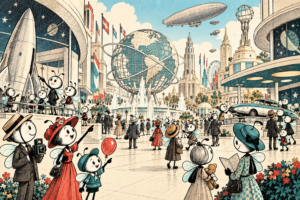
You didn’t need to work in technology, design, or industry. You just needed a ticket and enough curiosity to walk through the gates.
Maybe that’s the part I find myself missing for a world I never even got to experience.
WE DIDN’T LOSE THE FUTURE
There’s a temptation to turn this into one of those “everything was better back then” stories, but that’s not really what interests me here, because the future kept coming.
World Expos are still happening, and innovation didn’t stop, and I think we all know huge public spectacles didn’t vanish.
But what did fade was this idea of putting all of those things together in one place and telling ordinary people, “Come look at where we might be going.”
That feels different and really cool and exciting.
And maybe I am drawn to this because there was something almost innocent about building an enormous fairground around the belief that “tomorrow” could draw a crowd.
Maybe people came for the architecture or the rides. Maybe they were there for the food, inventions, or just because everybody else was going.
Whatever got them through the gate, they experienced the future together, and I love that.
THE LANDING
Maybe the future never stopped arriving; we just stopped showing up together to meet it.
STAY CURIOUS
Three more stories worth your curiosity.


Post Comment