🪰 Are We All Just Living on a Pile of Ancient Junk?
THE BUZZ
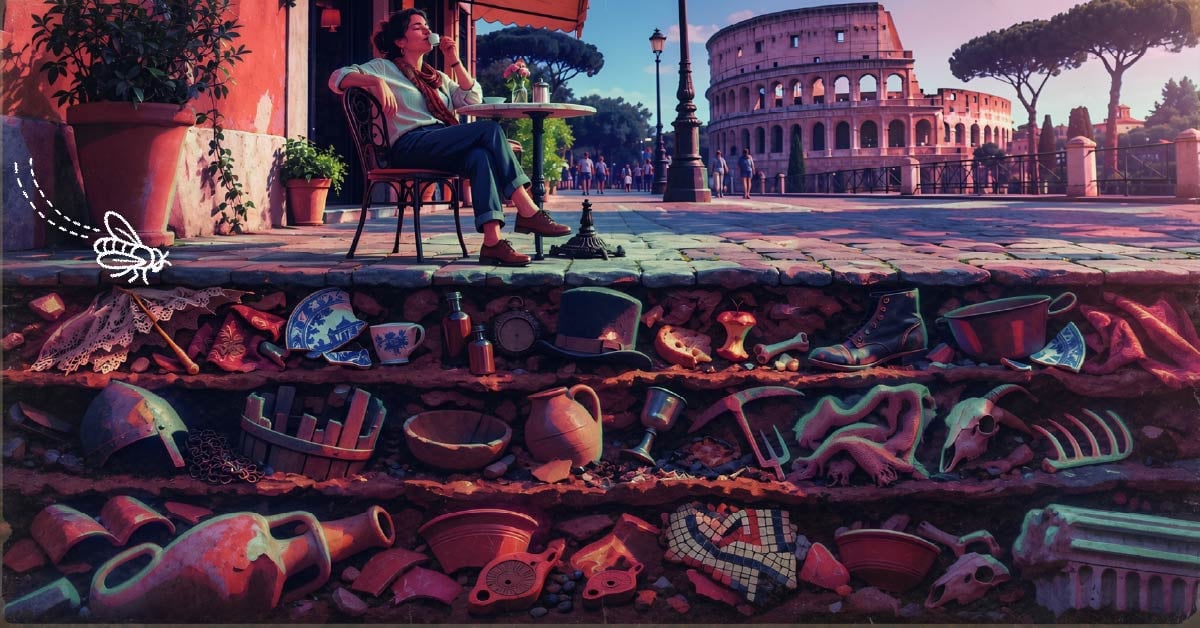
- Some prime real estate comes with ancestral garbage.
- The previous house may still be under the current one.
- Apparently, our clutter is just waiting for a research grant.
We can be awfully picky about the ground around us. A sticky café floor is enough to make us question the entire establishment, and a neighborhood with rubbish piled along the curb is ripe for a public complaint.
Yet in some of the world’s oldest settlements, a bunch of discarded junk literally became some of the most recognized cities that millions of us visit every year. We’re talking Rome, London, Paris, Istanbul, and countless others. And all of them have one big thing in common: they’re all built upon thousands and thousands of years worth of garbage.
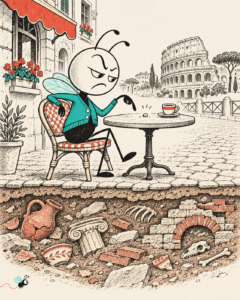
This is quite a contrast to how we picture ancient history. We tend to imagine it as this rather grand spectacle, and the process of unearthing it involves a bunch of archeologists carefully going through with their sieves, mindfully peeling back the earth to reveal some beautiful mosaic or the foundations of a long-lost temple.
But what they’re going through isn’t just “dirt.” They’re also sifting through thousands, if not millions, of pounds’ worth of waste. Everything that people thousands of years ago threw away. Everything from precious artifacts to last night’s supper.
A YouTube video from Basically Primitive answers the question a lot of us have when visiting cities like Rome: why are all of these ancient sights below us? Did the earth rise up around these ancient worlds? Or did they just sink further into the earth? Well, the answer is no. These ancient cities basically became buried under thousands of years worth of dirt and human garbage. It’s a much less glamorous answer.
Yesterday’s rubbish became someone else’s building site
Think back to the streets of ancient Rome and picture a broken pot being discarded. Now, these people didn’t have garbage trucks. They literally just threw whatever junk they had wherever there was an open space. Then, years later, rubble was spread over that surface of old broken up garbage, which was then followed by another building. And this folks is essentially how ancient cities like Rome became buried underground.
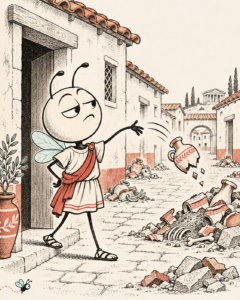
You’d think that maybe the next set of ancient folk would’ve cleared the junk out before laying the foundations for a new home, but in all honesty, ain’t nobody got time for that. Especially when winter is settling in and finding shelter is more important than making sure the space below it is neat and tidy.
But this habit of leaving things for later generations continued well beyond the ancient world. But not everyone was so haphazard about it. As a matter of fact, at St. Bartholomew’s Hospital in London, excavations revealed sections of the old city ditch, which actually sounds rather similar to a modern-day landfill:
The Roman city ditch was probably first cut around AD 200, contemporary with the first defensive masonry wall around the city, immediately to the south of where the hospital now lies. As originally built, the ditch was probably two or three metres deep and 15 metres across. Together the wall and ditch functioned as the city’s defence against possible attack. After falling into disuse at the end of the Roman period, from the 9th until the16th century both the ditch and the City Wall were continually enlarged, repaired, rebuilt, recut and reused.
Throughout the life of the ditch, people living in the city used it as a rubbish tip, throwing away items they no longer wanted. Today our archaeologists are recovering some of these items – our finds have included tobacco pipes, tweezers, pots, leather shoes and arrowheads.
The ditch was eventually built over. But it’s interesting to think that below an ordinary street was an area where people got rid of unwanted belongings, which, on top of that, would’ve later been where people put a cellar. All of this history of humans just figuring out what to do with their junk is layered thousands of feet beneath our modern cities.
The previous house stayed underneath
You know, sometimes, our ancient ancestors left more behind than just a broken pot…
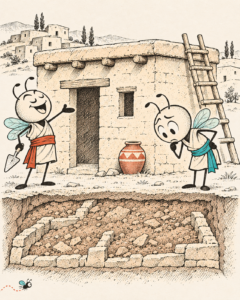
When we talk about clearing out a home, we usually mean a few trips to the local dump. But what happens when the entire home itself needs replacing? Well, at Çatalhöyük, an ancient settlement in what is now Turkey, old, unneeded houses basically became the foundation for even more houses. They’d fill it up with dirt, sometimes even including their buried dead, and build another house right on top of it. It’s both eerie and practical.
Çatalhöyük’s houses tended to be lived in for 45 to 90 years, with occupants continually re-plastering their internal walls and floors—perhaps on an annual or even a monthly basis. There is evidence that some homes were plastered up to 450 times. Each building had its own outer walls that abutted the houses next door. These independent walls allowed people to dismantle and reconstruct their homes without affecting surrounding residences. Upon abandonment, a home’s upper walls would be demolished and its lower half carefully filled with soil, leaving it well preserved. This explains why on site today archaeologists tend only to uncover very low walls, as the upper portions and second storeys were systematically destroyed by past residents. New houses were then constructed upon the bases of the old houses. There is evidence of as many as six rebuildings in the same place—one on top of the other.
Nature contributed to the pile
Let’s just clarify one thing: not all of what buries the world is a bunch of crushed-up ancient garbage. Mother Nature itself also played a role.
Floodwater was a big contributor, as it can leave sediment behind when it retreats, and wind can carry dust and sand over a site. All of this, combined with discarded objects, rubble, and later construction, all explains the pile-up of “earth” around ancient sites.
Someone’s old junk becomes our fascinating discovery
It’s actually kind of funny when you think of the amount of importance we now put on the discarded items from the ancient world. Just imagine being fed up with a cracked pot, finally getting rid of it, and somehow learning that centuries later someone has that pot sitting in a glass case in some world-class museum. Someone else’s trash became actual treasure.
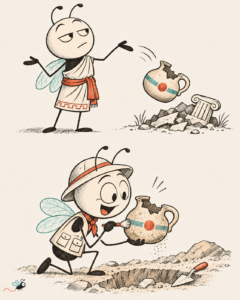
But besides it being pretty to display, archaeologists can use ordinary objects and the places they’re found to investigate how people lived. For most of us, imagining life thousands of years ago might be a struggle, but I think we can all understand a good kitchen utensil. These items, no matter how old, give present-day humans a connection to the mundane past.
This all leaves us in the slightly awkward position of being both the people fascinated by old junk and the folks currently producing heaps of it.
Perhaps a future archaeologist will be carefully examining our old beat-up Stanley bottles, deciphering how we lived during this time, and concluding that we were all obviously well-hydrated.
And the Amazon hauls… lordy… God help those future archaeologists…
THE LANDING
Apparently, leaving a lasting impression on civilization can be as simple as not taking out the trash properly.
STAY CURIOUS
Three more stories worth your curiosity.

 Your Brain Has a Dirty Little Secret, and It’s Covered in Cheetos Dust






Post Comment