🪰 Your Brain Has a Dirty Little Secret, and It’s Covered in Cheetos Dust
THE BUZZ
• Your dusty fingers have a dirty little secret.
• Scientists discovered something bizarre about the orange mess.
• Now Cheetos are going naked. Will it backfire?
You know the routine. You’re sitting on the couch, watching something good, when you reach into a bag of Cheetos. A few handfuls later, your fingers look like you’ve been working in a radioactive cheese factory. You can’t touch the remote, your phone is off-limits, and God help you if you’re wearing white.
Naturally, you complain about the mess. Then, without giving it a second thought, you lick every last bit of orange powder off your fingers.
Well, congratulations. You may have just fallen for one of the strangest little tricks in junk-food history.
Believe it or not, but that orange stuff has an official name: Cheetle. And apparently, your brain has some very interesting feelz about it.
The Dirty Little Secret Hiding on Your Fingers
Cheetle (pronounced CHEE-tle) is the official name for the powdery cheese gunk left behind after eating Cheetos. Yes, the company actually named the stuff that makes your hands look like evidence from a cheesey crime scene.
But here’s where your crunchy snack gets a little sinister…
Back in 2008, Frito-Lay hired a neuromarketing company called NeuroFocus to investigate what was happening inside people’s heads while they chowed down on Cheetos.
But they didn’t just ask if people liked the snack… how boring. Instead, researchers used EEG technology to measure the electrical activity in their customers’ brains. And what they discovered was rather amusing.
Because even though people might say they dislike getting orange powder all over their hands, their brain activity says something very different. The dusty orange mess actually produces a peculiar little thrill… something the study listed as a sense of “giddy rebellion.”
Weird, right? Because somewhere in a laboratory, researchers were apparently discovering that grown adults get a kick out of behaving like four-year-olds who’ve been left unsupervised with a bag of snacks.
The original brainwave data aren’t publicly available for us to inspect, so I can’t tell you exactly how much anyone’s brain lit up. But the findings were interesting enough to help inspire Frito-Lay’s mischievous advertising campaign, The Orange Underground, which leaned into the idea of people enjoying a little harmless bad behavior.
And that’s when Cheetos decided to let the cat outta the bag and turn that messy orange finger dust into a badge of honor.
There’s something wonderfully ridiculous about a snack company giving its leftover cheese dust an official name. But once you understand how much of the experience happens after you’ve eaten the Cheeto, the whole thing gets even stranger.
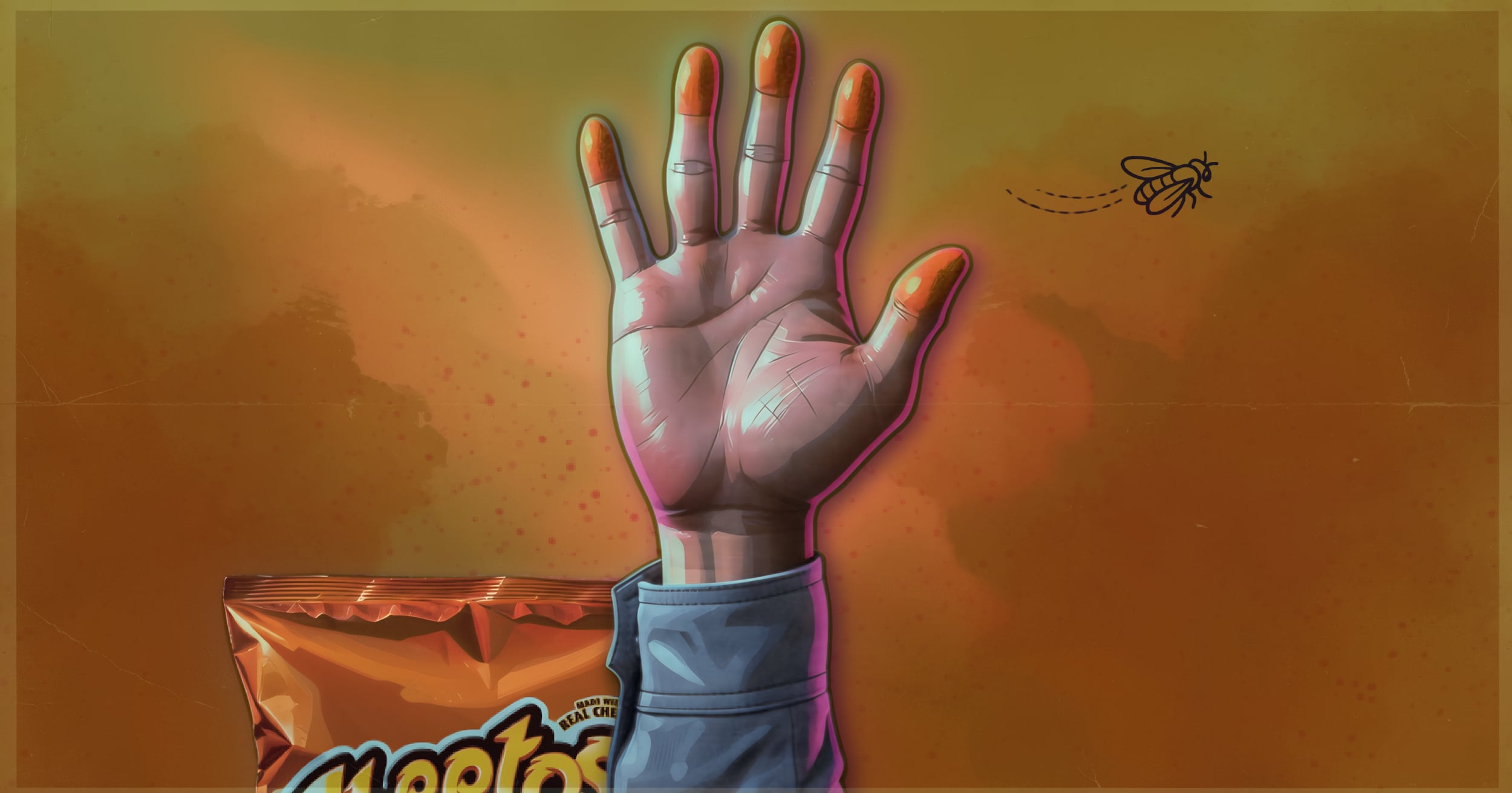
The funny thing is that Cheetle has become so recognizable that the company doesn’t even need to show you a Cheeto. A photograph of somebody holding up five bright orange fingers tells the entire story.
That’s some impressive branding for what is basically edible dirt.
A Little Salt, a Little Fat, and a Whole Lot of Brain Chemistry
Of course, the orange fingers are only part of the attraction. Before you can enjoy licking the evidence off your hands, the snack has to make you want another handful in the first place, right?
And that’s where food science starts getting interesting.
Snack manufacturers spend a ton of time and manpower studying how flavor, texture, and mouthfeel influence what we like to eat. Salt makes flavors pop, fat gives richness, and a satisfying crunch can make even a boring piece of processed corn seem irresistible.
There’s even a term for finding the ideal combination of pleasurable ingredients: the bliss point.
That concept helps explain why certain snacks are so difficult to abandon once you’ve started eating them. Your mouth is having a terrific time, your brain is learning that another bite is rewarding, and meanwhile, the bag is getting suspiciously lighter.
And this isn’t exclusive to Cheetos. Potato chips and other crunchy snacks rely on the same sensory tricks. The combination of salt, fat, crunch, and a fast-disappearing texture is a fascinating little crash course in why a supposedly innocent snack break can turn into an empty bag real fast.
The “Perfect Storm”: Salt, Fat & Crunch
Potato chips deliver the perfect combination of salt, fat, and crunch that makes every bite irresistible. This trio hits what scientists call the “bliss point,” a term popularized by food scientist Howard Moskowitz. The bliss point refers to the precise combination of flavors and textures that makes food maximally pleasurable, triggering the brain’s reward pathways.
Think about it: the saltiness tickles your taste buds, the fat gives you a rich, indulgent mouthfeel, and the crunch satisfies that primal craving for texture. Your brain loves this combo so much that it rewards you with a dopamine hit—the “feel-good” chemical—making you crave more.
Have you ever noticed how hard it is to stop eating Pringles after that first crisp? The iconic slogan “Once you pop, you can’t stop” isn’t just clever marketing—it’s rooted in how chips stimulate your brain’s reward center.
Dopamine and the “Addiction Cycle”
Here’s the deal: every time you take a bite, your brain releases dopamine, a neurotransmitter linked to pleasure and reward. This chemical reaction is the same one that occurs with other addictive substances (yeah, it’s that serious), which explains why you feel compelled to keep snacking, even when you’re not hungry.
A Little Science Behind It:
Dopamine reinforces behaviors that are enjoyable. When you eat chips, your brain learns, “Hey, this makes me feel good,” so it pushes you to reach for more. It’s like scrolling endlessly on Insta Reels—your brain just keeps saying, one more.
Vanishing Caloric Density: The Melting Trick
Have you ever noticed how potato chips seem to melt in your mouth? This phenomenon is known as vanishing caloric density. Chips are engineered to dissolve quickly, tricking your brain into thinking you haven’t eaten much at all. Since the sensation of fullness doesn’t kick in, you keep munching without realizing how much you’ve eaten.
Next time you snack on chips, pay attention: they’re light, airy, and dissolve almost instantly. Compare that to chewing something denser, like carrots or almonds, which take longer to break down and signal satiety faster.
Here’s what gets me about all this. You can spend five minutes chewing your way through a handful of carrots, but a handful of Cheetos practically disappears before your brain has even registered the first bite. And yet, you’re already reaching back into the bag for more. But the calories didn’t just magically disappear. Vanishing caloric density is a theory about how we perceive food, not an actual nutritional loophole… sadly.
But the idea makes sense as part of a bigger sensory experience. A Cheeto delivers a loud crunch, a burst of flavor, and then practically disappears, leaving you with one very obvious reminder that you ate it.
The orange dust…
The Crunch Is Doing Some Heavy Lifting, Too
The other part of the snack experience that delights the human brain: noise.
A good crunchy snack is practically its own little soundtrack. That first bite makes a satisfying crackle, and somehow, even though you’ve heard it a thousand times, you’re ready to hear it again, and again, and again.
Researchers have studied how the sound of food affects our perception of freshness and enjoyment. A chip that sounds crisp can actually seem more satisfying than an identical one that doesn’t deliver the same audible crunch.
The CRUNCH matters to us.
Maybe our ears are enjoying snack time almost as much as our mouths?
The psychology of crunchy snacks goes beyond flavor, and the following breakdown explains how several sensory pleasures can work together to keep us reaching into the bag.
The sound of the crunch itself plays a sneaky role. Studies have shown that the crunching noise enhances the snacking experience, making the food feel fresher and more satisfying.
Picture this: You’re watching Netflix after a stressful workday. A bowl of chips is beside you. The crispy crunch drowns out the day’s noise and tension. Before you know it, the bowl is empty—and you feel a mix of satisfaction and guilt
How Chips Hook Your Brain
Here’s a quick breakdown of how chips become addictive:
- Taste: Salt + fat hit your brain’s pleasure center.
- Texture: The satisfying crunch adds to the sensory experience.
- Dopamine: Each bite triggers a reward loop, making you want more.
- Vanishing Calories: The light, airy feel tricks your brain.
- Flavor Variety: New tastes keep boredom at bay.
And what’s crazy is that most of us never consciously think about any of this stuff. Nobody sits down with a bag of Cheetos and says, “I’m really looking forward to stimulating my auditory senses while exploring optimal flavor chemistry.”
You just want something salty and crunchy while you watch TV.
But the people making those snacks have spent years figuring out exactly how to deliver that experience to you, right down to the way a piece of puffed corn collapses and disappears between your teeth.
And if you’ve ever wondered how something so light and airy can make so much noise, a trip through the factory reveals a very entertaining answer.
How a Humble Piece of Corn Becomes a Cheese-Dusted Menace
Here’s something you probably didn’t know: the manufacturing process behind Cheetos involves a tiny explosion.
It begins with corn that’s been dried and milled into a cornmeal. That meal is mixed with water to form a dough, which gets pushed through an industrial machine called an extruder.
Inside, heat and pressure build as the mixture is forced toward a metal plate containing small openings.
When the dough finally emerges, the sudden pressure change causes moisture inside it to expand fast, puffing the corn mixture into the familiar airy shapes.
It’s basically a miniature corn explosion, repeated thousands of times as the snacks come tumbling out.
After additional heating and cooling, the pieces are ready for their transformation into Cheetos. They tumble through seasoning equipment, where oil helps the flavor coating stick to their surfaces.
And that’s where our old friend Cheetle enters the picture…
That famous orange powder is part of the seasoning that makes the snack taste like Cheetos. Some of it sticks to the puffed corn, and most of it ends up on your fingers.
The entire process is a remarkable bit of food engineering, and watching it happen makes you appreciate just how much work goes into producing something people routinely inhale while watching Netflix.
If you’ve ever wondered why every Cheeto has that strange, puffed-up shape, or how the famous orange coating gets there in the first place, this behind-the-scenes factory tour is surprisingly fascinating. Watch for the moment the corn mixture leaves the extruder and suddenly blows up.
And there you have it. From an ordinary field of corn to a crunchy snack that leaves orange stains all over your hands…
But that production process also helps explain another piece of Cheetos lore: their famous melt-in-your-mouth quality.
Food scientist Steven Witherly has discussed a fascinating concept called vanishing caloric density. His theory is that when airy snacks dissolve quickly in your mouth, your brain doesn’t quite register how much you’ve actually eaten. So you’re sitting there thinking, “These things are practically made of air. How many calories could they possibly have?” Meanwhile, you’ve polished off half the bag, and yes, they’re very calorie dense.
Some online explanations go further, claiming that Cheetle has been specially engineered to melt at a precise body temperature, almost as though somebody has programmed it to disappear on contact with your tongue. It’s a wonderfully sinister image, although that exact-temperature claim isn’t something I’ve found demonstrated in published testing.
Still, the larger idea is fascinating. When a snack delivers a big burst of flavor but doesn’t require much chewing, it’s easy to see why people might find themselves reaching for another piece before they’ve even finished the last one.
And once that final puff disappears, there’s always the encore waiting on your fingertips.
Now Cheetos Are Getting Naked. Seriously.
Just when you thought the orange-finger phenomenon couldn’t get any weirder, PepsiCo has decided to try something rather daring…
What if it made Cheetos and Doritos without their signature artificial colors?
In late 2025, the company introduced a new product line called Simply NKD, featuring familiar flavors without artificial dyes or flavors.
That means some of America’s most recognizable snacks are now available in much paler versions of their traditional selves.
Imagine opening a bag of Flamin’ Hot Cheetos and discovering that the snacks look almost suspiciously innocent.
The heat is supposed to be there. The flavor is supposed to be there. But that fiery red-orange appearance you’ve associated with the snack for years has essentially packed its bags and left.
The launch was part of PepsiCo’s broader effort to offer consumers different ingredient options, including products without artificial food dyes. But there’s something particularly interesting about removing the famous color from snacks whose entire personalities seem wrapped up in their dusty appearance.
PepsiCo recently announced a product line called “Simply NKD,” a new sub-category of Doritos and Cheetos that come with no artificial flavors or dyes, rendering them “completely colorless.” The collection will include orange-dust-free versions of Doritos Nacho Cheese, Doritos Cool Ranch, Cheetos Puffs, and Cheetos Flamin’ Hot, set to arrive on shelves starting on December 1.
[…]
For PepsiCo, the Simply NKD line is part of a larger effort to expand the company’s focus on health and nutrition, as a growing number of customers (especially young people) become more invested in wellness. It also signals a broader trend across the snack and beverage industry, as major corporations rush to replace artificial food dyes amidst new legislation from the Trump administration designed to phase out certain artificial dyes.
Don’t worry, guys, PepsiCo isn’t throwing the original orange Cheetos into a dumpster. The Simply NKD products are an additional choice, and removing artificial dyes doesn’t necessarily eliminate every trace of seasoning residue. It changes the famous color, not the entire experience of eating a crunchy, heavily seasoned snack.
But even that change creates a fascinating psychological experiment.
For years, people have associated Cheetos with their unmistakable orange appearance. You know what you’re getting before you ever take a bite.
So what happens when the flavor remains familiar, but the visual experience suddenly looks totally different?
Will Your Brain Miss the Mess?
This is where our little investigation gets really interesting.
Remember those neuromarketing findings suggesting people enjoyed the mischievous pleasure of orange-stained fingers?
Well, PepsiCo has now introduced an alternative that takes away one of the most recognizable parts of that experience.
And while the company has good reasons to offer consumers dye-free options, there’s a funny question lurking underneath the whole experiment.
What if the orange mess was the true magic all along?
Imagine two bowls sitting in front of you. One contains the familiar, aggressively orange Cheetos you’ve known for years. The other contains the pale Simply NKD version, which promises that familiar flavor without the artificial dyes.
You take a bite of each.
Would you enjoy them equally? Would the bright orange version somehow seem cheesier, more flavorful, or more satisfying simply because your brain recognizes it?
Or would you discover that the flavor and crunch were doing most of the work all along?
Well, some guy did just that in his living room, and the flavor seems exactly the same.
But there’s an even funnier possibility. What if some people genuinely miss looking down and seeing their fingertips coated in orange dust?
After all, that mess has been part of the Cheetos experience for generations. Getting your hands dirty is practically a tradition.
The strange pleasure of breaking the rules might be stronger than we realize, especially when the only rule you’re breaking is the one about not touching the sofa with cheese-covered fingers.
The Great Nacho Cheese Loyalty Test
Doritos brings another interesting wrinkle to the experiment.
Think of all the unusual flavors the brand has introduced over the years. There have been spicy varieties, tangy varieties, and enough limited-edition experiments to keep an entire snack aisle entertained for eons.
Yet the classic Nacho Cheese flavor remains the enduring fan favorite, regularly topping taste tests and popularity rankings.
And what color do most people immediately picture when they imagine Nacho Cheese Doritos?
Exactly.
That familiar orange dust has become almost inseparable from the experience. The flavor reminds you of the color, and the color reminds you of the flavor.
It’s the kind of association companies spend fortunes trying to create.
Oh, and if you’re curious about the most unpopular Dorito’s flavor of all time, there are actually two: Spicy Pineapple Jalapeño and Baja Fiery Mango.
I never tried either, but they don’t sound that bad to me.
Anyway, the bottom line is that PepsiCo is attempting something really bold. It’s asking consumers to separate a familiar taste from one of its most recognizable visual cues.
Maybe people will love the new versions, especially those who prefer to avoid artificial dyes. Maybe longtime fans will stick with the originals because that familiar appearance is part of the pleasure.
Or perhaps we’ll discover that people enjoy having a choice, and the two versions will happily coexist on store shelves.
We can’t declare a winner just yet. The Simply NKD experiment is fairly new. It started back in December 2025, and without separate, comparable sales figures, we can’t know whether removing the dyes has changed consumer loyalty or overall demand.
But the psychology question tickles my fancy.
For all the science, marketing research, and elaborate machinery involved in making Cheetos, the funniest part of this entire story might be how something as ridiculous as orange cheese dust became an important part of the experience.
We complain about the mess, carefully avoid touching anything valuable, and then lick our fingers clean with the enthusiasm of someone finishing a particularly good plate of chicken wings.
Will the cleaner-looking versions win people over, or will our brains quietly demand the return of their beloved orange fingerprints?
Either way, Chester Cheetah has managed to turn leftover seasoning into a legitimate psychology story, which is quite an achievement for a cartoon cat who doesn’t wear pants.
THE LANDING
Turns out the best part of Cheetos might be the stuff that doesn’t make it into your mouth.
STAY CURIOUS
Three more stories worth your curiosity.




Post Comment