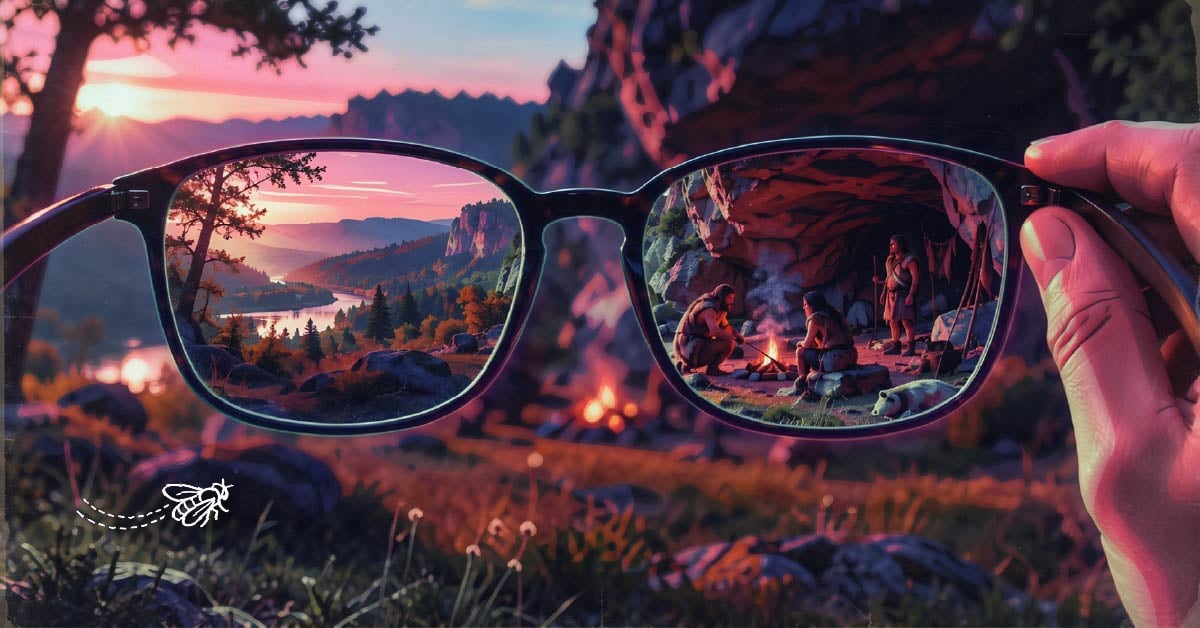
🪰 How Did Ancient Humans Survive Before Glasses?
THE BUZZ
- Seeing clearly wasn’t always a trip to LensCrafters.
- Some eyewear came without any lenses.
- The treatment options might make you flinch.
Whether you’re a four-eyed friend or not, try imagining this scenario…
Somebody’s waving at you from across a big, open clearing. You can make out an arm and a head, but the face isn’t giving you much. You wave back anyway, which feels polite until you realize they might be trying to warn you about something. Then all of a sudden a herd of wild buffalo comes charging from behind you. And you missed all of that because without glasses you’re as blind as a $2 hooker.
Thousands of years ago this would be exactly what you’d have to deal with every day, simply because there wasn’t anyone with a tiny eye chart writing up your prescription.
If you’re nearsighted, this is an easy scenario to picture. Getting dressed can already involve leaning toward the mirror like you’re about to tell it a secret. So how were people managing a whole life without glasses back in the day?
The video that prompted this story follows that question into some wonderfully inventive territory, including eyewear with no lenses and a cataract treatment that requires a little mental preparation.
Your Ancestors Weren’t Wearing Your Prescription
First, we need to be careful about sending our own crappy eyesight back in time.
Nearsightedness, or myopia, often develops in childhood when an eyeball that grows too long brings light into focus in front of the retina, leaving distant objects blurry. Family history matters, but the environment matters too.
The National Eye Institute sheds some light on this one particular detail:
“Children who spend more time outdoors are less likely to be nearsighted, but experts aren’t sure why.”
Researchers have tested that connection, and in a trial published in 2015, schools in Guangzhou, China, added 40 minutes of outdoor activity to the day for children around six years old. Over three years, 30.4% of initially nonmyopic children in those schools developed myopia, compared with 39.5% in schools following their usual routine.
So, an extra bit of time outside made a measurable difference, which then gives us a reason to wonder if people growing up with more sunshine would actually need glasses at the rate we need them today. Obviously, we don’t have a prehistoric prescription count to draw a fair comparison, but still, it makes you wonder…
Squinting Gets an Upgrade
So yes, sunshine is good and all that, but there’s also a flipside where getting too much light can be too much of a good thing.
Picture travelling across Arctic snow in bright sunshine. Light reflects off the ground into your face, and the ultraviolet exposure can injure the surface of your eyes. That’s called snow blindness, a painful condition that can temporarily impair vision.
So to combat this, Inuit people crafted a beautifully practical solution: goggles carved from materials such as wood, antler, or ivory, with narrow slits to look through. The surrounding material shields the eyes while the openings let the wearer see.
View this post on Instagram
The Canadian Museum of History holds an ivory pair found in an early Inuit house on Baffin Island. Look at them and you’ll notice the long, narrow openings and the space shaped around the nose. They give the impression that the wearer is permanently unimpressed with the weather, and given the circumstances, fair enough.
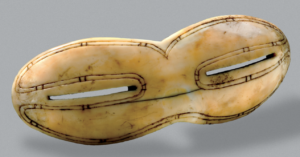
These were protective eyewear rather than a prescription for nearsightedness. For the person who needed to get home across that snow, protection was the point.
The Ancient Eye Clinic Was a Gamble
Back in the day, protecting your eyes was one thing, but treating an existing sight problem could take you into some pretty weird territory.
Even Egyptian eye makeup had a strange medical purpose, one intended to improve eyesight. In 2010, researchers investigated lead compounds associated with ancient cosmetics and found that low concentrations could stimulate nitric oxide production in cultured human skin cells. That molecule plays a role in immune defense, suggesting that ancient Egyptians weren’t wearing a smoky eye just to look fierce.

Then for cataracts, some old-school practitioners went even further.
A cataract clouds the eye’s natural lens. To remedy this, an old procedure called couching, described in early Indian and Greco-Roman medical traditions, involved using an instrument to displace that lens out of the path of light. The lens remained inside the eye but moved to the side of the eyeball.
Honestly, this sounds downright awful. Imagine being a patient, already struggling to see, while someone shoves a little instrument into your eye, all for the chance of possibly improving matters.
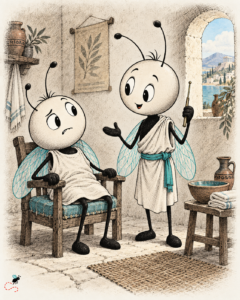
Moving the cloudy lens could let more light through, but it also removed the lens’s focusing power from where it was needed. Outcomes of this “procedure” could be really bad, including lasting blindness. Modern research on the poor souls who underwent couching documents some pretty bad results.
Finally, Something You Can Put on Your Nose
Now, through this entire journey back in time, there’s something missing: the people who had valid vision problems. Either caused by injury or age.
Starting with Shanidar 1, a Neanderthal who lived roughly 50,000 years ago, who survived multiple serious impairments, including an injury that likely reduced vision in one of his eyes. Researchers concluded that his survival with those vision problems was likely due to some kind of social support. This is one Neanderthal’s story, but it basically shows that having impaired sight didn’t automatically mean that you were left to fend for yourself. Thankfully, your fellow Neanderthals rallied around and helped your blindself get through the day.
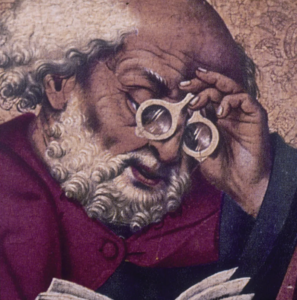
Much later, in thirteenth-century northern Italy, spectacles finally appeared. Their convex lenses helped with close work, particularly the age-related loss of near focus called presbyopia. As we age, the eye’s lens becomes less flexible, making nearby details harder to bring into focus.
So yeah, we finally got some spectacles, but they were pretty far from the version we know today. The College of Optometrists describes them as:
“The earliest form of spectacles was simply two mounted lenses riveted together at the handle ends.”
They had no arms reaching back over the ears, and wearers often supported them with a hand to keep them in place.
Honestly, looking through all of these examples of what our vision-impaired ancestors had to go through, we can really consider ourselves #blessed.
Next time you throw on a modern pair of glasses, pick up your book, and start reading, never forget the struggles the ancients had to go through. All so you can sit there comfy cozy, reading this article.
THE LANDING
Somebody figured out how to put clear vision on our noses, and we repay them by sitting on it.
STAY CURIOUS
Three more stories worth your curiosity.

 Have You Noticed Nobody Shops at Macy’s Anymore?





Post Comment