🪰 Why Africa Is Trapped in an Endless Loop of Poverty
THE BUZZ
- A fortune underground, with expensive obstacles above.
- The landscape keeps adding to the bill.
- Building a way out takes serious money.
Most of us know that Africa has long been a continent that’s struggled with poverty, but many of us are still pretty unclear on the exact reasons why. It’s definitely a vast space consisting of many different countries and different economic and socioeconomic structures.
So understandably, it’s hard to wrap your head around why such a large landmass seems to always be scrounging for cash, but there’s one specific place we can start pinpointing the issue: the Congo.
Say you’re trying to move a heavy shipment from central Africa to the Atlantic. You pull up a map, find the Congo River, and feel reasonably pleased with yourself.
There it is, winding through the interior before emptying into the ocean. A huge river connecting an enormous stretch of land to the outside world. Nature appears to have handled a considerable part of the shipping arrangements.
Then you look a little closer at the route.
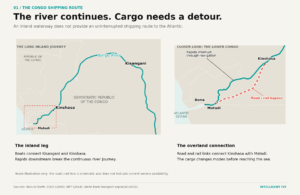
Downstream from Kinshasa, the river drops through a succession of rapids that boats just simply can’t pass through. The water gets to the Atlantic, but your shipment needs another plan.

That interruption is one of the details that stands out in RealLifeLore’s video about Africa’s geography and poverty. The video follows the obstacles that can make producing something, moving it, and selling it surprisingly difficult.
The Congo gives us a place to begin, and as the World Bank points out, the Democratic Republic of the Congo has major mineral resources, including copper and cobalt, yet most of its people haven’t shared in that wealth.
Geography helps explain part of that gap, and following the journey from there also brings us into decisions about infrastructure, political power, and who actually gets paid.
The Blue Line Has Fine Print
The Congo is a workhorse, with long navigable stretches serving communities deep inland. RealLifeLore walks through the frustrating arrangement: boats can travel between Kisangani and Kinshasa, but the onward journey toward the ocean runs into a very different river.
The U.S. Geological Survey describes a descent of roughly 270 meters from Malebo Pool, beside Kinshasa and Brazzaville, to the Atlantic, through a landscape of rapids, cataracts, and deep pools. That’s close to 900 feet of elevation the water has to lose.
The map’s blue line continues politely across the page, but it doesn’t show you the part where the cargo has to change vehicles.
Road and rail connections between Kinshasa and the river port of Matadi provide a way around the interruption. But transferring freight means handling it again, arranging another leg, and relying on the condition and capacity of another transport system. The video uses that sequence to explain why a river’s length tells us surprisingly little about how easy it is to get shipments through its vast waters.
For a business, those transitions become costs, and someone has to pay the people moving the goods, cover the delay, and foot the bill if one connection fails. Depending on the market, that can leave the seller earning less, the customer paying more, or both.
A Port Is Only the Beginning
Once you start thinking about that gap between having a gigantic river and having a usable route, the coastline becomes even more interesting too.
A sheltered place for ships is valuable, but the next logical question is how easily people inland can reach it. As RealLifeLore explains, steep rises behind parts of Africa’s coast complicate the connections between coastal ports and elevated interiors. Roads and railways have to negotiate the climb that a flat map barely acknowledges.
Of course, this varies enormously by location, and Africa has a long history of successful maritime trade: UNESCO describes the Swahili port cities of Kilwa Kisiwani and Songo Mnara trading with Arabia, India, and China for centuries now.
There’s also useful river routes too. The Gambia’s trade policy describes navigation inland from the coast, so the video’s blanket claim that sub-Saharan Africa lacks such routes goes a bit too far.
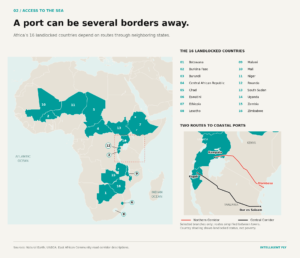
But the difficulty becomes especially clear once you move farther inland. Africa has 16 landlocked developing countries, whose access to seaports depends on routes through neighboring states. The UN Economic Commission for Africa identifies distance, limited infrastructure, and higher trade costs as major challenges for these countries.
So basically, a business can do everything “right” and still depend on a road, a border crossing, and a port it has no control over.
A Fly Has Entered the Economy
The transport problem also has a much smaller participant, and as a fly-themed publication, I feel we should address the family embarrassment.
Turns out our annoying little relative, the tsetse fly, can transmit parasites that cause serious disease in livestock. In farming villages that rely on animals to pull plows and carry loads, losing cattle also means losing some of the power needed to grow and move food.
@unknown_world_stroiesWhat If I Told You☠️💀♬ original sound – Unknown World Stories
Economist Marcella Alsan examined this historical relationship in a 2015 paper in the American Economic Review. Its opening puts the biological problem plainly:
“The TseTse fly is unique to Africa and transmits a parasite harmful to humans and lethal to livestock.”
Alsan found that groups living in environments suitable for tsetse were historically less likely to use domesticated animals and plows. Her research links that pattern to differences in agricultural production and political development.
Naturally the importance of animal power is easy to overlook once you’ve grown accustomed to engines. But an ox could help a farmer cultivate more land, then help move what came out of it. Unfortunately, disease has made keeping those animals nearly impossible to keep, and as a result, more of that work has fallen to the people.
Somebody Chose Where the Tracks Went
With all these challenges between the Congo River, complicated coastlines, and deadly flies, building better transport sounds like the obvious answer. It can make a massive difference, but the destination is a big factor.
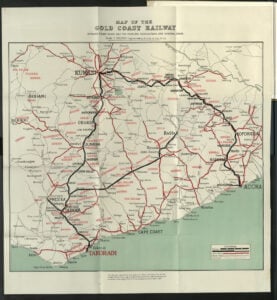
Researchers Rémi Jedwab, Edward Kerby, and Alexander Moradi studied how colonial railways shaped African economies. They identified military control, mining, and cash crops as major reasons colonial authorities built particular lines. In Ghana, they describe how a proposed route changed when a new governor favored gold-mining interests.
The research found substantial benefits around the lines that were built. Transport became cheaper, production expanded, and towns developed. Their work also traced how some of those advantages persisted long after the original railway investment.
For communities left off the route, a line built elsewhere has done practically diddly squat to help them, unfortunately.
The Mine Can Make Money While the Country Struggles
Now we can come back to the apparent contradiction that opens the video: how can a country contain so much valuable material and still have widespread poverty?
The World Bank’s overview of the DRC lists its substantial natural assets, then follows with this sentence:
“Most people, however, have not benefited from this wealth.”
Its account of the country’s 2024 household survey puts roughly 69% of the population below the national poverty line. That’s massive, and the same overview identifies conflict and political instability as major problems and notes that mining’s limited job creation constrains the spread of economic gains.
That helps explain why a mineral deposit isn’t an instant boost to the continent’s bank account.
A mine can justify expensive transport because the material basically sells itself, or sort of. Because a nearby farmer or small manufacturer will face some pretty significant challenges getting those materials to travel. And even when the export is profitable, the earnings depend on employment, taxes, ownership, and how the proceeds are used.
After all, copper in the ground doesn’t automatically become a reliable road past somebody’s village.
A Border Can Be More Expensive Than a River
And now we’ve come to the next challenge for Africa: borders.
Across the Congo River sits Brazzaville, the capital of the neighboring Republic of the Congo. These are two major cities close enough to see the riches they can make together.
Yet a World Bank analysis published in 2011 found that crossing between them was extremely expensive when compared to the base local income. It pointed to limited competition between the cities and complicated customs procedures. In a nutshell:
“These high prices largely result from lack of competition in river crossing services”
The analysis also reported that up to 17 agencies were operating at the Kinshasa crossing, although only four were supposed to be there.
That was a finding from 2011, so the data is a bit stale, but it shows how unnecessarily complicated border crossings have become in some of the continent’s most profitable areas.
The Detour Becomes the Cycle
Now let’s go back yet again to a company trying to move a shipment.
This is the cycle of ridiculousness:
- There’s a difficult route raising the cost of reaching customers.
- That difficulty alone makes business expansion less attractive and reduces investment funds
- There’s no money, so then the next business encounters basically the same problems
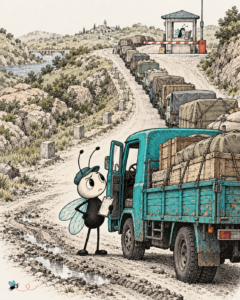
And that, folks, is basically how the poverty cycle keeps going. Then you pile on conflict, corruption, and poor maintenance, and you’ve got an issue that seems manageable on the surface but is very complicated under the hood.
Geography helps explain why that journey can be so hard. Changing the outcome means paying attention to the whole route, including the obstacles people have built along the way.
THE LANDING
A country can sit on a fortune and still struggle to afford the trip to market.
STAY CURIOUS
Three more stories worth your curiosity.






Post Comment