🪰 Soon You Won’t OWN Anything, Not Even Your Favorite Video Game…
THE BUZZ
- We used to bring our favorites home.
- Convenience comes with some very interesting fine print.
- Are we trading away more than shelf space?
Remember going into a dusty record store with just enough money for one album? You’d linger, browse, and soak up the vibes with absolutely no intention of making a quick decision. Ahhh… those were the days…
We can all remember it as if it were yesterday… that week’s hit song wafting through the store, your friend wandering into another section and holding up a cover as if they’d discovered buried treasure. You were flipping through the racks, weighing the album you’d come for against the one with the artwork you couldn’t stop looking at. Whoever drove you there had already checked their watch twice.
By the time you got home, that record had a story attached to it. Years later, hearing a song could bring back the store, the smell of the sleeves, and even the person who talked you into buying it.
A lot of us have some version of that memory. Maybe yours involves CDs at Tower Records or a paperback you lent to somebody who apparently interpreted “borrow” as a permanent arrangement.
Nowadays, we can get almost anything delivered to a screen. The entire thing is convenient in ways our younger selves would’ve found mind-blowing or downright revolutionary. But somewhere along the way, getting that new album, book, or latest movie became adding it to a “digital account.” Yet, we kept using the same word for both: buying.
The Box Is Doing a Lot of Pretending
Author Jason Pargin recently posted a TikTok video about physical media disappearing. He remembers getting The Legend of Zelda on its golden cartridge when he was 12 and how the cartridge itself felt like a valuable artifact. Owning that object was part of playing the game.
That detail makes the latest development in the gaming world especially poignant.
In its announcement for Grand Theft Auto VI, Take-Two describes the upcoming boxed version as:
“containing a download code inside the box”
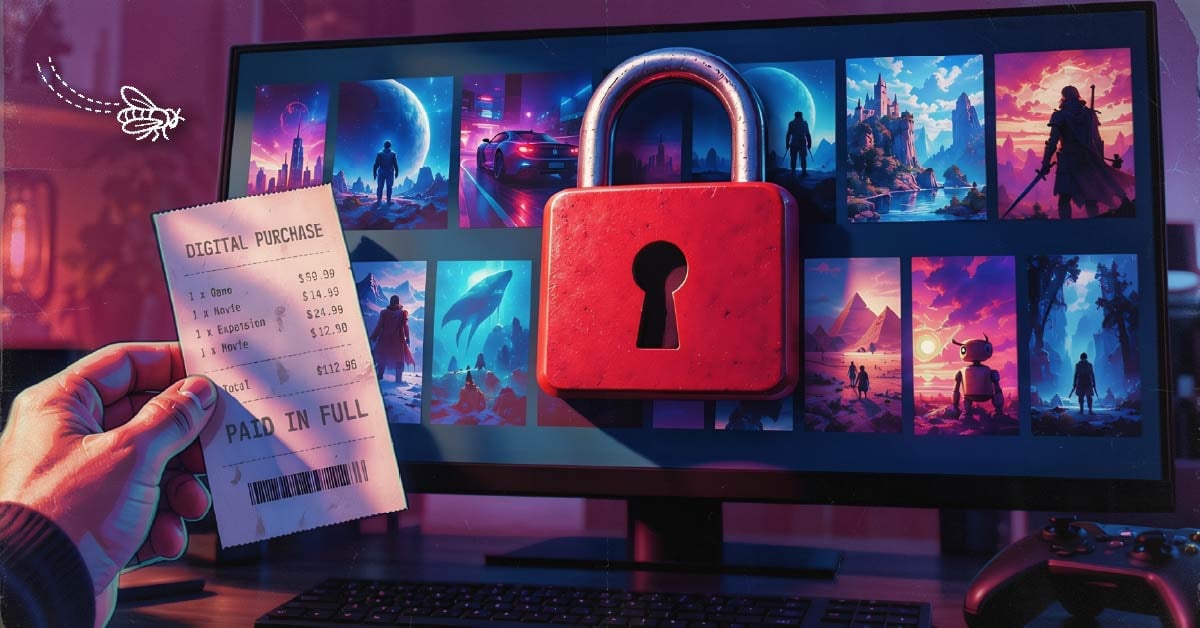
That’s from the company’s own preorder announcement. You can still go to the store, hand over your hard-earned cash, and carry home what’s essentially an empty box containing instructions for acquiring the thing you thought you’d just bought.
So… is the box now literally just for show?
Sony also announced that disc production for new PlayStation games will end starting in January 2028. In its announcement, the company says:
“Following this date, new games will be available on PlayStation Store and at retailers in digital formats only.”
Just to clarify, this change is going to affect new releases from the 2028 cutoff and onward, and Sony says earlier disc releases will be unaffected. Still, it’s a big shift in what buying a new PlayStation game will involve.
Pargin starts there, then follows the thought somewhere more personal. His question is what happens to our relationship with these things when the objects disappear.
@jasonkpargin♬ original sound – Jason Pargin, author
Your Movie Collection Has a Licensing Problem
There’s another side to all this, and it’s pretty darn emotional: the practical matter of whether the movie you bought digitally will still be available when you want to watch it.
On PlayStation’s UK website, a StudioCanal notice set September 1, 2026, as the date affected purchased titles would become inaccessible and leave customers’ libraries because of licensing agreements. Its wording includes:
“you will no longer be able to access your previously purchased content from Studio Canal”
The official notice and affected-title list included classics like Hot Fuzz and Terminator 2.
Imagine your shelf deciding it no longer has a business relationship with your copy of Hot Fuzz.
That’s why “previously purchased” deserves our attention. Someone had already paid for these titles and put them in a collection they expected to use. But still, an agreement between companies can reach into that collection and change what was available.
With a DVD, the studio’s next licensing negotiation generally doesn’t concern the copy sitting beside your television, collecting dust. You might scratch it, lose it, or lend it to that same friend who’s still enjoying your paperback. But keeping track of it is your problem. Not some random business arrangement that’s honestly none of your concern.
@shayne.vibes31 #greenscreen ♬ original sound – Shayne Vibes Truth
Blockbuster Was at Least Clear About the Renting Part
Now, before we get too sentimental about our precious little discs, we should probably acknowledge the large blue-and-yellow rental store in the room.
A lot of us get really sentimental about Blockbuster, but it’s important to remember that we didn’t own anything, as the return date was always a prominent reminder.
And yet plenty of us remember those trips as part of the evening itself. Someone wanted a comedy, while somebody else was lobbying for a horror movie, and you’d circle the new releases, check behind the display case, and discover that every available copy had already gone home with a family that apparently planned better than yours.
Eventually, a decision got made, and snacks were selected.
The whole rental arrangement had its annoyances, but it was all part of the process. You paid to borrow a movie or video game and then brought it back. Simple as that.
Blockbuster also complicates the nostalgia in an interesting way: ownership wasn’t the only thing making these experiences meaningful. Going somewhere together and choosing something gave the night a beginning.
Now streaming has removed the trip, and now it’s up to us to provide the experience instead of a store with bad carpeting and the smell of stale popcorn doing it for us.
@relivethe90s_ POV: Going to Blockbuster in 1993 – – #blockbuster #throwback #nostalgia #90skid #fyp ♬ aquatic ambience – scizzie*+
Turns Out, “Mine” Has a Feeling
Even when access is reliable, a small digital file and an object just don’t hit the same.
Researchers Özgün Atasoy and Carey Morewedge examined that difference in a paper published in the Journal of Consumer Research. As they explain in the study:
“Yet, in five experiments, people ascribed less value to digital than to physical versions of the same good.”
Their explanation involves psychological ownership, the feeling that something belongs to us and connects to who we are. The effect depended on factors including control, personal relevance, and whether people expected to keep the item.
That actually makes a lot of sense when you think about a collection. A shelf of records gives your taste a physical address, a display for everyone to see. Someone visiting can pull out an album and ask you about it. That’s vastly different than someone half-heartedly flipping through your Spotify collection.
A book with a friend’s inscription carries something the text alone can’t. So does a magazine kept because its cover once seemed important enough to save.
A digital favorite can mean plenty, too. But the object gives us additional ways to encounter it, handle it, and attach a little of our lives to it. Losing those details changes the experience, even if every song is still there.
Pargin’s Ghost Mansion Has Terrible Amenities
Near the end of his video, Pargin reaches for an unlikely comparison: The Great Divorce by C.S. Lewis.
The novel follows a journey from a ghostly town toward Heaven. In that town, people can imagine possessions into existence, but the results lack substance. There’s a particularly telling detail: their imagined houses don’t keep out the rain. The Great Divorce, chapters 1–3
Pargin uses that image to describe the feeling of having almost everything available and still sensing that something is missing. It’s a comparison a lot of us can relate to. A collection on a screen can look good, sure, but then you realize that, say, in the middle of a power outage or a bad Wi-Fi connection, that entire collection would be gone. Literally, *poof* gone.
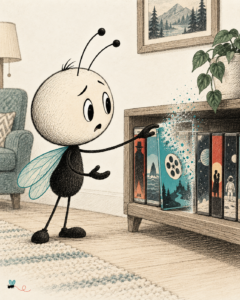
Those trips to the record store gave us memories we couldn’t have downloaded. What we brought home also gave us independence. After all, once that album was on the turntable, listening to it wasn’t something the store could later take away from you.
Sure, we can build new rituals around digital things, and we already do with the now infamous “Netflix and Chill” thing. But if a company wants us to pay for something and call it ours, we should be able to ask what happens when its next agreement falls apart.
THE LANDING
The future looks awfully convenient for whoever gets to decide what we keep.
STAY CURIOUS
Three more stories worth your curiosity.


Post Comment