🪰 Are We Living in The Sims? The Simulation Idea People Can’t Shake
THE BUZZ
- Imagine being the Sim who starts asking questions.
- What if reality has a settings menu?
- Proving it is where things get complicated.
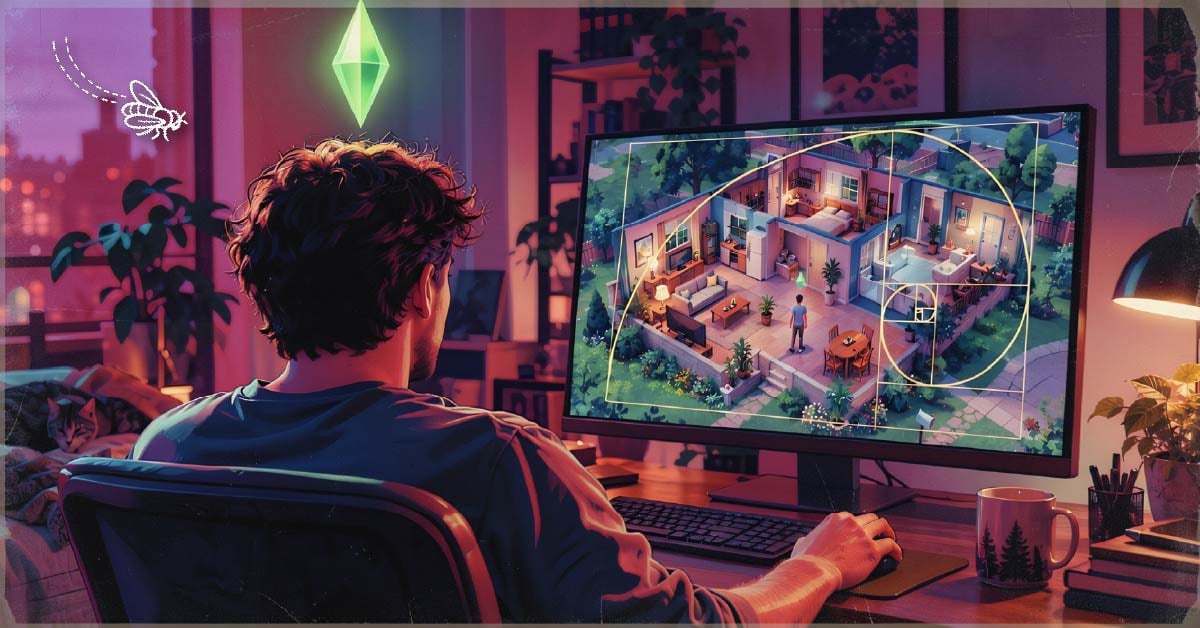
If any of you reading this have played The Sims, you’re going to sort of understand the whole gist of what we’re about to dive into.
But for those of you who haven’t, The Sims is basically a vast life simulation game, where you and your mouse are God, and you’re controlling literally every element of these little pixelated humans’ lives. All while they continue about, blissfully unaware of the simulation they’re living in.
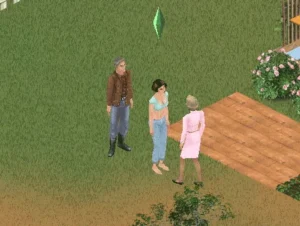
And that folks is what some scientists and physicists believe we’re essentially living in. At this very moment.
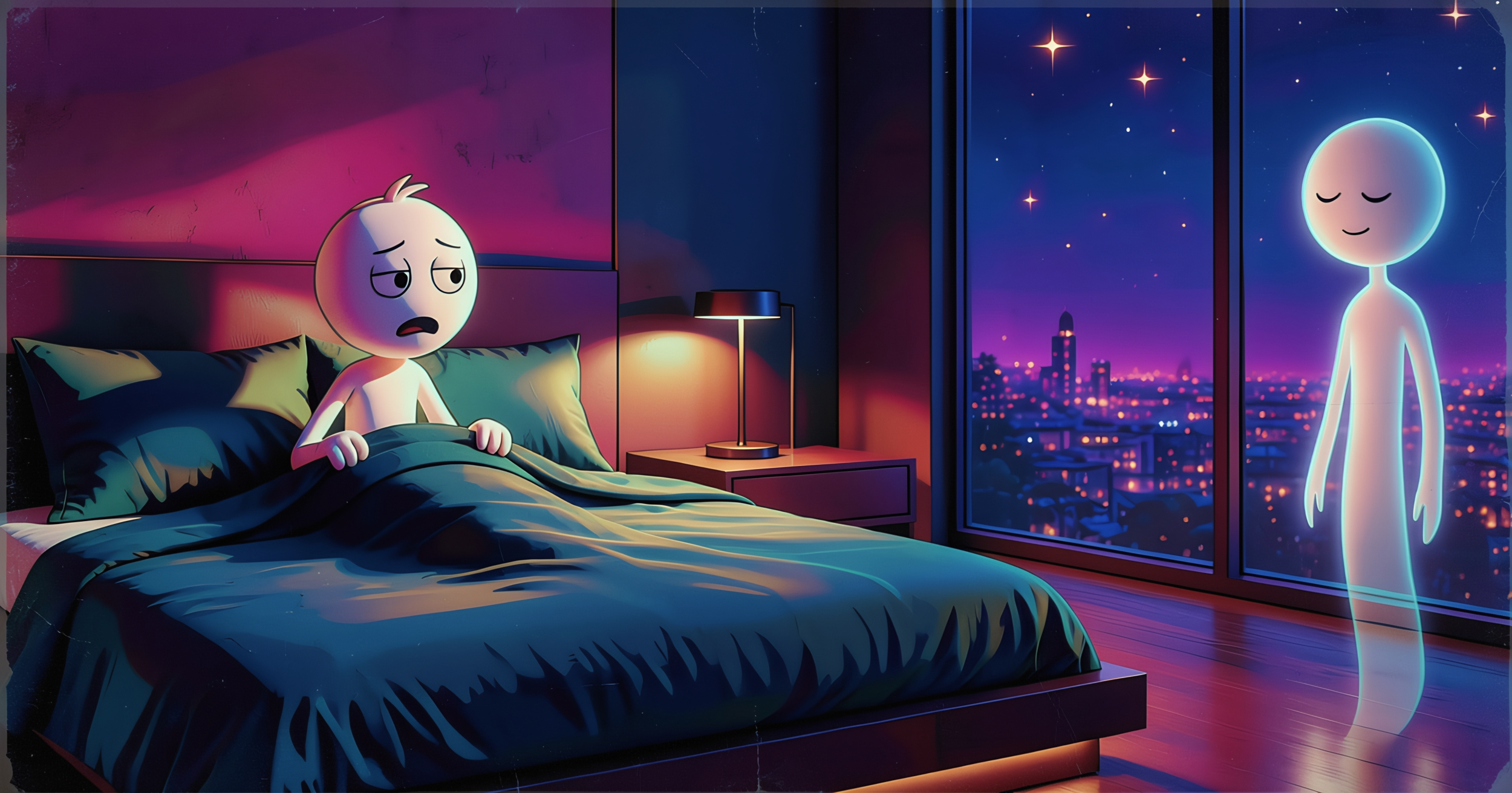
So, back to The Sims… let’s step into our little pixel friends’ home. Your Sim has a pretty decent kitchen. You paid for the counters, chose the wallpaper, and gave them a stove. But somehow, dinner is now on fire, and the little person you created is having a dreadful evening while you sit there wondering whether to reload.

It’s a peculiar relationship…
Their entire neighborhood fits inside a machine on your desk, and you can pause the whole thing in order to grab your freshly delivered DoorDash.
Now imagine a future version of that game whose inhabitants could actually think and feel on their own. You know, “free will” and all that. Then one of them becomes a scientist, and they study their world, build instruments, and discover rules that let them break down the world around them.
Could they find out about you and your desk? All while you sit there mindlessly chowing down on lo mein?
That’s the question that makes the simulation idea interesting. Everything available to that imaginary scientist, including the equipment used to investigate reality, would be inside essentially the same system. Except for us, we’re not trapped inside someone’s desktop computer.
Or are we?
The TikTok video below takes that possibility on quite a trip, from the absence of alien visitors to mathematical patterns in flowers and the part about a physicist finding error-correcting codes.
But before we really start nerding out, the big question at the heart of all this is why a universe as enormous as ours is so darn quiet.
@tvhush Fermi’s Paradox | Drake Equation | Fibonacci Sequence | Golden Ratio . . . #fibinaccisequence #goldenratio #thebasement #thewhyfiles #foryou ♬ original sound – TVHush
Why Is the Rest of the Map So Quiet?
Just look out at the sky full of stars, and it’s reasonable to wonder whether somebody, somewhere, is looking back. Give civilizations enough time to develop and travel, and you start wondering why we haven’t encountered any.
That simple question is referred to as the Fermi paradox, usually summed up as “Where is everybody?” NASA’s description of what we’ve discovered so far is pretty blunt and anticlimatic:
“But so far, we have no evidence of life beyond Earth.”
Then there’s the Drake equation, which the video presents as producing more than a million advanced civilizations in our galaxy. However, that equation isn’t completely decisive.
The Drake equation kind of works like this: Imagine inviting 100 people to a party, and you estimate that only half will be available and only half will turn up. That gives you 25 guests.
But when it comes to our universe, the Drake equation uses way bigger and more complex figures, like how often suitable stars form, how many have planets, how frequently life becomes intelligent, and how long a civilization remains detectable. Several crucial inputs are still unknown, so getting a confident head count will take considerably more work.
The simulation twist is to imagine the distant stars as scenery around our particular story. Perhaps the other neighborhoods haven’t been “loaded in” quite yet. The TikTok video even theorizes that the speed of light is a restriction that keeps the characters (or Sims) from wandering too far.
Wait, What Do You Mean by “Code”?
Physicist S. James Gates Jr. and his colleagues found a connection between certain mathematical models in physics and error-correcting codes. Gates described their findings in an interview with On Being:
“We found a role for error correcting codes in the equations of supersymmetry, and this was just stunning for us.”
Okay, but what the heck is an error-correcting code, and what does it actually do?
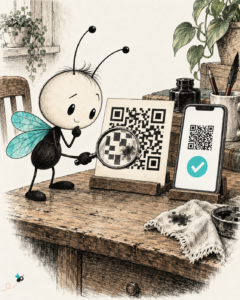
Think about a QR code that still scans despite a smudge. Despite the smudge, the QR code still contains extra information that can help reconstruct damaged data, and the scanner, or your phone’s camera, still has enough structure to work out some of what it can’t read. QR codes use a different family of codes from those in Gates’s research, but still, the comparison gives us a familiar example to latch onto.
Gates was investigating supersymmetry, a proposal that pairs familiar particles with undiscovered partner particles, although it still remains unconfirmed experimentally. To explore these relationships, his team used diagrams showing how parts of their mathematical models connect. Certain codes made of ones and zeros determined how those diagrams could be put together.
The fascinating thing is that the mathematics associated with protecting information also appears in theoretical physics. And discovering that connection is pretty substantial, as it implies that there’s almost some type of “software” running our universe. However, that theory still isn’t rock solid, and Gates himself cautioned in that interview that shared mathematics doesn’t necessarily make two systems the same thing.
Then the video introduces an experiment that really did put computer code into DNA.
In 2017, University of Washington researchers encoded instructions for a computer attack in a synthetic strand of DNA. When the strand was read and its data processed by software the researchers had deliberately made vulnerable, the attack gave them control of the processing computer.
Does Nature Have a Favorite Number?
Okay, phew, after breaking down the theoretical physics code, let’s literally return to earth and start inspecting something a bit more tangible. Like a simple sunflower.

Look closely at its seed head, and you can trace spirals running in opposite directions. Counts such as 34, 55, and 89 turn up frequently. They’re members of the Fibonacci sequence, which begins 1, 1, 2, 3, 5, 8, 13. Each new number comes from adding the previous two.
Divide a number farther along the sequence by the one before it, and the result approaches roughly 1.618, which is the infamous golden ratio. The TikTok video’s 144 divided by 89 is a close approximation.
So how does a flower have those arrangements?
Imagine fitting more and more round beads onto a growing surface. Where each new bead fits depends on the space left by its neighbors. In plants, chemical signals and growth help govern where new structures form, and repeated interactions can produce an orderly pattern across the whole head.
Researchers have used models that place disks according to available space in order to reproduce Fibonacci arrangements, along with other patterns observed in real sunflowers.
It’s a super fascinating process to see how a flower can develop striking mathematical order without consulting a diagram of the finished product.
The TikTok video stretches this into claims about how the golden ratio governs human proportions and spirals throughout nature, but that’s not universally true. A spiral alone doesn’t tell us its precise mathematical proportions.
So, finding a golden ratio arrangement in nature is certainly something interesting and worth investigating. However, leaping into the idea that “someone” programmed it that way remains a separate and unresolved question.
So, How Would We Know?
There’s a reason why that simple question survives even when the individual clues become less convincing. The simulation argument can be made even without a single suspicious sunflower.
In a 2003 paper, philosopher Nick Bostrom asked us to imagine civilizations capable of running enormous numbers of simulations containing conscious inhabitants. One original civilization could potentially create many virtual civilizations, making simulated people vastly more numerous than their creators.
If that happened, Bostrom argued, we’d need a reason to assume we belonged to the much smaller original population. His argument leaves three broad possibilities: almost no civilizations reach that capability, then the ones that do never run these types of simulations, or people with experiences like ours are overwhelmingly simulated.
Bostrom’s theory is a conditional argument, and it depends a lot on assumptions, including whether computation could produce consciousness and whether advanced civilizations would create those worlds. It doesn’t give us anything too concrete to prove that our lives are simulated.
Still, it’s enough to make the question linger, and it’s one big reason why people are still kicking this idea around.
But, in order to prove these theories, like truly 100% prove them, that would take years upon years of precise testing. One where a laboratory would need to run repeated, controlled checks and peer through the cracks just long enough to see where a proposed simulation effect came from equipment trouble or unfamiliar physics.
We can get there someday, sure, but as of right now, the human race just isn’t there yet.
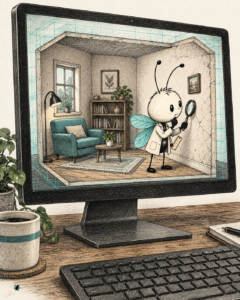
So now, back in our imagined house, the little scientific Sim could spend a lifetime measuring their world with remarkable accuracy. They might discover the rules governing everything they can touch and still have no access to the desk on which the computer sits.
That’s the part many people, not just the scientists and physicists, find hardest to shake: how much could you learn about the inside without ever getting a real look at the outside?
THE LANDING
The strange part is imagining we could understand every rule of our world and still have no idea what’s running it.
STAY CURIOUS
Three more stories worth your curiosity.

 How Did Ancient Humans Survive Before Glasses?



Post Comment