🪰 Cypress Gardens, 1936: Sexy Water-Skiing Babes, Flirty Southern Belles, and One Really Freaky Backstory…
THE BUZZ
- Before Disney, Florida already had its fantasy land.
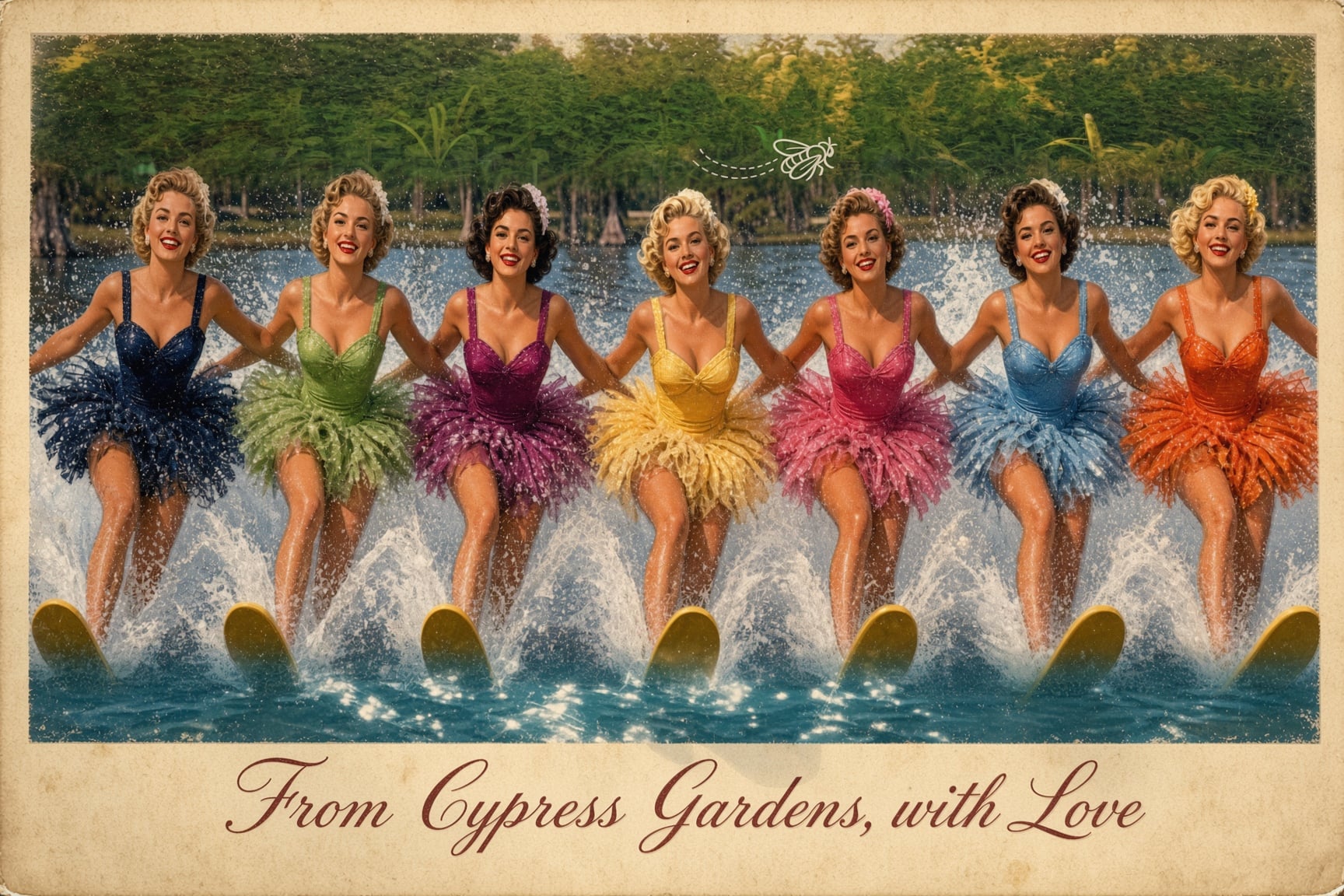
- Water-skiing babes turned a lake into a theater.
- Hollywood came calling, and America ate it up.
Florida, 1936.
Central Florida looked nothing like the vacation kingdom we know today. Orlando wasn’t covered in castles, roller coasters, themed hotels, and gift shops selling rodent ears. Down in Winter Haven, Dick and Julie Pope were working on a very different idea along the shores of Lake Eloise.
They wanted to build a paradise. Not the thrill-ride kind, the kind you could stroll through.
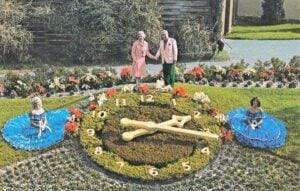
Cypress Gardens was lush in that almost way-too-perfect way, like how those cool old Florida postcards always looked. Little paths disappeared into tropical greenery, charming bridges arched over narrow canals, lagoons sat glassy and still beneath the trees, and flowers seemed to be packed into every scrap of dirt that could possibly hold a root.
Then, drifting through all of it, were women dressed as Southern Belles in these pastel-colored enormous hoop skirts, stopping for photos among the roses like they’d wandered out of another century and landed in central Florida.
The whole place had this romantic, really over-the-top charm to it. Part botanical garden, part fantasy, part living the postcard dream. And I get why people fell for it. Because this was Florida’s first official theme park.
That feels almost strange to say now. In 2026, Florida tourism is so tied to Disney that it’s hard to imagine the state before castles, monorails, and mouse ears. But decades before Walt and Mickey took over the state, Cypress Gardens was already figuring out the same basic trick… don’t just give people somewhere to go. Give them a world they want to step into.
And this little clip is what sent me down the Cypress rabbit hole in the first place.
The Florida Fantasy Before Disney
It’s hard to explain the vibe of Cypress Gardens without actually seeing it. Everything looked almost too pretty to be real, like old Florida had been polished up just enough to make you wonder if you were looking at a place or somebody’s antebellum fantasy.
@dspacestv Mid-Century American Tourism 🌴
The clip nails the atmosphere, but the story underneath all that polished beauty is even wilder.
Cypress Gardens didn’t become famous by accident. Dick Pope was a relentless promoter who understood something simple and powerful about tourism: if you can make somebody hundreds of miles away feel like they’re missing out, you’ve hooked them.
And Dick was very, very good at that.
The Swamp Had a Publicist
Then the Southern Belles Arrived
The Southern Belles were the most iconic and recognizable image of Cypress Gardens. They drifted through the property in these ridiculously enormous dresses inspired by the antebellum South, posing under lush flowering arches, beside fountains, and along these curved garden paths that looked like a real-life postcard. The costumes gave the place an old-fashioned romantic charm that fit perfectly with the dreamy world Dick and Julie Pope were creating.
The Belle story is interesting. After a freeze left part of the gardens looking rough, Julie Pope came up with a distraction tactic: put a pretty young woman in an elaborate dress near the damaged foliage and give visitors something better to look at.
It worked so well that the idea stuck, and the Southern Belles became part of the Cypress Gardens experience, and visitors weren’t just photographing the flowers anymore. They were photographing themselves inside the Southern fantasy.
By the 1950s, that fantasy had grown into something much bigger than a garden.
Now Step Into Cypress Gardens in 1958
By 1958, Cypress Gardens had been working its magic for more than two decades, and by then the whole fantasy had found its groove. The gardens were lush, the bridges had become part of the scenery, Southern Belles drifted through the grounds like they literally lived there, and Lake Eloise had turned into its own kind of theater.
That’s what makes this old footage so good.
There’s no narration telling you what matters and no voice trying to sell you the place. For six minutes, Cypress Gardens just exists in front of you exactly as it did in its prime, from the clothes and crowds to the gardens, the water, and that wonderfully unhurried feeling of people actually taking their time to enjoy the vibes.
This clip transports you back to 1958 Florida.
There’s something almost hypnotic about that footage. Cypress Gardens feels calm and polished, right up until Lake Eloise enters the chat and a speedboat starts dragging people across the water.
That’s when the whole place suddenly shows off its other personality.
The garden fantasy turns into a full-blown spectacle.
The Water-Ski Show Began Almost by Accident
The ski shows would become the thing Cypress Gardens was famous for, but the origin story is comically accidental.
During World War II, a newspaper photo showed people water skiing at the Gardens, and some servicemen apparently took that to mean there was already a full-blown show waiting for them. So they arrived expecting one.
But there wasn’t a show.
Julie Pope could’ve sent them on their way with an apology. Instead, she pulled together her kids and a few friends who knew how to ski and basically said, All right, I guess we have a show now.
That improvised afternoon on Lake Eloise turned out to be the start of something huge.
“The next weekend, 800 soldiers showed up, and the rest, as they say, is history.”
The Skiers Were Absolute Maniacs
What began as a few people putting on a quick show for some servicemen slowly turned Lake Eloise into the wildest part of Cypress Gardens. The routines got crazier, the crowds got bigger, and the skiers started doing things that looked almost impossible to pull off… and they did it with smiles plastered on their faces.
That’s what gets me about the old footage. Everything looks so cheerful that you can miss how insane the athleticism really was. The costumes are cute, the hair is perfect, and everybody’s waving like they’re out for a Sunday drive, while some babe is balancing on a dude’s shoulders behind a speedboat and some beefcake is catching air off a ski ramp.
And they made it look elegant.
The shows kept evolving until even skis became optional. Barefoot routines joined the mix, the human pyramids got more elaborate, and Lake Eloise was now a stage where the performers were constantly trying to outdo last week’s stunts.
The women were a huge part of that magic. They brought this mix of glamour, grace, and nerves of steel that helped turn the ski shows into the thing people came to Cypress Gardens to see.
The Water-Skiing Babes Were Badasses
Among the women who helped turn Cypress Gardens’ ski shows into an art form was Willa McGuire Cook, one of the biggest stars of the whole shebang.
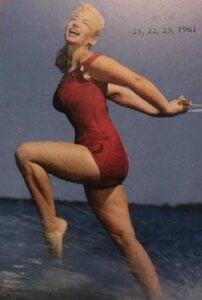
Willa had the glamour the cameras loved, but there was so much more to this badass. She helped shape routines, taught other skiers, worked on costumes, and pushed water-ski ballet into something audiences could watch for the beauty of it, not even realizing how much skill it took to make all of that look effortless.
She invented what the show could become.
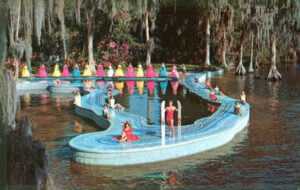
Old Florida Knew How to Put on a Show
There’s something about Cypress Gardens that’s impossible to recreate these days.
It belonged to an era that was smaller, stranger, and more personal. The place didn’t need an army of characters or fifty attractions competing for your attention.
But what really made Cypress Gardens work was its personality.
Dick and Julie Pope took a soggy piece of Florida and turned it into a world people wanted to step inside. Then they photographed that world, polished it up, sent it out into America, and made millions of people wonder what it might feel like to see it for themselves.
And for decades, they came to find out.
THE LANDING
Florida was selling the fantasy way before a mouse ever moved to Orlando.
STAY CURIOUS
Three more stories worth your curiosity.





Post Comment