🪰 We Should Be Living Like the Jetsons
THE BUZZ
- A factory-built space house? I’m listening.
- These architects had some gloriously big ideas.
- What happened to the neighborhood they imagined?
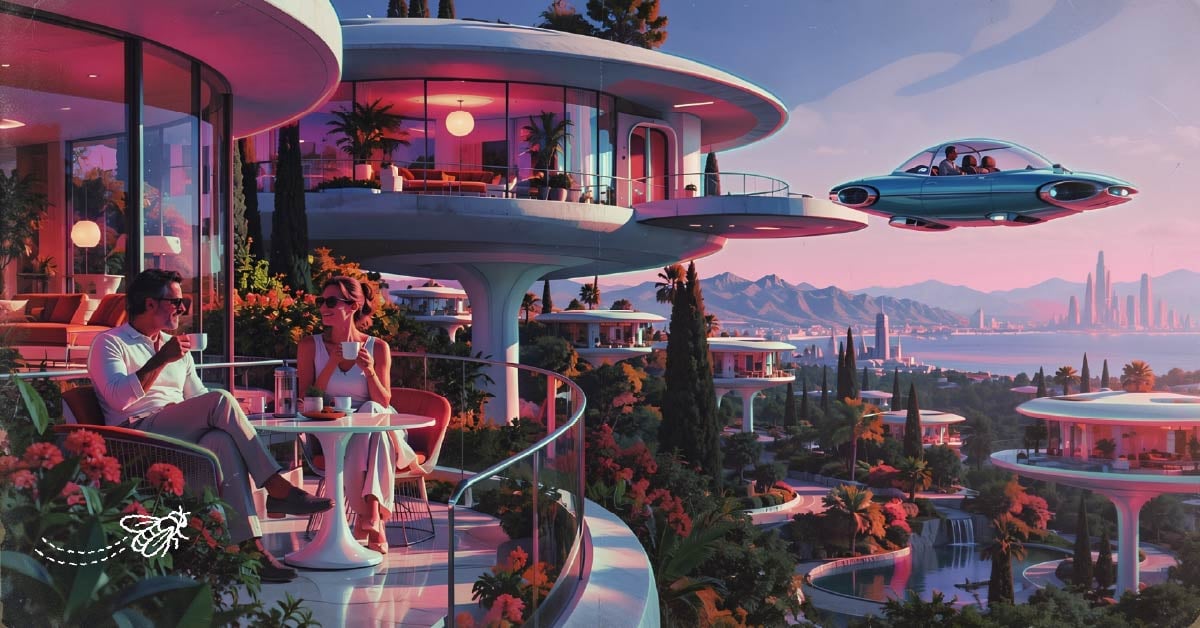
I’d like to know who downgraded our future pads.
Back in the day, somebody was designing homes that looked ready to leave Earth’s atmosphere, and somehow we’ve ended up arguing about whether the cabinets should be white or slightly warmer white.
ModernLivingLA’s TikTok brings together a collection of twentieth-century houses that makes this disappointment considerably worse. Architects were experimenting with metal homes assembled in days, factory production, and buildings that could pass for visiting spacecraft. And you could actually walk inside these things.
As the video puts it:
Some of the most fascinating houses of the 20th century weren’t designed for the people who lived then, they were designed for us. Beginning in the 1930s, some of the era’s most important architects tried to imagine how we would live in the future.
@modernlivingla Many Architects have tried to imagine how we’d live in the future. In the early 20th Century several leading architects experimented with fantastic, exciting and even outrageous ideas. Some predictions were wildly wrong, while others became part of everyday life. The remarkable part isn’t what they got wrong. It’s how much they got right. Much of the future they imagined is now remarkably familiar to us today. #HouseOfTomorrow #MidCenturyModern #ArchitecturalHistory #FuturistArchitecture #ModernLivingLA ♬ original sound – ModernLivingLA
Spend a little time with these houses, and it’s hard to avoid wondering what happened between those wonderfully ambitious experiments and the rather plain, cookie-cutter homes most of us actually got.
Because I think most of us would’ve absolutely attended the flying-saucer open house.
They Even Made Room for Your Airplane
At Chicago’s 1933 World’s Fair, architect George Fred Keck’s House of Tomorrow included a place to park the family airplane. According to the National Park Service, the ground floor accommodated both a garage and an airplane hangar, reflecting the expectation that regular families would eventually own aircraft. They were mighty ambitious back then…
Imagine your neighbor casually showing you around their place and pointing out where their plane would go. Meanwhile, in today’s world, we’re still figuring out how to fit our sectional sofa through the front door.
Above that optimistic parking arrangement were living spaces enclosed by enormous stretches of glass, with a solarium on the upper level. Keck was offering visitors a radically different way of inhabiting a house. One that was surrounded by daylight and views.
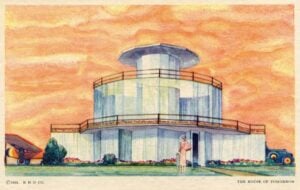
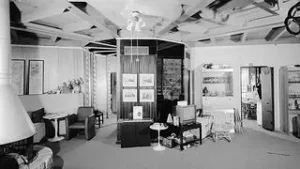
That’s what makes these places so inspiring. You start imagining ordinary life happening inside them, like someone making coffee in that glass room or a child doing homework upstairs, just below a freaking solarium.
Your Next House Might Come From a Factory
Two years earlier, Albert Frey and A. Lawrence Kocher had demonstrated how quickly a beautiful modern home could come together. Their three-story Aluminaire House was assembled in ten days for a New York exhibition in 1931, using donated materials, according to the Palm Springs Preservation Foundation.

Ten days, guys. It takes me about that long to assemble an Ikea dresser.
Then, literally building on top of Frey and Kocher’s design was Buckminster Fuller, who was fascinated by the grand possibilities of industrial production. His Dymaxion House took shape as a lightweight, circular home, with its roof and floor supported from a central mast. The Henry Ford museum’s collection identifies Beech Aircraft as the manufacturer of its 1946 example, so the aircraft connection was quite literal.
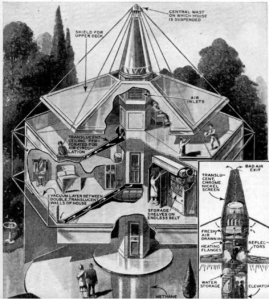
Inside, there were ingenious touches such as revolving closets that brought clothes and shoes around to you. Yeah, while we’re struggling with overloaded, crappy wire closet shelving, a home that’s 80 years old was airlifting your cardigan right to you.
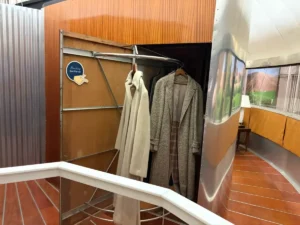
Fuller wanted factory production to make homes inexpensive and widely available. It’s Fuller and others’ ambitions that’s worth remembering as we tour more homes with even stranger shapes. All of these architects were trying to rethink not only the house but also how people could obtain a home in the first place.
I Would Like to Live in the Flying Saucer, Please
By 1957, Disneyland visitors could explore the Monsanto House of the Future, a plastic building with four wings projecting from its center. Disney’s D23 history describes a showcase of furnishings, appliances, and intercoms that were still unusual in homes at the time.
Then there’s the Futuro, which looks as though its occupants should emerge carrying a message for the people of Earth.
Finnish architect Matti Suuronen’s 1968 design has an oval body, little windows, and entrance steps resembling an aircraft stairway. Museum Boijmans Van Beuningen, which holds the prototype, describes a fibreglass-reinforced plastic structure that could be dismantled and transported, with space inside for sleeping, cooking, and bathing.
These so-called “homes of the future” also had their glamorous relatives. Los Angeles’ Post-War House, designed by Walter Wurdeman and Welton Becket, showcased built-in storage, intercoms, and plenty of labor-saving equipment.

So Why Didn’t This Become the Neighbourhood?
This is the point where most of our enthusiasm starts asking follow-up questions.
These were exceptional buildings, the new “home of the future,” and many imagined that we would have entire neighborhoods filled with efficient little flying saucer homes.
So what the heck happened? Why are we all living in little boxes consisting of gypsum, 4x4s, and wires? Where’s my revolving closet, damn it?
Well, unfortunately, this is a classic tale where ambition outran reality, and most importantly, money.
Sometimes these buildings themselves needed more work. For example, Keck’s glass walls helped capture warmth in winter, but can you imagine living in that thing when it’s 95 degrees in the summer?
As a matter of fact, after the house was moved from Chicago to Beverly Shores, its new owner replaced the fixed glass walls with windows that opened.
The house of tomorrow had encountered July.
Other obstacles for these homes were commercial. In a post-WWII era, the Dymaxion faced enormous expenses in preparing a factory for mass production, as well as disagreements between Fuller and his investors. Unfortunately, the project never reached commercial production.
Futuro had its own problems too. Espoo’s museum states the difficulty plainly:
It was too peculiar and too expensive to break into the mass market.
Its manufacturer also lacked the resources and experience for a large launch. Then the 1973 oil crisis pushed plastic prices sharply upward, making the whole project nearly impossible.
You know, admiring a house and dumping your entire life savings into it are two very different things. Heck, a lot of us would love a curved wall while also wondering who sells replacement windows for a Finnish spaceship.
What’s funny, though, is that some of these practical problems are arising with futuristic homes today.
A HUD report on 3D-printed concrete housing shows all the familiar logistical problems, such as warranties, building standards, and fitting conventional components into a new construction system. Like, how and where exactly do you fit standard plumbing into a house that’s built by a massive printer?
We Got Some of Tomorrow. But We Still Want the House.
In the end, we didn’t get completely jipped. Actually, a lot of the innovations from these homes designed decades ago have indeed influenced our homes today.
As the first TikTok video points out, dishwashers and automatic garage doors became familiar, and we can now ask a device to adjust the lights or put on our favorite show without leaving the sofa. So yeah, we got a little bit of the “Jetson” experience going for us.
However, I think we’d all like a bit more imagination and innovation to enter the chat.
THE LANDING
The dishwasher is appreciated, but I’d still like to know who cancelled my space house.
STAY CURIOUS
Three more stories worth your curiosity.







Post Comment