🪰 The Roman Ball of Mystery That’s Still Befuddling Researchers

THE BUZZ
- It looks useful, and that’s part of the problem.
- Nearly three centuries, and we’re still taking suggestions.
- Someone really should have labelled the thing.
We all have that one mysterious object in our kitchen drawer that we’ve kept because it looks “important.” You don’t really know what it attaches to or what it does exactly, and, of course, nobody in the house remembers buying it. But throwing it away feels like a decision you’ll somehow regret, so it just continues to sit in the drawer, eminating mystery.
This is basically the same feeling archeologists and historians have when looking at the Roman dodecahedron. It’s a little metal object from Ancient Rome, and it’s so simple with so many deliberate features that you expect an explanation any minute now. Some people think this little twelve-sided wonder was used for simple mechanical tasks like knitting, and then some believe it was even more advanced, perhaps being used to work with complicated math ratios.
And who knows, maybe it was used to communicate with extraterrestials. At this point, it’s anyone’s guess.
In the TikTok below, Michael McBride introduces this archaeological mystery:
@idea.soup it looks so weirdly modern too #interestingfacts #funfacts #romanhistory #ancienthistory #history ♬ original sound – Michael McBride
The Name Is Doing Diddly Squat
“Roman dodecahedron” sounds like a pretty epic name, one that should surely indicate its purpose. But really, “dodecahedron” just means “twelve-sided. ” Pretty anti-climactic.
The Hunt Museum’s description of its bronze example is something most of us can grasp:
It has 12 sides with 12 circular holes of varying diameters. These holes are set within 12 equal pentagons.
Small rounded knobs project from the corners, while grooves circle the openings, and it’s hollow, so you can look through it. The surviving dodecahedrons also vary in size, which gives researchers even more to chew on.
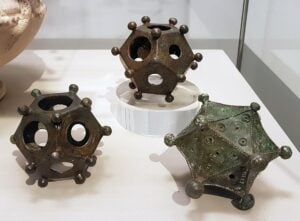
More than a hundred of these things have been found in Europe, with most coming from the former northwestern Roman provinces. But what’s weird is that most of these dodecahedrons aren’t even found in Italy itself. A 2025 archaeological study notes the absence of these in modern Italy, and the study also describes the lack of ancient written or visual evidence explaining their function.
People have been staring at this mystery object for a looong time. The Society of Antiquaries of London’s meeting record for June 28, 1739, documents a twelve-sided bronze object from Aston, Hertfordshire, being presented to the society.
Imagine bringing in an interesting little object like this and then finding out that three centuries later, we’re still trying to discover the damn function.
Someone Brought Yarn
One of the more convincing theories for the dodecahedron is that it was used for glove making. Yeah… definitely not as exciting as using it to see through time and space, but apparently this is how the ancient Roman’s stayed crafty.
In a 2015 account on Manchester Museum’s Ancient Worlds blog, Bryan Sitch describes visiting researcher Regina Degiovanni, who demonstrated this theory. Working with a dodecahedron model, she showed how glove fingers could be made.
@ellieah_art As a knitter, I’m definitely biased towards this theory about the roman dodecahedrons. I don’t know if it is true. All I know is I love it. #greenscreen #archeology #history #mysteries #knitting ♬ Funny and Unusual Scene of 3 Minutes – HarmonicoHCO
Sitch stopped short of declaring the mystery of the dodecahedron solved. Instead, he said it would be necessary to perform a microscopic examination looking for wear consistent with thread passing to conclude 100% that knitting was its purpose.
Thus far, no examination has concluded without a doubt that crafting was its purpose. So the mystery continues…
Perhaps It Was Just Supposed to Be Impressive
The openings on the dodecahedron also make measuring or surveying seem plausible. The Hunt Museum delves into a theory where one could use the opposing holes to spot a distant object and work with ratios. They believe this also might be why the object has differing sizes.
However, a bunch of holes still doesn’t answer exactly how this instrument would’ve been used.
McBride’s favorite possibility takes us in another direction, and in his video, he says:
There was probably something valuable about it because we find it in coin hoards and graves, and it’s very intricately designed, which has led to my personal favorite theory that this is some kind of a test or a marketing device for metalsmiths to show how good they are.
So, according to McBridges’ theory, the dodecahedron could’ve just been ancient Roman metal smiths just flexing. Again, there’s no substantial evidence to support it, but who knows, it’s a possibility.
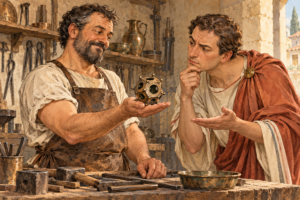
The Norton Disney History and Archaeology Group, which excavated an example of its own, brings another more “godly” explanation into the mix:
A potential link with local religious practice is our current working theory. More investigation is required though.
The group points to the craftsmanship and lack of wear, arguing against an everyday tool like one used to knit gloves. Elaborate construction and careful preservation give the researchers clues, but still, nothing 100% concrete has been proven.
Another One Turns Up
In June 2023, a volunteer on the Norton Disney group’s excavation in Lincolnshire found a complete dodecahedron. The trench had only been opened during the final days of the dig, and after all that waiting, the object apparently chose to pop up the moment when everyone was ready to pack up.
The condition of the dodecahedron was subperb, but even more intriguing is that the researchers could identify interesting clues based on where it had been buried.
Newcastle University’s account of the discovery explains that most of the time, surviving dodecahedrons sit in collections with little information about their original archaeological surroundings. But in the case of this one found on the Lincolnshire excavation, researcher Lorena Hitchens was astonished by the item’s condition and where it was discovered:
… it’s a large, very finely-made example in excellent condition. Importantly, it was found in a modern controlled dig, right where it was buried.
Knowing what lay beside the dodecahedron and how it ended up there gives researchers a lot more to consider than its shape. An excavation like this one can start to explain the relationship between the dodecahedron and the other objects that were buried near it.
Sadly, we’re still not at the dodecahedron answer, but discoveries like these give researchers a better opportunity to ask questions and start to put the puzzle pieces of this little 12-sided guy together. Honestly, any context at this point would be great.
The Missing Conversation
By now, you may have settled on glove theory or decided the metal smith flexing sounds more entertaining.
Or maybe you’re really getting out there with a theory about how the ancient Romans and aliens worked together to make this object and then bury thousands of them all over the place just to confuse modern-day humans.
Honestly, if only someone would’ve either printed a manual or engraved something on it. That would’ve been grand.
But until we can time travel, it seems we’re left just turning the ol’ dodecahedron over and over, hoping the next angle will reveal something earth-shattering.
STAY CURIOUS
Three more stories worth your curiosity.







Post Comment