🪰 Arrr, Matey: How Luxury Cruise Ships Fight Off Pirates
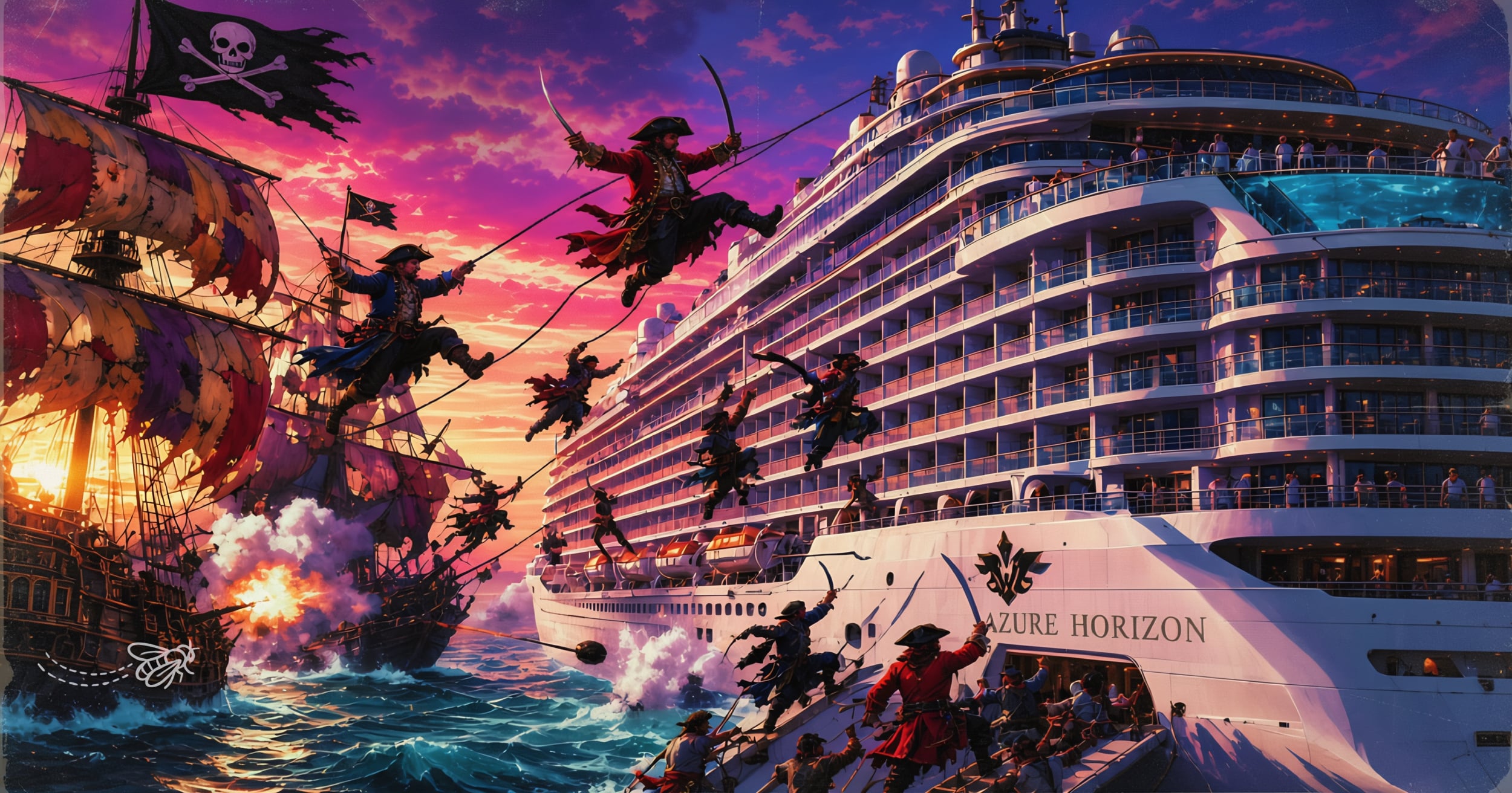
THE BUZZ
- Today’s pirates traded cutlasses for assault rifles
- Luxury liners fight back without firing a shot
- One strange weapon turns sound into a wall
Pirates Got a Serious Upgrade
When most of us hear the word “pirate,” our brains still go straight to the fun version.
Eye patches, treasure maps, bottles of rum, and a sassy parrot. And of course some lunatic yelling “ARRR!” while swinging onto the deck with a sword between his teeth.
Hollywood has done a magnificent job with the branding.
Unfortunately, the pirates still operating around the world today are way less charming… and you really don’t want to run into one on the high seas.
But imagine you do… picture yourself on a luxury cruise ship… you’ve just spent the morning eating enough buffet food to embarrass yourself and your entire family, somebody’s already laid claim to every good chair by the pool, and your biggest problem is deciding whether 11:30 a.m. is too early for yet another frozen drink.
Then you glance out at the water and spot a small boat in the distance.
And man, it’s moving fast.
Except this isn’t Captain Jack Sparrow waving a cutlass. The men aboard are more likely carrying big-ass firearms, and they’re not hunting for buried treasure. They’re after cargo, ransom money, or control of the ship itself.
Suddenly, the question nobody thought to ask when booking the balcony cabin becomes really important:
How the hell does a cruise ship fight pirates?
Because these enormous floating resorts aren’t warships. Families are eating pizza inside, people are getting massages downstairs, and some poor guy on Deck 14 is probably still trying to figure out whether his drink package includes bottled water.
But the scary part is that modern cruise ships are targets, but they can be surprisingly difficult one. And the ways they protect themselves are much stranger than just handing the crew a pile of guns.
We’ll get there…
First, though, we need to sail backward a few hundred years, because pirates have been making life miserable on the high seas for a really long time.
Before the Water Cannons Came Blackbeard
Piracy certainly wasn’t invented in the Caribbean, but the period most people picture when somebody says “pirate” was several centuries ago.
This was the swashbuckling world that gave us the pirate mythology we still love today, complete with infamous captains, stolen cargo, and ships hunting other ships across enormous stretches of ocean.
It’s called the Golden Age of Piracy.
The real history, naturally, was much rougher than the Halloween-costume version, but it’s still pretty cool nonetheless.
In the Western world, the period from the 1680s to the 1720s has come to be known as the ‘golden age’ of piracy.
This was a time of heightened pirate activity, when thousands of ships in the Atlantic and beyond became the prey of roving bands of sea-robbers. Many of the most infamous pirates from history come from this era, including Edward ‘Blackbeard’ Teach, Captain William Kidd, ‘Calico’ Jack Rackham, Henry Morgan and more.
The Caribbean and the east coast of North America were the main areas that saw a surge in activity in the early 1700s. Ships carrying expensive cargoes were often intercepted, and stolen goods were sold in nearby islands and European colonies. Some pirates operated further afield, off the West African coast or in the Indian Ocean, where the island of Madagascar became a key base.
Ships involved in the transatlantic slave trade were also targeted. While there are some stories of pirates freeing enslaved people, this rarely happened. Pirates often treated enslaved people as badly as their captors did and usually sold them for profit once they reached land.
The Romance Ends Pretty Quickly
That last part is where the charming pirate fantasy hits the rocks.
The Golden Age gave history some of its most famous outlaws, but underneath the legends was robbery, violence, and a business built around taking whatever another ship was carrying.
Modern pirates operate in a very different world with much better toys, but the motive hasn’t changed much: find something valuable and take it. The peg legs may be gone, but piracy most definitely isn’t.
Meet the Modern Pirate
Today’s pirate doesn’t need a wooden ship with black sails rolling dramatically over the horizon.
A small, fast boat can do the job just fine.
Modern attackers will likely move teams, race toward a larger vessel, board as quickly as possible, and attempt to take control before the crew has enough time to react.
Their goals are also much more practical than digging up buried treasure.
Here’s what modern piracy actually looks like…
Modern pirates, armed with machetes or firearms, often operate in small teams and quickly board vessels. Once on board, they seize the ship by taking control of the pilothouse and often round up the ship’s crew to maintain control.
These modern-day pirates often work in conjunction with a mother ship. The mother ship is used for refueling and has a major role in the logistics of modern piracy.
Once in control, the pirates often demand ransoms for the release of the ship or crew, steal the ship’s cargo, or repurpose the vessel. They commonly target commercial ships that carry fuel or oil.
Where Does Modern Piracy Occur?
Some of the common areas where modern piracy occurs include:
- The Horn of Africa
- The Gulf of Aden
- The Arabian Sea
- The Gulf of Guinea and other areas near West Africa
- The Straits of Malacca, the Singapore Strait, and other areas near southeast Asia
- Waters off the Indonesian coast
Why Is Modern Piracy So Dangerous for Seafarers?
Modern piracy threatens maritime security by placing seafarers in dangerous situations. The occupants of a ship or boat are confronted by armed robbers and risk losing their lives, becoming injured, or being held for ransom. If a ship is damaged or sunk, its owners suffer financial losses.
Commercial cargo ships are also targets for violent, armed pirates. These pirates typically hold ships, their cargo or their crews for ransom.
Same Business, Much Worse Toys
The contemporary pirate is looking for leverage, whether that means a valuable cargo, a vessel that can be repurposed, or human beings who can be held for ransom… so you can see why a floating hotel would be enticing.
But cruise ships present a strange problem for that business model.
They’re enormous and really visible.
Thousands of people are aboard, and a vessel the size of a floating apartment complex is way harder to sneak away with than some smaller commercial ship carrying a tiny crew.
But that doesn’t mean pirates won’t try, and cruise lines know this.
That’s why behind all the waterslides, restaurants, and fancy pools is a security plan built around one simple goal: make approaching, boarding, and controlling the ship an absolute freaking nightmare for any pirate dumb enough to try.
Which brings us to the floating behemoth in our video.
Good Luck Boarding the Floating Skyscraper
The Icon of the Seas is roughly 1,200 feet long, rises through 20 decks, and can carry thousands of passengers.
From a pirate’s perspective, that presents one mighty big logistical issue.
Where exactly will they climb aboard?
One of the first defenses available to a giant cruise ship is comically simple: it’s gigantic.
Pirates trying to board from a small skiff usually need some way to climb from a boat sitting almost at sea level onto the ship above them. The Icon looks more like a steel cliff.
And then the steel cliff starts moving.
A ship that enormous can still travel at roughly 22 knots, or about 25 MPH. It can also turn aggressively and throw an enormous wake behind it. Suddenly, the pirate boat trying to pull alongside isn’t approaching a stationary hotel. It’s chasing a moving wall of steel while the ocean underneath it is being churned into absolute chaos.
And that’s before the really weird stuff comes out…
There are ways to ruin an attacker’s vision, blast their boat with seawater, tangle a propeller, make the hull nearly impossible to climb, and hit somebody with a beam of sound so intense that sticking your fingers in your ears isn’t going to save you.
Yes, folks…
A sound cannon.
At this point, you really should see this thing explained, because the defenses get increasingly wild as the video goes along.
Apparently, the Buffet Ship Has Teeth
I didn’t expect water hoses to rank this highly in the pirate-defense department.
Yet they make a surprising amount of sense.
High-pressure water cannons can blast across the side of a ship without forcing crew members to stand exposed on deck. Some systems can target an approaching boat directly, while other setups create a nasty curtain of water along the hull.
One really creative version described in the video involved weighted hoses thrashing near the waterline, turning something like a fire hose into a wildly unpredictable obstacle for any pirate trying to climb aboard.
Super low-tech, but very effective.
Please reconsider your career choices, matey.
Other defenses are designed to make getting anywhere near the hull such a pain in the ass that boarding looks like the worst idea ever. Razor wire and smooth anti-boarding barriers interfere with pirate ladders and grappling hooks. Meanwhile, trailing lines can snag a small attack boat’s propeller and stop it dead in the water.
The Best Pirate Fight Is the One Nobody Has
Of course, cruise lines would much rather avoid all of this.
The quieter defenses begin long before anybody is aiming a water cannon over the railing.
Radar and tracking systems help crews watch for small boats behaving badly. Dangerous areas can bring extra lookouts and tighter security procedures, while routes can be changed when the risk is too high.
That might be the least exciting answer in the entire story, but it’s probably the smartest one.
Nobody has to fight off pirates if the ship never sails near them in the first place.
But when avoidance fails, speed becomes another major advantage. A giant cruise liner may look like some lumbering giant from the shore, but like we mentioned earlier, once that sucker’s moving hard through open water, a little attack boat has to match its pace while dealing with turns, spray, and an enormous wake.
The ocean steps in and does some of the security work.
Not bad for a ship with a mini-golf course upstairs.
No, the Bartender Doesn’t Get a Rifle
This brings us to the obvious question.
If pirates may have guns, why not arm the cruise ship crew?
The video made a pretty convincing case for why that gets messy real fast.
Cruise ships move constantly between different countries and jurisdictions, where firearm laws can change dramatically from one port to another. A weapon that’s permitted in one place might create a serious legal problem somewhere else.
Then there’s the even more obvious issue: the people running a cruise ship were hired to run a cruise ship, not shoot guns on the frontlines.
The engineer needs to keep the machinery working, while the waiter needs to handle the dining room. Nobody booked a Mediterranean itinerary because they were hoping Chad from Guest Services would eventually have to win a firefight.
However, when a route really does require armed protection, the video explained that trained private security can be brought aboard for that job.
If attackers somehow make it aboard, the crew’s priority is all about getting passengers to safety while keeping the bridge and engine controls secure, because boarding a ship and actually taking control of it are two very different things.
Now for the Really Weird Weapon
Then we get to my favorite piece of pirate-repelling technology in the whole video.
The LRAD.
A Long-Range Acoustic Device can direct intensely powerful sound toward an approaching threat. It can be used to hail or warn a boat, but at close range the sound can become painfully intense.
Even earplugs don’t solve the problem because sound can reach the inner ear through bone conduction.
Which means somewhere in modern maritime history, somebody apparently sat down and said, “You know what this ship needs? A noise so horrible you can feel it through your skull.”
And somebody else approved the budget for it.
Funny as that sounds, the real-world example at the end of the video is nothing to chuckle at.
When All of This Became Very Real
In 2005, the Seabourn Spirit was sailing off Somalia with 151 passengers when two pirate speedboats came racing toward it and opened fire with machine guns and rocket-propelled grenades.
Passengers were moved into the ship’s interior while the captain pushed the vessel hard, using speed, aggressive turns, and the ship’s own wake to make it difficult for the attackers to close the gap. At the same time, crew members deployed the LRAD, turning one of those strange-sounding defensive tools into something very real, very fast.
The attack was so serious that a member of the ship’s security team was badly wounded by gunfire, and for roughly half an hour the crew worked to keep the pirates from getting close enough to board.
Eventually, they gave up.

That’s the moment all those odd layers of defense start making perfect sense. A cruise ship doesn’t need to become a battleship if its size, speed, maneuvering, barriers, and non-lethal defenses can make boarding it such a nightmare that the attackers never get the chance.
Turns Out the Pirates Picked the Wrong Boat
We’ve come a long way from Blackbeard.
Modern piracy has different weapons, different targets, and a very different look, but the danger at the heart of it hasn’t become quaint with age.
Cruise ships have adapted accordingly.
The clever part is how many of their defenses rely on making the attacker’s job progressively more miserable rather than trying to outgun him.
Stay far away from the threat whenever possible. Spot trouble early. Keep moving. Make the hull difficult to reach. Blast the approach with light, water, or sound, and protect the parts of the ship that actually matter if somebody somehow gets aboard.
All while thousands of passengers are downstairs completely unaware that their floating vacation resort has been designed with pirates in mind.
So enjoy the buffet, and order another daiquiri… and give that giant water cannon a respectful nod on your way back to the pool.
THE LANDING
Turns out the best way to fight pirates may be making your ship one gigantic pain in the arrrse to board.

 Duolingo: How A Toxic Little Owl Destroyed Language Learning




Post Comment