🪰 Ancient Romans Had No Clue What They Actually Looked Like
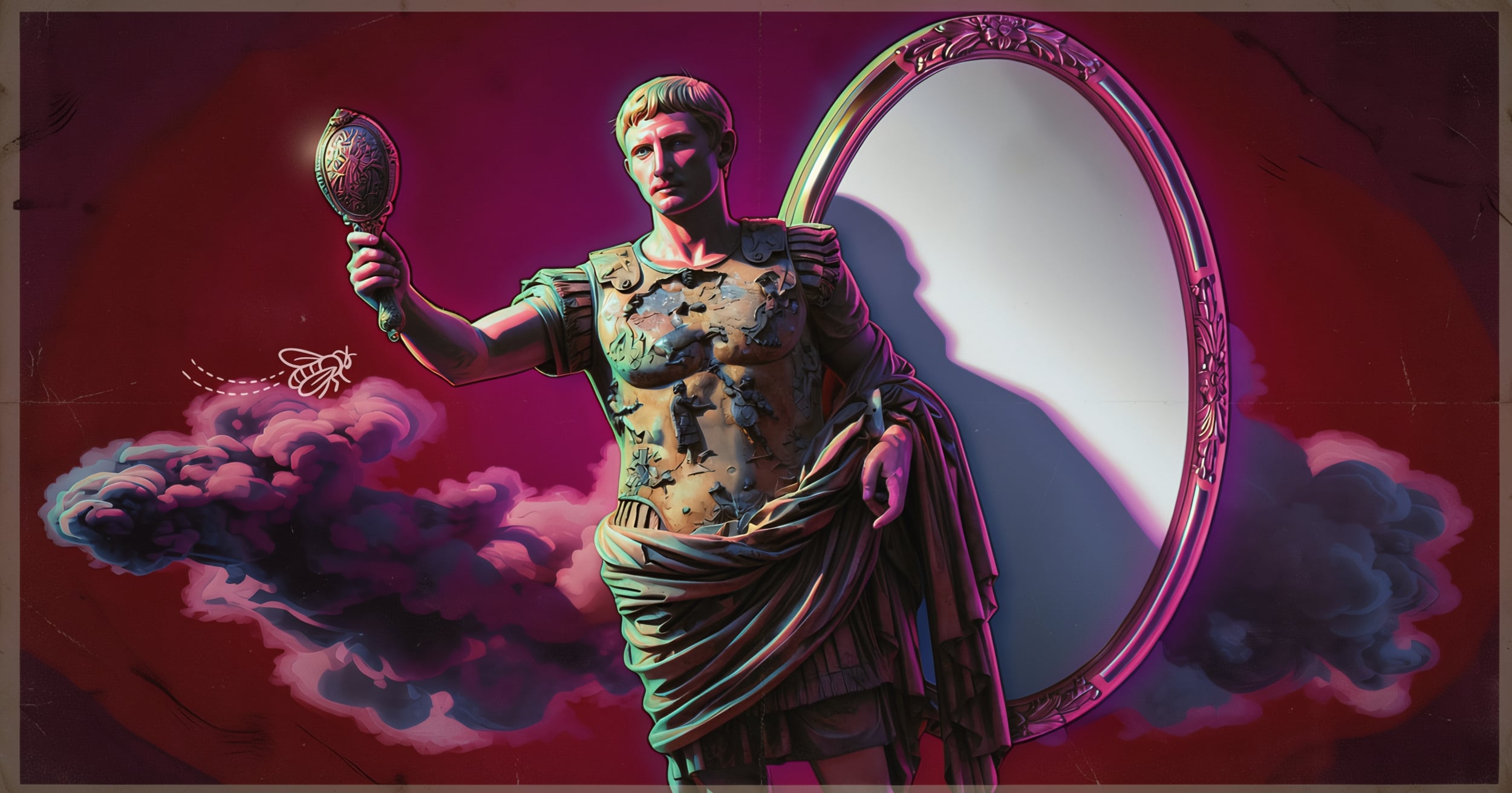
THE BUZZ
- Imagine spending your entire life not knowing your face
- Roman emperors had sculptors. And probably excellent publicists
- One handsome Greek fell in love with his reflection. Fatally.
I was scrolling through TikTok the other day when I came across a clip of famous historian Mary Beard casually mentioning something about ancient Romans that stopped me dead in my scroll.
Most Romans had no idea what they actually looked like.
Wait. WHAT?
Think about that for a minute. Imagine spending your entire life without ever getting a good look at your own face. You’d know what your mother looked like, recognize your friends in a crowd, and probably have a pretty strong opinion about whether your neighbor was attractive. But the face staring back at everybody else when they looked at you? That would remain a mystery.
I find this absolutely fascinating, especially considering how much time we spend staring at ourselves today.
We check our reflections while brushing our teeth, getting dressed, applying makeup, or making sure we don’t have spinach stuck between our teeth. Hell, we even sneak a peek at ourselves in store windows.
Our faces are so familiar that we can picture them with our eyes closed.
Now imagine growing up in ancient Rome, surrounded by people who knew exactly what you looked like, while you had basically no idea yourself.
What a strange way to go through life, right?
And the more I thought about it, the more questions I had:
How would you know whether you were handsome or ugly?
Would you worry about your appearance as much as we do today?
What would happen if you finally caught a clear glimpse of your face and discovered you looked completely different from the person you’d imagined?
As it turns out, the answers involve some pretty lousy mirrors, Roman vanity, political propaganda, and one spectacularly handsome Greek who took self-obsession to an extreme.
THE ROMANS HAD MIRRORS. SORT OF.
Here’s the funny thing. The Romans actually did have mirrors, although calling them “mirrors” by today’s standards is being super generous.
Forget the beautiful, crystal-clear glass hanging above your bathroom sink… because Ancient Roman mirrors were often made from polished metals, including bronze, copper, and silver. Craftsmen would work the metal until its surface became reflective enough to produce an image.
And while a well-polished metal mirror could sorta show someone’s face, the experience was a far cry from looking into a modern bathroom mirror.
Depending on the quality of the metal, how carefully it had been polished, and the available light, your reflection could appear dim, distorted, or lacking in detail. Ironically, you’d probably look a helluva lot worse than you actually did in real life.
It’d be like trying to check out yourself using the back of a spoon… and that’d be the best mirror you’ve ever gotten your hands on.
But those “mirrors” were expensive, so only elites could sorta, maybe, see what they kinda looked like.
Wealthier citizens also had other options, including servants who helped them dress, groom, and shave. Ancient Roman artwork even depicts servants holding mirrors for their employers.
But for regular people, getting a good look at yourself could be way more difficult.
But one place where you could possibly catch a glimpse might be water. A still pool could produce a pretty clear reflection, especially under the right conditions. But unless you happened to be standing over perfectly calm water with the right lighting, checking your appearance wasn’t exactly convenient.
These days we have a mental picture of ourselves that’s been reinforced by thousands upon thousands of reflections and photographs. We know our best angles, the expressions we make when we’re annoyed, and precisely how terrible we look after a sleepless night.
An ancient Roman might have been far more dependent on what other people told them about who they were and how they looked.
Imagine your mother insisting you were handsome while your friends politely avoided the subject. Yikes. Who would you believe?
And how strange would it be to know your face was familiar to absolutely everyone except you?
HISTORIAN MARY BEARD MAKES A FASCINATING POINT
This whole rabbit hole started with the brilliant historian Mary Beard, who explains the problem with ancient Roman mirrors far better than I can.
She also points out something interesting about the relationship between appearance, wealth, and slavery in Roman society.
Because when you couldn’t easily inspect your own face, having someone else available to groom you became especially useful.
@theresthistory Romans had no idea what they looked like 😱 #history #therestishistory #ancientrome #romanempire
♬ original sound – The Rest Is History – The Rest Is History
What I love about Beard’s observation is how easily it gets you thinking about the ordinary details of ancient life that history books never bother mentioning.
We spend so much time learning about Roman emperors, wars, politics, and spectacular architecture that it’s easy to forget these people had to get dressed every morning, deal with bad haircuts, and figure out whether they had some ancient herb stuck in their teeth.
And imagine how different personal appearance might feel when you don’t have constant access to your own reflection.
Of course these people still cared deeply about being attractive, well-groomed, or fashionable. The Romans weren’t strangers to vanity. But much of your understanding of your appearance would come from other people and whatever warped, weird, imperfect reflections you managed to see.
Which brings me to another question.
What if somebody made a sculpture of you? Wouldn’t that finally solve the mystery of what you actually looked like?
Well, maybe. But Roman sculptors had a few tricks up their toga sleeves.
ROMAN SCULPTORS: THE ORIGINAL BEAUTY FILTER
If you’ve ever wandered through a museum filled with ancient Roman statues, you’ve probably noticed how downright badass some of these people look.
Strong features, commanding expressions, heroic poses, and enough sculpted confidence to make these guys and gals Insta famous. But how much of what we’re looking at is actually accurate?
That’s where things get murky.
Roman portrait sculptors were very talented. Some created remarkably lifelike faces, complete with wrinkles, prominent noses, sagging cheeks, and other wonderfully human imperfections. In fact, certain Roman portraits are so detailed that you can almost imagine the person stepping down from the pedestal and complaining about their favorite gladiator.
But sculptors were also working for powerful people who had very specific ideas about how they wanted to be thought of and remembered.
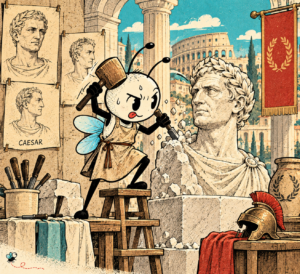
And when your customer happens to be the emperor of Rome, telling him that his double chin deserves a little extra marble probably isn’t the smartest career move you can make.
Roman portraiture was about so much more than just accurately recording somebody’s appearance.
It was also a powerful form of public messaging and propaganda.
An emperor could commission images that emphasized youth, strength, intelligence, military authority, or even a connection to the gods. Just look at Augustus Caesar. This guy looked “forever young.”
He was always portrayed with this idealized, youthful appearance that reinforced his authority. Other rulers preferred portraits that suggested wisdom, maturity, or practical leadership. And then there was Commodus, who had himself depicted as Hercules, complete with the legendary hero’s lion skin.
This guy wanted to be remembered as a mythological superhero. But honestly, there’s something wonderfully human about all this. Thousands of years before Insta filters and Photoshop, powerful people were already carefully managing their public image.
And if you were some ordinary Roman who saw one of these magnificent statues, how would you know whether the emperor really looked like that?
You probably wouldn’t.
Because for many subjects scattered across the empire, a statue or coin might’ve been their only visual of the man running their world.
So, most Roman citizens had their entire opinion of their leaders’ appearance created and shaped by a sculptor who was being paid to make him look impressive.
In evaluating the realism of Roman portraiture, it is essential to acknowledge the cultural and political context in which these works were created. Emperors used their images to communicate specific messages to their subjects, whether it was Augustus’ divine authority, Vespasian’s pragmatism, or Commodus’ hubris. While written descriptions provide valuable clues about the physical appearance of historical figures, they are often filtered through the biases of their authors, just as sculptural depictions are shaped by the agendas of their patrons.
Roman statues occupy a space between realism and idealisation. While sculptors demonstrated exceptional skill in rendering lifelike details, these portraits were rarely ever unvarnished depictions of their subjects. Instead, they were carefully curated images designed to convey messages of power, virtue, or divine favour. Comparisons with written accounts reveal that Roman portraiture was as much about shaping perceptions as it was about reflecting reality, illustrating the sophisticated interplay between art, politics, and identity in ancient Rome.
I can’t help but wonder what happened when some “regular Joe” finally saw the real emperor and discovered he looked nothing like the handsome fella on their coins.
Imagine that disappointment… it’s like seeing a TikTok beauty influencer without the 17 filters on her face.
But long before Roman emperors were worrying about their public image, the ancient Greeks had already come up with a wonderfully bizarre story about a young man who became so obsessed with his own face that it literally killed him.
And believe me, this guy makes today’s selfie addicts look downright humble.
But way before Roman emperors were immortalizing themselves in marble, humanity had already developed a fascination with its own reflection.
And one ancient Greek myth suggests that discovering your face could be a dangerous business.
THE HANDSOMEST MAN IN GREECE HAD A VERY UNFORTUNATE HOBBY
Meet Narcissus.
If that name sounds familiar, there’s a good reason. He’s the mythological character whose name eventually gave us the word narcissism.
And believe me, this guy earned every bit of it.
According to Greek mythology, Narcissus was so ridiculously handsome that everybody fell in love with him. Unfortunately, he was also a bit of a jerk who rejected anyone who showed him affection, including a poor nymph named Echo.
Eventually, the goddess Nemesis decided he’d earned a little payback.
One day, Narcissus stopped at a pool of water and spotted the most beautiful face he’d ever seen. His own. Except the idiot didn’t realize it was his reflection and fell madly in love with himself.

He became so obsessed with the handsome stranger in the water that he refused to leave, eventually wasting away and dying beside the pool.
Imagine being so good-looking that you literally die trying to date yourself.
Good grief.
For people who didn’t have modern mirrors, the idea of encountering an astonishingly lifelike image in a pool of water must have carried a special kind of magic.
And the Narcissus legend takes that fascination to its most ridiculous possible conclusion.
THE BOY WHO FELL IN LOVE WITH HIMSELF
This short retelling of the Narcissus myth gives us the whole wonderfully tragic story, including Echo, a revenge-seeking goddess, and the world’s most disastrous encounter with a reflection.
SOMEONE SHOULD’VE HANDED THIS GUY A MIRROR
Poor Narcissus.
Although, considering how badly he treated everybody who loved him, I suspect the ancient Greeks weren’t particularly devastated by his fate.
What’s interesting is that the myth taps into something people have wondered about for thousands of years: our relationship with our own image.
Human beings have been fascinated by reflections since long before anyone figured out how to manufacture a decent mirror.
And while Narcissus was busy ruining his life next to a pond, actual civilizations were developing new, very clever ways to see themselves.
And some became so valuable that European governments were willing to go to absurd lengths to get their hands on them.
And that’s why the history of mirrors turns out to be a whole lot stranger than you’d think.
FROM PONDS TO POLISHED ROCKS: OUR LONG OBSESSION WITH OUR OWN FACES
Let’s travel back thousands of years, long before Rome became an empire.
Some of the earliest manufactured mirrors were made from obsidian, a naturally occurring volcanic glass that can develop a dark, reflective surface when carefully polished.
Archaeologists have discovered obsidian mirrors at Çatalhöyük, an ancient settlement in what is now Turkey, dating back about 7,500 years.
That’s how long people have been experimenting with ways to see their faces thousands of years before the Roman Empire even existed.
Those early mirrors were very small, sometimes just a few inches across, but they were truly a remarkable achievement for the time.
Instead of waiting for a perfectly still pond, someone could hold a reflective object and kinda inspect their appearance.
Over time, civilizations began experimenting with metal mirrors.
The Egyptians, Greeks, Romans, Chinese, and some other cultures developed versions made from copper, bronze, and silver.
And mirrors weren’t always ordinary grooming accessories. Some cultures thought reflective surfaces were spiritual or religious. They believed they could reveal things beyond the physical world with reflections.
Imagine being an ancient person staring into a polished black stone and watching another version of yourself move every time you do.
It’s not crazy that these people assumed the thing was haunted.
By the time the Romans came along, metal mirrors were a thing, but getting a truly clear, reliable reflection wasn’t happening.
Glass technology was improving, but the kind of large, flat, reflective glass we’re used to was still centuries away.
And the next major breakthrough would eventually turn mirrors into some of Europe’s most highly desirable goods.
VENICE TURNED MIRRORS INTO A LUXURY OBSESSION
Now we’re getting into one of my favorite parts of this story… during the Renaissance, the amazing glassmakers of Venice, particularly those working on the island of Murano, developed a reputation for producing this exceptionally fine glass.
Their craftsmanship became famous throughout Europe… and still is to this day.
And they were making mirrors from this beautiful Venetian glass, and they were absurdly expensive.
We’re talking serious money.
A Venetian mirror in the 1500s could be worth more than twice the price of a painting by Raphael.
Imagine standing in front of a gorgeous Renaissance painting and deciding you’d rather spend twice as much money on something that lets you admire your own face. Man, human vanity really is timeless.
But the Venetians were fiercely protective of their glassmaking techniques. Skilled craftsmen weren’t allowed to reveal their secrets, and leaving the Republic without permission could bring severe consequences.
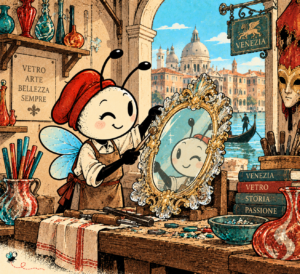
There were threats against glassmakers’ families and allegations of assassinations connected to the fiercely competitive “mirror” industry. Meanwhile, France desperately wanted its own mirror industry, and during the reign of Louis XIV, officials worked to lure Venetian craftsmen away.
There were secret negotiations, financial incentives, political maneuvering, and plenty of accusations flying around.
All because wealthy Europeans wanted better mirrors.
It’s amazing what people will do for a really flattering reflection of themselves.
FRANCE FINALLY FIGURED OUT HOW TO GO BIG
Eventually, French glassmakers developed techniques that made it possible to produce much larger sheets of glass.
And that’s when mirrors really began transforming European interiors.
The magnificent Hall of Mirrors at Versailles became one of the craziest examples of this new luxury and obsession with mirrors.
Now, reflections were an architectural bonanza. Instead of holding a small polished inch of glass in your hand, you could walk into a room surrounded by enormous reflective surfaces.
Imagine how astonishing that would have seemed to somebody whose grandparents had grown up using a tiny, weird little metal mirror.
But the real transformation happened as glassmaking continued to improve, and over time, mirrors became more affordable.
By the early nineteenth century, mirrors were a common thing in Parisian homes, but not so much in rural areas.
Then, in 1835, German chemist Justus von Liebig developed a chemical method for coating glass with reflective silver.
That innovation laid the foundation for modern mirror manufacturing and turned what was this luxury object into something practically everybody could own.
Today, we take mirrors so completely for granted that most of us probably couldn’t tell you how many we have in our house.
But it took thousands of years of experimentation, craftsmanship, scientific discovery, and technological advances to get us here.
THE SURPRISING HISTORY OF MIRRORS
If you’ve enjoyed this little journey through ancient reflections, I found another fascinating video that traces the development of mirrors from prehistoric obsidian all the way to the modern glass we use today.
It also digs into the incredible story of Venetian glassmakers, the European obsession with luxury mirrors, and the surprising lengths governments went to protect or steal valuable manufacturing secrets.
The history is much richer than I ever expected, and it’s worth watching for the Venetian intrigue alone.
THE MIRROR CHANGED MORE THAN OUR BATHROOMS
One of the most interesting ideas raised in the video is that the spread of mirrors may have changed the way people understood themselves.
Think about the difference between having only occasional access to your reflection and growing up surrounded by mirrors.
Today, we know exactly how we look when we’re happy, angry, surprised, exhausted, or trying to pretend we understand something somebody just explained.
We’re familiar with the tiny imperfections in our faces (maybe too much), the way our expressions change, and how other people see us.
Some historians believe the availability of mirrors helped encourage a stronger sense of individual identity.
It’s an intriguing theory, but human beings had clear identities, self-awareness, and vanity way before modern mirrors existed.
Still, when you can examine your own face whenever you want, you get a perspective on yourself that earlier generations didn’t have.
Now, a farmer, merchant, servant, or ordinary working person could eventually enjoy the same basic privilege that had once belonged to people who could afford polished silver and professional craftsmen.
Everybody got to see their mug in the mirror.
Which sounds like such a small thing until you imagine living without it.
IMAGINE MEETING YOUR OWN FACE FOR THE FIRST TIME
I keep coming back to Mary Beard’s observation because it’s such a wonderfully simple way to make the ancient world feel strange again.
We’re so used to thinking about Romans as people who lived in magnificent cities, built spectacular monuments, wore elaborate clothing, and developed remarkably sophisticated engineering.
But something as ordinary as looking into a mirror was foreign.
And that gets me wondering about all the little things we take for granted.
Would you feel differently about aging if you hardly never saw the changes happening to your face?
Would you worry as much about a crooked nose or a few wrinkles if you couldn’t inspect them every morning?
And imagine hearing people compliment your beautiful eyes without having any real idea of what your eyes actually looked like.
Your face would belong to you, of course, but your understanding of it would depend much more heavily on other people.
Meanwhile, wealthy Romans were commissioning portraits, emperors were carefully managing their public images, and sculptors were turning human faces into political statements. And somewhere along the way, humanity became so fascinated with its own reflection that we spent thousands of years figuring out how to make it clear, large, and more accessible.
And judging by the modern obsession with selfies, we haven’t lost interest.
THE LANDING
For most of history, the face you knew least was your own.
STAY CURIOUS
Three more stories worth your curiosity.

 The Roman Ball of Mystery That’s Still Befuddling Researchers





1 comment