🪰 Your Brain Purposely Erased Your Childhood
THE BUZZ
- Your first birthday went brilliantly. Apparently.
- You may remember the photo, not the party.
- A developing brain has questionable archival standards.
We’ve all been there…
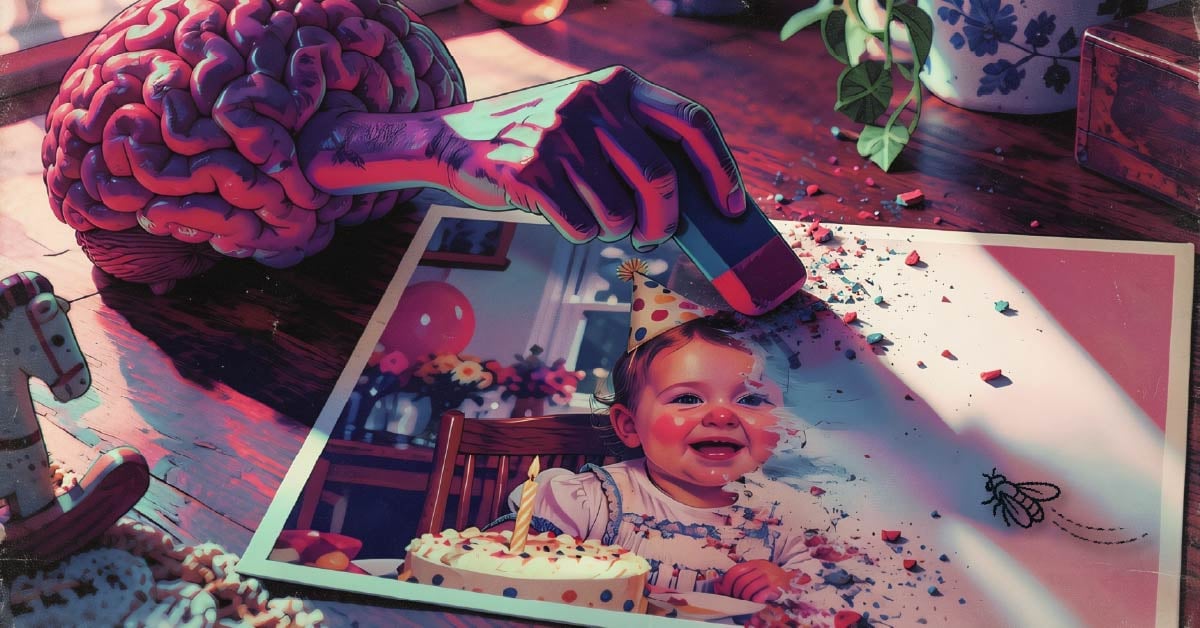
You’re at a family gathering, the dusty old photo albums are out, and suddenly you’re being handed a photograph of yourself at your first birthday. There you are, wearing something super out-of-date, possibly with an unnecessarily large collar, apparently delighted to be slathering buttercream frosting all over your face.
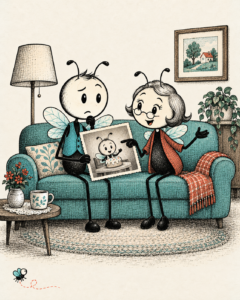
As you stare at your infantile self, your mom pipes up beside you, saying how she remembers buying you that outfit. Then your grandpa starts going off on some long-winded tale of why that party nearly didn’t happen, and your aunt knows exactly what you did five minutes after the picture was taken.
And you, the person whose birthday it actually was, sit there with nothing to contribute.
It’s kind of weird when you think about it: other people remember spending entire afternoons with a version of you that you can’t remember being. They knew what made you laugh and what would throw you into a childhood tangent. They remember you stripping naked and running through the neighborhood, eating dirt, falling on your little tricycle, and your first swear word. But you? You remember nothing.
Where Did the Beginning Go?
There’s actually a name for this gap: infantile amnesia or childhood amnesia. It’s the technical term used for the scarcity of memories from our earliest years, rather than the loss of an entire childhood. But what’s really odd is that those years, the ones we can’t remember, were full of learning. We literally picked up an enormous amount of intel on how to be a functional human while retaining very little we can later revisit as a personal memory.
The Infographics Show explores that puzzle through a provocative idea: some of the changes that help a young brain develop may also make earlier memories harder to retain or retrieve. Their video follows the mystery from brain growth into language and our developing sense of ourselves.
A Brain Still Under Construction
This all comes back to how much we expect that little baby brain of ours to do. You know, a baby has a pretty big job. They have to work out how to move through a room while learning which sounds belong to which people, what can be eaten, and why the adults keep removing an obviously excellent object from its mouth. \
Inside that busy little head, the connections supporting learning and memory are changing rapidly. The hippocampus, a brain region involved in forming memories of events, is part of that developing system. One explanation explored in the video concerns neurogenesis: the creation of new neurons, which join and alter existing circuits.
What’s really fascinating is that this remodeling can make earlier memories harder to access or maintain. Imagine trying to retrace a route through a neighborhood while the streets themselves are being rapidly rearranged. It’s literally like taking two steps forward but then literally disregarding how you got there in the first place.
The brain also adjusts its connections through synaptic pruning, a process where it strengthens some pathways while removing others. Like picture a tiny groundskeeper snipping your second birthday out of your brain’s existence, but that little section it snips isn’t exactly the entire memory, more like the glue holding it together.
Before You Could Tell the Story
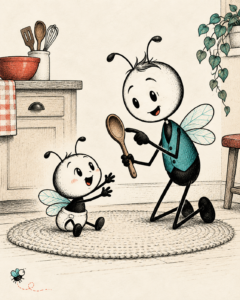
Try explaining a childhood holiday without using words. You might be able to picture the room or hear someone’s voice, but sooner or later, it’s language that helps you form the experience. With words, you can identify who was there and explain why that moment mattered, and then the memory becomes something you can actually tell another person about.
But, of course, a baby hasn’t acquired that whole toolkit. The experience of being carried into a room can arrive through familiar voices, movement, warmth, and light, well before the child can give anyone a useful account of the visit. Having the experience and being able to narrate it are two completely different accomplishments.
One experiment described in the video makes that distinction particularly interesting. Researchers examined whether children could later use newly acquired words to describe aspects of an earlier event. By the time they were tested, the children had learned much of the vocabulary they would need, but yet their spoken accounts didn’t include details they hadn’t had the words for when the event itself happened.
The Small Person in the Mirror
Alongside language comes another developing ability: recognizing yourself as the person having the experience.
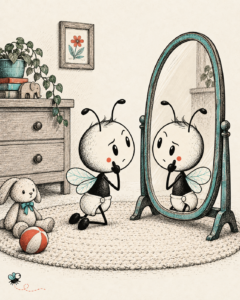
The video describes the mirror test, which is when a small mark is placed on a child’s face where they can’t directly see it. If the child notices the mark in the reflection and reaches toward their own face, that suggests they recognize the reflection as themselves. Before that kind of skill of recognition appears, the other child in the glass will be seen more as another play friend rather than a reflection.
A mirror test gives us one window into self-recognition. It doesn’t mark the instant a person comes into existence. Still, it adds something to the puzzle of looking back: the familiar adult habit of identifying an experience as something that happened to me has its own developmental history.
What Those Years Left Behind
Despite all of the memory gaps, there are still some pretty darn big accomplishments in our earliest years. Walking is probably the biggest one. Most of us can’t remember the struggle bus we were all on trying to put one foot in front of the other, but we can still get up and cross a room without begging our parents for help or having to recall the original technique. It’s all completely automatic.
That’s where it’s important to point out the distinction between remembering and retaining something learned. Procedural memory supports learned skills, like walking, and it belongs to the broader territory of implicit memory: ways the past can show up in what we do without arriving as a consciously recalled scene.
The video also dives into early emotional associations and bonds, where an experience can contribute to what becomes familiar or comforting even when we can’t later describe a particular afternoon. That all leaves room for lasting influence, ones that shape who we are. All without requiring us to remember the thing that made us develop an adult preference, like ketchup on eggs. Why do we like such an abominable combination? Don’t remember, don’t care.
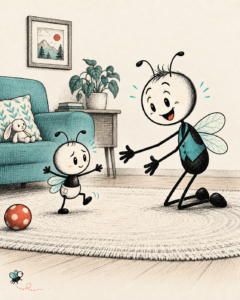
Back to the Photograph
Look at that birthday picture again, and there’s a little bit more to ponder. The child in it was having an actual afternoon, with a room to explore and people to recognize. Whatever mattered most in that moment might have been just outside the frame of you sitting there with cake smeared all over your onsie.
It’s a little melancholic, as you’ll never be able to revisit that memory truly. But thankfully, your parents kept the picture, and they’re usually able to fill in the blanks.
Then you can question their choice of outfit afterward.
THE LANDING
The family album proves you showed up. The rest, apparently, requires a convo with mom.
STAY CURIOUS
Three more stories worth your curiosity.

 Arrr, Matey: How Luxury Cruise Ships Fight Off Pirates


Post Comment