🪰 How Your Tattoo Can Literally Outlive You
THE BUZZ
-
You may eventually reconsider that tattoo.
-
Your ink can outlast the cells holding it.
-
Five thousand years is quite the commitment.
You know, there’s usually a lot of thought that goes into a tattoo, after all the suckers are on your body for life.
Oftentimes, before you get a tattoo, many of us ask ourselves whether we’ll still like it when we’re eighty. It’s a sensible question, but science and archaeology suggest that maybe we should be thinking a little further ahead.
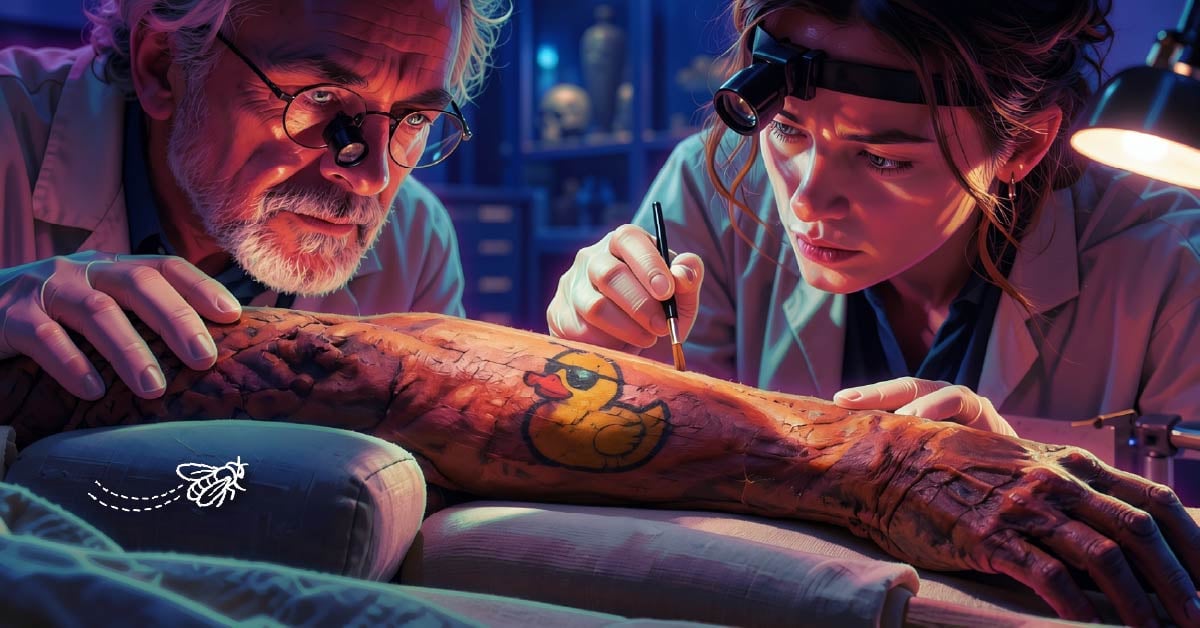
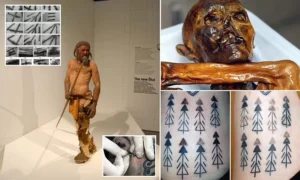
Case in point: Our old buddy Ötzi the Iceman, who died more than 5,300 years ago. Researchers have identified 61 tattoos on his preserved body, which is a considerably longer commitment than most people discuss at the tattoo appointment. His tats have outlasted entire civilizations.
This all raises one simple question: how does such little pigment last so long in something as busy as human skin?
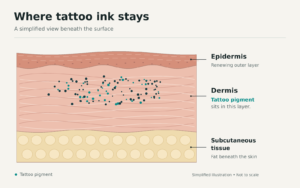
An X video gives us a quick and rather disturbing look beneath the surface. A tattoo machine repeatedly punctures the skin, placing ink into the deeper layer called the dermis. The skin heals over it, while much of the pigment remains underneath.
What Really Happens to Your Skin During a Tattoo? 🧐 pic.twitter.com/Bt0fiySAdC
— ØFF FÃCÊ🥷🏹 (@MaskOnBro) July 17, 2026
The Institute of Human Anatomy takes that small example even further in its YouTube video, What Tattoos Do to the Skin. Turns out there’s a surprisingly elaborate relationship between the ink, the tissue around it, and the immune cells that encounter it.
The Ink Has to Get Past the Exit
Now we’re gonna dive into some basic human anatomy…
The outermost layer of your skin, the epidermis, is constantly renewing itself. New cells form toward the bottom, move outward, and eventually become part of the surface that sheds away. It’s an excellent system for maintaining a protective barrier and a terrible place to store a permanent illustration.
Some tattoo ink does end up in that outer layer during the process, and The Institute of Human Anatomy explains what happens to it, using a rough timetable for the cells’ journey:
It takes around four weeks or so for a cell to get from the bottom to the top, so any of the ink that does get deposited in there, you can see it’s pretty much scattered throughout your house as dust.
The dermis beneath it provides a much more stable setting. It contains a network of collagen fibers, along with blood vessels, nerves, and sweat glands. Pigment can remain among those supporting structures and inside cells in the tissue, below the surface that keeps flaking away.
That’s why washing your skin doesn’t take a healed tattoo with it. The artwork is underneath the layer you’re washing, and its location gives it a chance to stay put for years.
Your Immune System Would Like a Word
Of course, your body is perfectly aware when someone repeatedly jabs small little needles into its precious protective covering and introduces something unfamiliar. The whole tattooing process causes an injury, and as a result, the inflammatory response brings immune cells into the picture.
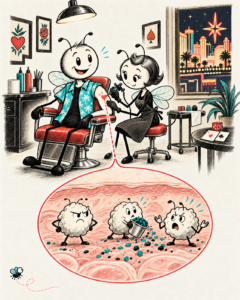
Among them are macrophages, cells that engulf material such as microbes and cellular debris. The name of that whole process is phagocytosis, which sounds considerably more formal than the activity looks.
With tattoo pigment, taking something in doesn’t necessarily mean being able to dispose of it. As the YouTuve video explains, these cells struggle to break down many of the materials found in tattoo ink. Still, pigment can remain inside them, contributing to the color you see through the skin.
It’s really an excellent example of accidental teamwork, because the artist has created something you want to keep, and cells responding to this strange, foreign material become part of what keeps it there. Your immune system has no opinion on whether that drunken Vegas tattoo was necessary or not.
Your Tattoo Has a Succession Plan
This is really the pièce de résistance of the whole tattoo process, because it turns something that looks rather normal and comprehensible on the surface and then turns it into something just a tad bit unsettling.
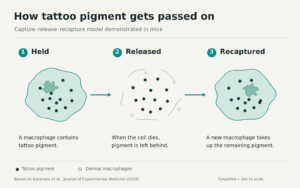
The Institute of Human Anatomy’s video describes what can happen when an ink-containing macrophage dies and releases its pigment:
And then guess what happens? A new macrophage comes in and engulfs that ink. So, it’s almost like this engulf-release, engulf-release, this kind of cyclic process that happens to maintain the tattoo in that area.
A 2018 study published in the Journal of Experimental Medicine tested this mechanism in mice tattooed with green pigment. Researchers selectively eliminated the dermal macrophages holding the ink. The pigment was released, but the tattoo’s visible appearance remained much the same. Over the following weeks, incoming macrophages took the pigment up again.
This experiment demonstrates that the tattoo could survive a change in the cells storing its color. It provides a model for how pigment might persist through cell turnover, although we’re clearly not rats and the authors said its application to humans still needs to be established.
It’s a really strange thing to think of the next time you glance down at that tattoo on your arm. That design can remain in place even while the cells around it continue to change.
Permanent, With Some Wear and Tear
Anyone who has compared an older tattoo with a photograph taken when it was new knows that the term “permanent” doesn’t mean looking identical forever.
The YouTube video above discusses how some pigment can leave the tattooed area, and researchers have even found tattoo pigments in human lymph nodes. A 2017 study in Scientific Reports analyzed donated skin and lymph-node tissue, finding smaller pigment particles in the nodes. So clearly, some of that ink is floating away from the original design and into other parts of the body.
But, of course, our old friend the sun plays a big role in how tattoos fade over time. The American Academy of Dermatology notes that ultraviolet light can fade some tattoo inks, and over time, the artwork can become a softer version of its younger, fresher self.

There’s also a separate issue called tattoo blowout, which is when pigment is deposited too deeply into the fatty tissue beneath the dermis. When that happens, it can spread beyond the intended lines and create a blurred effect.
So the depth of placement helps determine both whether the pigment stays and how neatly it behaves. Turns out there’s quite a lot of anatomy behind a clean outline.
When Your Tattoo Becomes Archaeology
Eventually, we arrive at the more ambitious meaning of permanent: a tattoo that can survive its owner.
During life, pigment is retained within living tissue, but after death, its longer survival depends on what happens to that tissue. Conditions that preserve the skin can preserve the markings within it, allowing a tattoo to remain recognizable long after its owner is gone.
That is what makes Ötzi such an extraordinary example. His body was naturally preserved in the Alps, carrying his tattoos across more than five millennia. The South Tyrol Museum of Archaeology describes the markings as groups of lines and crosses. The exact meaning of these tattoos still isn’t known, but some experts have suggested it had some kind of “therapeutic” purpose.
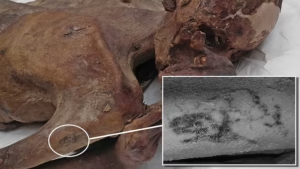
Ancient Egypt gives us another example of this kind of preservation. In a study of two naturally mummified people from Gebelein, researchers documented tattoos more than 5,000 years old. As the paper explains:
In the Egyptian Nile valley, the arid climate has also promoted extensive soft tissue preservation. britishmuseum.iro.bl.uk
The dry environment helped preserve the skin that carried the designs. Tattoos on the male individual included horned animals, and markings on the female appeared on her arm and shoulder. So it turns out that even the prehistoric Egyptians were rocking some ink.
A Very Long-Term Audience
Most of us choose a tattoo completely unaware of how permanent it is or the complex anatomy involved. Usually we’re thinking about its meaning, how cool we’re gonna look when we hit the bars on Friday night, and whether the person holding the needle understood the reference picture. Its potential contribution to a future museum exhibition rarely crosses our mind.
Yet that’s part of what makes this biology so interesting. Several thousands of tiny little pockets of ink placed beneath a renewing surface can endure through years of life, and as we’ve seen, in certain circumstances, preserved skin can then carry that mark far beyond the tattoo chair.
But honestly, if archaeologists ever uncover our tattoos (tramp stamps included) let’s hope they consider putting “thought it looked cool” before publishing an elaborate theory about our spiritual beliefs.
THE LANDING
Somewhere in the future, an archaeologist may give your drunken tattoo considerably more thought than you did.
STAY CURIOUS
Three more stories worth your curiosity.

 We Should Be Living Like the Jetsons





Post Comment