🪰 You’d Better PRAY Nobody Invents Teleportation. It Would Destroy the World
THE BUZZ
- Congratulations! Your morning commute just went extinct.
- Your local diner now competes with Paris
- One wrong teleport, and “hello” outer space
Imagine waking up tomorrow morning to the greatest technological announcement in human history.
Some brilliant nerd has finally figured out teleportation.
And I’m not talking about the terrifying Star Trek version where your body gets disassembled into a trillion little particles and hopefully reconstructed somewhere else with all the important bits still attached.
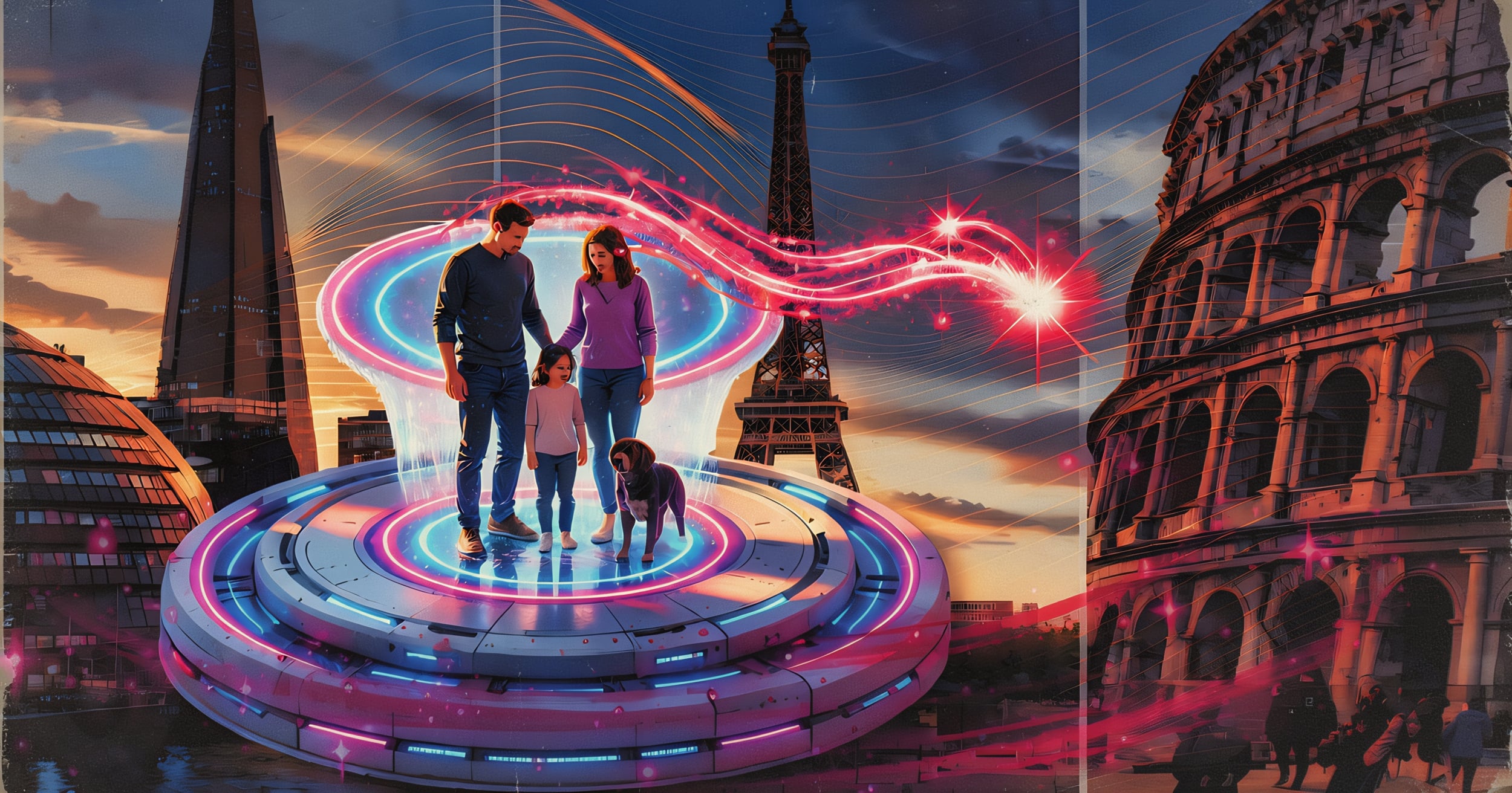
Nope. This invention is a simple portal you can install in your house. Step through one side, and you instantly emerge anywhere on Earth.
Paris? Done. Tokyo? Piece of cake. Want to have lunch in Florence and be home in time to pick up the kids from school? Go right ahead, ma’am, the world is your oyster.
Even better, the technology is affordable enough that practically every household can have one.
HOLY CRAP.
Think about what this would mean for your life.
You could finally take that dream vacation without spending fourteen hours wedged into an airplane seat next to somebody who thinks deodorant is overrated.
Your morning commute would disappear. That miserable stretch of highway you’ve spent years crawling along at seven miles an hour would become a distant memory, along with airport security lines, delayed flights, and the privilege of paying $85 to park your car.
Hell, you could wake up in your pajamas, teleport to a little bakery in France for fresh croissants, and be back home before your coffee finished brewing.
This might be the greatest invention since indoor plumbing.
And for about five glorious minutes, the entire world would be celebrating.
Then somebody would realize we’d just made half the modern economy look like a collection of dusty old dinosaur bones.
Because the more you think about teleportation, the more you begin to understand that our entire civilization has been built around one rather inconvenient fact…
Getting from one place to another takes time, effort, and money.
We’ve constructed enormous industries, entire cities, and countless careers around dealing with that problem.
And now some bow-tie-wearing genius has invented a little glowing doorway that makes most of those arrangements seem downright ridiculous.
Oh, this is going to get ugly, real fast.
CONGRATULATIONS, YOU’VE JUST INVENTED GLOBAL CHAOS
I found this fascinating video that starts with a wonderfully simple question.
What if somebody invented affordable, instantaneous teleportation and made it available to everybody?
The creator imagines the technology as a doorway connecting two locations, rather than some complicated molecular reconstruction machine.
And while the idea sounds like an absolute dream, he begins following what would happen to the businesses, industries, and jobs we’ve built around transportation.
The consequences are downright catastrophic.
And here’s the twist, folks… the technology wouldn’t have to malfunction to create an enormous mess… if it works perfectly, it literally destroys the world.
THE GREATEST INVENTION EVER JUST FIRED YOUR ENTIRE COMMUTE
Okay, let’s pretend this incredible invention actually exists, and the company announces that household teleporters will be available beginning next month.
Naturally, everybody loses their minds.
The internet goes berserk, people start lining up to buy one, and some poor guy who just financed a brand-new SUV is wondering whether he can still return it.
Because why would you need a car anymore?
Sure, people would still drive for recreation, certain kinds of work, or situations where teleportation wasn’t practical. But for ordinary commuting and errands, the whole concept of owning a vehicle would suddenly become unnecessary.
Now think about what happens to the businesses built around that vehicle.
Car dealerships, gas stations, parking garages, auto repair shops, rental companies, and businesses selling everything from windshield wipers to baby car seats would face an absolute annihilation in about 12 minutes—flat.
And those are just the obvious things.
Airlines would suddenly be competing with a doorway that gets you to your destination instantly, without requiring you to remove your shoes, surrender your shampoo bottle, or spend three hours sitting at your departure gate.
Railroads, bus companies, and commercial shipping operations would have to rethink their entire business models.
The oil industry would face a serious change in demand and probably collapse, while governments would have to reconsider all the infrastructure we’ve spent centuries building.
And imagine being the CEO of a major airline when somebody announces that people can now travel from New York to London in approximately two seconds.
What exactly do you say at the next shareholder meeting?
“Well, folks, we’ve had a bit of a setback.”

That first video makes an important point about how rapidly these disruptions could unfold.
Technology has always replaced older ways of doing things, but society generally needs time to adjust.
If teleportation became available everywhere almost overnight, millions of people could suddenly find themselves working in industries whose future had become extinct overnight.
And that’s before we even consider what happens to the places we live.
YOUR HOUSE JUST BECAME THE CENTER OF THE UNIVERSE
Let’s say you live in a little town in rural Nebraska, but your dream job happens to be in Manhattan.
Today, that presents a rather obvious problem.
Unless you enjoy spending your entire paycheck on airfare or commuting across half the country, you’re probably going to have to move.
But with teleportation, who cares?
You could live on a beautiful piece of land in the countryside, enjoy all the peace and quiet you want, and pop into your New York office every morning without even putting on a coat.
Suddenly, living near your workplace wouldn’t matter.
Which means real estate would get VERY interesting.
For generations, people have paid enormous premiums to live near major employment centers. A cramped apartment in a desirable part of Manhattan can cost a fortune, while a beautiful house somewhere remote might be downright cheap.
But if you could live anywhere and work anywhere, the entire calculation would change.
Maybe people would start moving to gorgeous rural locations because they no longer needed access to highways, airports, or convenient commutes.
Imagine owning a home on a beautiful stretch of coastline while working in downtown Chicago.
Of course, there’s a rather hilarious complication…
Once everybody realizes they can live anywhere, all those previously affordable little paradise locations might suddenly become incredibly expensive.
But hey, that shoebox in SoHo won’t cost 10K a month anymore.
Congratulations! You escaped the overpriced city only to discover that half the country now wants to buy the same charming farmhouse you had your eye on, and now that’s 20K a month!
Meanwhile, enormous parking lots, sprawling highway interchanges, and some commercial properties might become candidates for entirely new uses.
Cities could change dramatically as the need to cluster everything around transportation routes ends.
And just when you thought the real estate industry had enough headaches, the hotel business and Airbnb’s would get one hell of a blow.
THE HOTEL INDUSTRY IS ABOUT TO HAVE A VERY BAD DAY
Picture this.
You’ve always dreamed of visiting Rome, but international travel is expensive. There’s airfare, hotel accommodations, transportation, and all the other little charges that turn a reasonably priced vacation into something requiring a second mortgage.
With teleportation, you could spend the entire day exploring Rome, enjoy a wonderful Italian dinner, and step through a portal back to your own bedroom.
No hotel required.
And why stop there?
You could spend Monday sightseeing in London, Tuesday lounging on a beach in Greece, and Wednesday visiting the pyramids in Egypt.
Every night, you’d sleep in your own bed.
Now, plenty of people would still want hotels. A romantic weekend away, an all-inclusive resort, or an elaborate luxury experience would still have appeal.
But the enormous industry built around providing people with somewhere to sleep simply because they’re too far from home would face a pretty serious challenge.
But imagine trying to convince someone to pay $400 a night for a hotel room when their own perfectly comfortable bedroom is one glowing doorway away.
“Yes, but madam, we do provide complimentary shampoo.”
Lovely. I’ll be sleeping at home, thanks.
Tourism would explode, riff-raff and all, as distant destinations became accessible to pretty much everybody, but the businesses that profit from getting boatloads of tourists and keeping them overnight would be crushed.
And speaking of adapting, your neighborhood businesses are in for an ugly surprise.
YOUR LOCAL DINER NOW HAS TO COMPETE WITH PARIS
Imagine you own a perfectly nice little diner in suburban Ohio.
You’ve been serving pancakes, eggs, and bottomless coffee for twenty years. Your customers love you, the regulars know each other, and business is pretty darn good.
Then teleportation arrives…
Suddenly, somebody who would’ve stopped by for your $10 breakfast can hop over to a beautiful café in Paris, enjoy a fresh croissant, and return home before you finish refilling the sugar dispensers.
And the competition doesn’t stop at restaurants.
Your local clothing store is now competing with shops in Milan. The neighborhood bakery is competing with pastry chefs in France, and that little coffee shop down the street has to convince customers not to spend their mornings sipping espresso in some charming Italian piazza.
The entire planet has essentially become one enormous shopping mall, and every business on Earth is fighting for customers who no longer care about distance.
Now, that could create wonderful opportunities for some businesses. Some tiny family-owned restaurant in a remote town could suddenly attract customers from around the globe. The little shop that once depended entirely on people living within ten miles might discover an entirely new audience.
But the competition would be a bloodbath.
And here’s something else to consider…
If everybody can visit the world’s most popular destinations whenever they want, what happens when millions of people decide to show up at the same place?
That charming little cafe in Paris will need a bouncer.
And reservations.
And its own international security force.
Because when distance stops being an obstacle, controlling tourism and access becomes a very big deal.
GOOD LUCK EXPLAINING THIS TO BORDER SECURITY
Remember when international travel involved passports, immigration checkpoints, customs inspections, and some creepy TSA agent?
Well, how exactly does that work when anyone with a teleporter can appear on the other side of the planet? Terrorism will have a whole new lease on life.
Surely countries wouldn’t simply throw open their borders and announce that everybody was welcome to materialize wherever they pleased.
Governments would need ways to control which portals could connect to which locations, verify travelers’ identities, inspect goods, and prevent unauthorized access.
Because otherwise, the world’s most advanced border-security system would become rather useless the minute somebody installed a teleporter in their guest room.
And we haven’t even discussed regular, everyday crime.
Imagine discovering that a burglar could potentially teleport directly into your living room.
Or some lunatic halfway around the world could appear in your kitchen because he’d somehow obtained access to your home’s portal system.
Good Lord, we’d need security technology that makes today’s smart-home systems look like a kids toy.
Every household would need some way to control arrivals, authenticate visitors, and prevent unwanted connections.
And what happens when the technology breaks down?
Imagine stepping into your portal on the way to work and discovering that the company responsible for operating it is having server problems.
“Sorry, your destination is currently unavailable.”
Wonderful. Guess I’m calling in sick from the office that’s technically three seconds away.
Of course, this same technology could be extraordinary for emergency services.
Doctors could reach patients almost instantly. Medical supplies or donated organs could move between hospitals without waiting for conventional transportation, and rescue teams could potentially respond to disasters much faster.
Those benefits would be enormous.
But everything would depend on the technology being reliable, secure, and accessible.
And that’s a lot of responsibility to hand over to whoever controls the world’s teleportation network.
Especially when the physical safety of the people traveling through it is still a rather important question.
Which brings us to our second video.
Because apparently, the universe itself might have a few objections to this whole teleportation business.
YOU MIGHT WANT TO CHECK WHERE THE EARTH IS BEFORE YOU LEAVE
So far, we’ve been assuming teleportation works perfectly.
You step into a doorway, disappear, and emerge somewhere else without losing your luggage, your eyebrows, or any important internal organs.
But what if the technology works more like the teleportation powers we see in science-fiction movies?
You vanish from one location and reappear in another, perhaps traveling through some mysterious extra dimension along the way.
Sounds fantastic!
Except the Earth isn’t sitting perfectly still while you’re doing all this.
It’s rotating, moving around the Sun, and carrying everything on its surface along for the ride.
This next video gets into some fascinating physics behind fictional teleportation and explores what might happen if a person disappeared from our familiar frame of reference and reappeared without thinking abut the movement of the planet.
And let’s just say you might want to postpone that spontaneous trip to Tokyo.
CONGRATULATIONS, YOU’VE TELEPORTED INTO A PHYSICS NIGHTMARE
Okay, now THIS is the kind of thing that makes me appreciate the boring reliability of an ordinary airplane.
Because when you really think about it, we’re all traveling through space at ridiculous speeds every single day.
Near the equator, the Earth’s rotation carries us eastward at more than 1,000 miles per hour.
And while we’re busy doing that, the entire planet is racing around the Sun at roughly 67,000 miles per hour.
You don’t notice any of this because the ground, the atmosphere, and everything around you are moving together.
Your morning coffee isn’t flying across the kitchen at supersonic speed because you and the coffee are part of the same moving system.
But now imagine a teleportation device that somehow removes you from that system and drops you back into reality without properly accounting for where the Earth is or how fast your destination is moving.
Oops!
Depending on how our hypothetical machine works, you could arrive with a dangerously different velocity from your surroundings.
Or materialize somewhere you didn’t plan on being.
Imagine entering a teleporter in your bedroom, expecting to emerge in a charming little café in Rome, only to discover that somebody forgot to account for the Earth’s movement.
Instead of enjoying a cappuccino, you’re now having an extremely unpleasant encounter with the atmosphere.
And in some versions of this hypothetical technology, your destination coordinates could be so off that you end up in space, and that could be a very short visit if you’re not properly suited up.
Which brings up an important distinction.
This doesn’t mean physics has proved that any possible teleportation machine would automatically launch people into space.
The first video’s imaginary doorway system and the second video’s superhero-style dimensional jumps are different concepts.
A successful device would need to connect the correct locations and handle the movement of its travelers relative to their destinations. A portal fixed between two points on Earth might solve some of these problems very differently from a person vanishing into another dimension.
But that’s exactly why this whole chat is so fascinating.
Teleportation isn’t just about figuring out how to disappear and reappear.
You’d need technology sophisticated enough to ensure you arrived safely, moving at an appropriate speed, in an actual usable location.
And please, for the love of God, not inside somebody’s refrigerator.
THE WORLD’S GREATEST INVENTION WOULD NEED THE WORLD’S BEST WARRANTY
Now imagine explaining all this to the average consumer.
You’ve just spent a small fortune installing a brand-new teleporter in your house, and the company sends you a safety manual.
Before traveling, please ensure that your destination is properly calibrated, your arrival location is unobstructed, and all relevant motion parameters have been synchronized.
Oh, and under no circumstances should you attempt an unverified journey across the planet.
Well, that’s reassuring.
I can already picture the customer reviews.
“Fantastic product. Saved twelve hours flying to London. Unfortunately, my husband arrived in the neighbor’s swimming pool.”
Two stars.
And don’t even get me started on the insurance industry.
What exactly does a teleportation accident claim look like?
Does your homeowner’s policy cover accidental materialization inside a wall?
Who pays when somebody’s portal opens into a crowded restaurant and knocks over six tables?
What happens if the company sends you to the wrong country?
And imagine the poor customer service representative trying to explain why your mother-in-law ended up in Antarctica.
The sheer number of things that would need to work correctly is almost impossible to imagine.
But let’s assume the scientists solve the physics, the engineers create an extraordinarily reliable system, and nobody gets accidentally launched into orbit.
We’ve still got one enormous problem.
What happens to the billions of people whose livelihoods depend on the world operating the old-fashioned way?
THE SCARIEST PART IS HOW FAST EVERYTHING WOULD CHANGE
This is where the first video’s comparison to artificial intelligence becomes particularly interesting.
We’ve dealt with disruptive inventions before.
Cars transformed transportation and the businesses built around horses. Computers changed offices, factories, and entire professions. The internet completely rewrote how people shop, communicate, and consume entertainment.
New industries emerged, and existing ones faced painful transitions along the way, and many went belly-up. Just ask Blockbuster.
Teleportation would be another technological revolution, except its effects could potentially spread across an extraordinary number of industries all at once.
And the speed of that transition would be off the charts.
If the technology took fifty years to become affordable and widely available, businesses and workers would have time to adjust.
Airlines could develop new services, transportation companies could adapt their operations, and governments could plan for changes in infrastructure and taxation.
But what if some brilliant inventor figured out how to mass-produce inexpensive teleportation devices and suddenly made them available to everybody?
Imagine what that announcement would do to investors, businesses, and workers around the world.
Companies that had spent decades building enormous transportation networks would be over by the end of the day.
Some industries would buckle, and others would expand dramatically. Entirely new careers would appear as people built, operated, maintained, regulated, and secured teleportation systems.
But those new opportunities wouldn’t necessarily show up in the same places or employ the same people whose jobs were lost.
A mechanic who’s spent twenty years repairing cars isn’t going to wake up tomorrow and become a quantum portal engineer because some guy on television announced that teleportation is the future.
And that’s the part that could get really ugly.
The invention might create extraordinary wealth and opportunity while also destroying the economic situations that millions of ordinary people depend on.
It wouldn’t necessarily happen overnight, and nobody can calculate precisely how many jobs would disappear from an invention that doesn’t exist.
But the disruption would be staggering.
And here’s a question we haven’t even considered…
Who gets to control this miracle?
WHAT IF ONE COMPANY OWNS THE ENTIRE PLANET’S DOORWAYS?
Imagine that most of the planet’s teleportation infrastructure is controlled by one enormous corporation.
Suddenly, that company has all the power. They control how people and products move around the world.
What happens when it raises prices?
Or suffers a massive technical failure?
Or decides that certain people, businesses, or destinations no longer qualify for access?
You could wake up one morning to discover that visiting your family means you have to agree to a new subscription plan.
And naturally, there would be premium upgrades.
Want to teleport during peak hours? That’ll cost extra.
Traveling internationally? Please purchase the Global Explorer Package.
Need to bring a suitcase? Wonderful. We’ve introduced a convenient new baggage-processing fee.
Oh, good Lord, the list would go on.
But the larger concern is serious.
A technology powerful enough to change how the entire planet functions would need thoughtful rules, reliable safeguards, and enough competition to prevent its benefits from becoming dependent on one company’s decisions.
Because once the world reorganizes itself around instantaneous travel, losing access could become a much bigger problem than simply missing your flight.
And that brings us back to the original question.
Would inventing teleportation actually be a good thing?
SO, SHOULD WE HOPE SOMEBODY INVENTS THIS THING OR NOT?
Here’s the funny part.
Even after thinking through all this potential nightmare, I’d love to have a teleporter.
Are you kidding me?
The ability to visit anywhere on Earth without dealing with airports, traffic, expensive transportation, or miserable travel schedules would be freaking amazing.
Think about elderly people being able to visit distant family members whenever they wanted.
Children growing up with opportunities to experience cultures, museums, historical landmarks, and natural wonders that would otherwise be far beyond their family’s budget.
And consider what instantaneous travel could mean for scientific collaboration, emergency medical care, disaster response, and humanitarian assistance.
The possibilities are genuinely breathtaking.
But those possibilities come with some very big complications and tradeoffs.
We’d have to rethink how cities work, how countries manage borders, how businesses compete, how people earn a living, and how enormous portions of the global economy function.
And we’d have to develop safety systems capable of handling a form of transportation that, at least in our imaginary scenario, would make conventional travel look positively prehistoric.
That’s an awful lot to figure out simply because everybody wants to skip the morning commute.
And I think that’s what makes teleportation such an entertaining thought experiment.
At first, all you can think about is how wonderful it would be to go wherever you wanted.
Then you start realizing how much of the world exists because you currently can’t.
You know, I started thinking about teleportation as the ultimate convenience…
A magical little doorway that would finally free us from traffic jams, long flights, expensive vacations, and the absolute misery of trying to get through airport security.
And I still think that sounds pretty awesome.
But the more you imagine it becoming a normal part of everyday life, the stranger the consequences become.
Maybe one day humanity will invent something that makes distance irrelevant, and future generations will look back at our highways and airports the way we look at horse-drawn carriages.
But if that day ever comes, I hope the people responsible have thought through a few things beyond how convenient it’d be to grab lunch in Paris.
Because I’d hate to discover that the inventor of teleportation spent twenty years perfecting the physics and approximately eleven minutes considering what happens to everybody else.
Although I will admit, the thought of never sitting in another traffic jam is awfully tempting.
THE LANDING
You’ll never be late for work again, assuming your job still exists.
STAY CURIOUS
Three more stories worth your curiosity.

 Did the World Lose Its Color, or Are We Just in Our Beige Era?






Post Comment