🪰 Why Flying Over Washington, D.C. Is Truly Terrifying
THE BUZZ
-
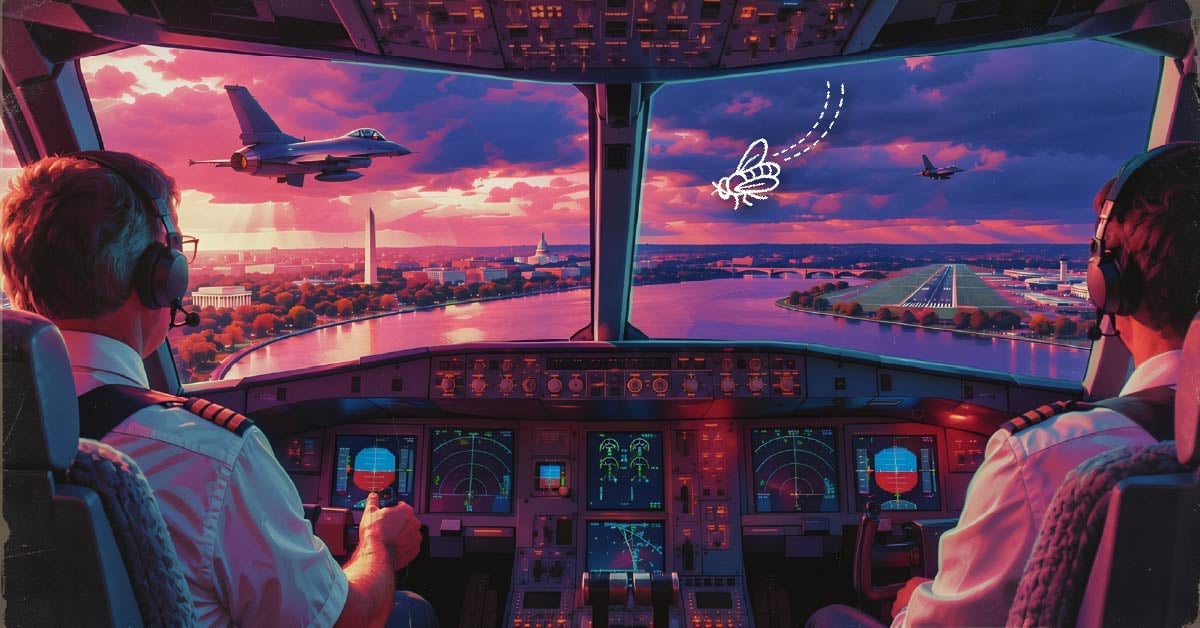
That scenic landing comes with some conditions.
-
One wrong turn can bring in the entire military.
-
Imagine seeing an army of F-16s outside of your window.
There’s a particular kind of pleasure that comes with having a window seat. Especially when you’re flying over our wonderful capital. We can lean out of the window, spot a familiar landmark, and narrate the entire descent to whatever sad sap is sitting next to us. Somewhere in our camera roll, the Washington Monument is about to become a tiny white blur behind a reflection of our own face.
Then the plane takes a sharp turn, and all of a sudden your opportunities of taking a blurry shot of our capital are foiled. Also, where the heck is the airport?!
Well, as it turns out, flying into Ronald Reagan Washington National Airport, better known as DCA, is one of the most complex areas to fly in the United States, if not in the world. One wrong turn from the pilot and you’re at risk of a full-blown military arsenal showing up.
A video from YouTube creators Half as Interesting takes us through the complex journey of how the average flight goes from airspace to ground when entering our precious capital.
So while we’re sitting there enjoying our complimentary peanuts, the flight crew is up front navigating one of the most complicated airspaces out there. Who knew, right?
Washington has fences we can’t see
Washington’s outer Special Flight Rules Area, or SFRA, extends roughly 30 nautical miles from its center. It’s an intense little space where a pilot requires authorization, identification for their aircraft, altitude reporting, and required radio contact.
As the FAA lays out, getting these authorizations isn’t as simple as filling out a form and calling it a day. Nope. It’s one that has extensive checks and requirements.
There are a number of requirements for aircraft flying within the SFRA:
- Pilots must obtain an advanced clearance from FAA air traffic control to fly within, into, or out of the SFRA.
- Aircraft flying within the SFRA must have an altitude-encoding transponder and it must be operating.
- FAA air traffic control must assign a four-digit number that identifies the aircraft by call sign or registration number when it gives a pilot clearance to fly in the SFRA.
- While flying within the SFRA, the pilot must be in direct contact with air traffic control unless cleared to the local airport traffic advisory frequency.
Closer in, the Flight-Restricted Zone adds tighter controls across an area extending approximately 15 nautical miles around DCA. Scheduled airlines are able to access the airport a tad more easily, while civilian flights require more extensive authorization.
So yeah, you and the family rolling in on your Southwest flight isn’t as easy-breezy as you’d think…

Then there’s P-56, covering the White House and National Mall, with a separate section around the vice president’s residence. Access to this area is reserved only for specially authorized government-related missions. Sorry, no photo-op opportunities around this zone, folks.
So, being cleared to land at the nearby airport doesn’t mean the pilot has been handed the keys to the whole neighborhood. As you can see, it’s a super complex system that’s a bizarre mix of government aircraft, highly guarded spaces, and average commercial flights.
The river is doing more than looking pretty
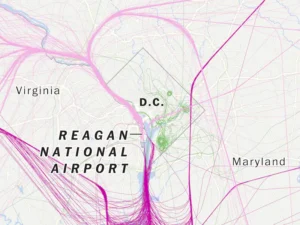
So now that we know what the plane is avoiding, the infamous Potomac River starts standing out and looking rather useful.
Reagan National’s route guidance explains that the aircraft generally follows the Potomac and Anacostia river corridors when traffic and weather allow. That helps keep flights clear of prohibited airspace while reducing noise over more densely populated neighborhoods. Granted, there are still people living beside those corridors, and they can still hear the nonstop flow of planes, so unfortunately the river hasn’t magically solved everybody’s noise complaints.
Naturally, the direction of travel matters, too. The airport describes operations as north flow or south flow, with wind and weather playing a major role.
The air traffic direction, North Flow or South Flow, is primarily based on airfield and enroute wind and weather conditions.
In south-flow operations, arriving aircraft can approach from the northwest along the Potomac before lining up with the runway. The River Visual approach to Runway 19 is one option with good weather and visibility, while the other approaches depend on different conditions and equipment.
Whew! Talk about complex… so that scenic ride over the river isn’t just for aesthetics. It’s basically the path of least resistance.
Everybody else would also like to land
Now, all of this would be considerably easier if, say, your flight was the only one attempting to land in D.C. But, unfortunately, the airspace over our capital isn’t just filled with safety minefields, but it’s also incredibly busy. Go figure.
DCA handled 24.89 million passengers in 2025, according to the Metropolitan Washington Airports Authority. That’s a pretty staggering number, but it was actually below its 2024 record. People are literally clamoring to enter D.C., even though the latest numbers do show a decline.
Reagan National Airport recorded its lowest annual passenger count in three years in 2025, even as Dulles International Airport set an all-time record.
Just under 24.9 million passengers traveled through DCA last year, down 5.3% from 26.3 million in 2024, the Metropolitan Washington Airports Authority (MWAA) reported yesterday (Tuesday) — confirming preliminary numbers released last month.
It’s the lowest passenger count since 2022, when 24 million passengers flew out of the airport as air travel began to recover from a pandemic-era downturn. Passenger totals at Reagan National then increased 25.5 million in 2023 before hitting the all-time high in 2024.
The airport’s calendar-year 2026 budget, adopted in late 2025, anticipates a modest increase in passenger totals this year.
Despite the decline in 2025, passenger totals at the 85-year-old airport remained above pre-pandemic levels. Travelers totaled 23.5 million in 2018 and 23.9 million in 2019, according to MWAA data, before bottoming out at 7.6 million in 2020 and rising to 14 million in 2021.
Honestly, if you put all of this airspace congestion next to the route restrictions, we can easily start to appreciate all the complex coordination involved. This is a delicate and intricate dance involving tons of restrictions, regulations, and complicated flight paths. And all of this happens while the pilots have to navigate the overwhelming traffic of other aircraft. Seriously, these pilots give the guys from Top Gun a run for their money…

Washington would like a word with your pilot
The folks responsible for protecting this precious airspace have ways to get a pilot’s attention that go way beyond a stern email.
The FAA describes a visual warning system using focused red and green lights to alert certain aircraft making unauthorized entries or otherwise operating against the area’s rules. Actually, if things get bad enough, military interception is a real possibility.
And we don’t have to rely on a hypothetical scenario to imagine that. It’s actually happened.
On May 19, 2026, NORAD reported that F-16s intercepted a general aviation aircraft after it entered the Washington SFRA without authorization.
Earlier today, NORAD F-16 fighter aircraft from the Continental U.S. NORAD Region safely intercepted a general aviation aircraft that violated #FAA restricted airspace over the United States National Capital Region, and escorted it clear of the area without further incident.
Pilots are reminded to check all #FAA Notice to Airmen (NOTAMs) and FAA Temporary Flight Restrictions (TFRs), including in the National Capital Region and Mar-a-Lago regions.
More General Aviation guidance on NORAD Intercept Procedures ➡️ https://t.co/8s0ZlNom2U
#FlyInformed #FlySafe #WeHaveTheWatch
— North American Aerospace Defense Command (@NORADCommand) May 19, 2026
Here’s the military’s account of the event:
North American Aerospace Defense Command (NORAD) F-16 fighter aircraft from the Continental U.S. NORAD Region (CONR) intercepted a general aviation aircraft that violated the restricted airspace over the National Capital Region on May 19, 2026.
The civilian aircraft entered the Special Flight Rules Area (SFRA) at approximately 11:15 a.m. EDT. CONR fighters intercepted the aircraft and ensured it remained clear of restricted airspace without further incident.
Should NORAD aircraft intercept a general aviation aircraft, the pilot should immediately come up on frequency 121.5 or 243.0 and turn around to reverse course until receiving additional instructions on one of those frequencies.
NORAD employs a layered defense network of radars, satellites, and fighter aircraft to identify and respond to potential threats. The identification and monitoring of the civilian aircraft demonstrate how NORAD executes its aerospace warning and control missions for the United States and Canada.
Aircrews are reminded to verify all Federal Aviation Administration (FAA) NOTAMs, especially in the National Capitol Region and Mar-a-Lago regions.
That’s a remarkably calm recount of a situation involving fighter jets. But it just shows how tightly controlled and coordinated the sky above D.C. is. In this situation, the aircraft was intercepted and kept clear, and the incident ended without further trouble.
For anyone picturing restricted airspace as a few fussy lines on a map, just imagine being on a flight when all of a sudden a formation of F-16s shows up. That would be nothing short of terrifying.

By the time we all get off our flight, most of us are completely unaware of the absolute nightmare we just flew through. Instead, most of us are just wondering where we need to pick up our bags and where the closest restroom is.
So, the next time you fly through or into D.C., take a minute to not only take in your surroundings, but maybe give those pilots a good, appreciative pat on the back.
Without that expertise, your plane could’ve either collided with another aircraft or the U.S. military could’ve intercepted it. Neither of which gets you that coveted photo of you standing in front of the White House.
THE LANDING
After all that, a boring arrival at the gate starts looking like a pretty impressive piece of work.
STAY CURIOUS
Three more stories worth your curiosity.

 Who Decided We Were Done With Rock Music?





Post Comment