🪰 Q: Is the Story Of Stephen Hawking Totally Fake? A: Yeah, Probably
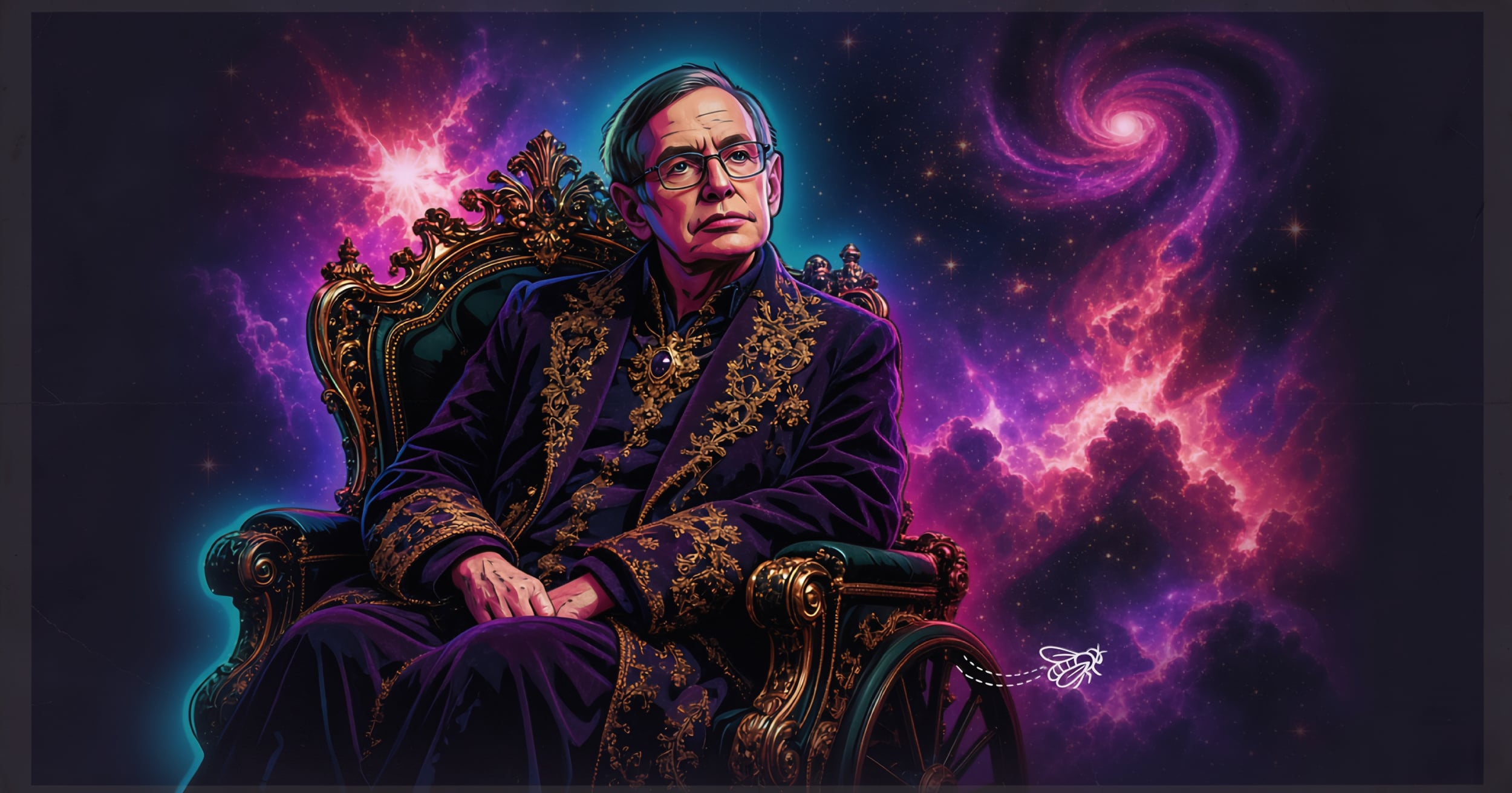
THE BUZZ
- Stephen Hawking’s legend gets stranger up close
- At some point, inspiration became mythology
- The story has a lot of loose threads
I have a real weakness for stories society has repeated so many times that eventually they stop sounding like stories at all… they become lore. Hellen Keller is one of those stories for me, and so is the magical mystery tour of Stephen Hawking.
By the time most of us encountered Steve, the package was already complete and had a bow on top: brilliant physicist, devastating disease, extraordinary survival, computerized voice, wicked sense of humor, cultural icon, and a mind apparently roaming the outer edges of the universe while his body became increasingly limited.
Yes indeed, it’s an incredible story.
Maybe a little too incredible…
And before any Hawking’s fans loose their neurons, I’m not saying Stephen Hawking didn’t exist, wasn’t intelligent, didn’t have ALS, or that somebody wheeled a mannequin into Cambridge and hoped nobody would notice. But what fascinates me is the mythology that formed around him.
Because once you stop standing 30 feet away, admiring the story, and start looking at the individual pieces, some of them are really strange and don’t add up. And this is why many people have gone down some seriously deep rabbit holes over this guy.
I’ve been here before.
Like I said, I have some serious questions about the whole Helen Keller story, another historical figure whose life eventually became such a perfectly constructed story of super-human triumph, and if you questioned any part of the legend, you’d be flogged in the town square.
Honestly, that’s usually when my curiosity really kicks into high gear.
WHEN AN AMAZING STORY BECOMES AN UNTOUCHABLE ONE
The strange thing about cultural legends is that the most inspirational parts eventually become their armor… do you know what I mean? They become untouchable souls.
There’s no denying that Hawking’s physical condition was devastating, so questioning the public story around him could very easily be twisted into some cruel character assassination. Also, his reputation for brilliance made any skepticism sound downright dumb. Add in the famous computerized voice, the celebrity appearances, the jokes, and the sweeping statements about the universe, God, humanity, and everything else, and eventually you aren’t talking about some random physicist anymore. You’re dealing with Stephen Hawking, the cultural superhero.
A real person can be brilliant and still acquire mythology around him. In fact, extraordinary people may be especially vulnerable to that label because the public prefers clean, down-to-earth stories. Complicated people are harder to package and market to the masses.
“Genius overcomes impossible odds” fits nicely on a movie poster. But real life tends to leave messy fingerprints everywhere.
If you know me, you know I love a good rabbit hole, so this video I found really sent me spiraling. But before we get too carried away, I’m not really too much into the wild, off-the-rails theories. The guys who made this video go much farther than I would. They basically throw every suspicion they have against the wall… some are serious, some are totally ridiculous, some are very deliberately provocative, and occasionally the whole thing feels like two friends trying to see who can make the other spit out his coffee first.
But buried underneath some of that silliness are some really interesting questions about Hawkings and his “miracle on ice” persona.
The biggest is simply how extraordinarily over-the-top the whole Hawking story became.
The video keeps returning to the sheer length of his illness compared with the much shorter survival period people commonly associate with ALS. From there, it starts looking at the different ways Hawking communicated over the years, including early footage where another person interprets his speech and the later computerized system that became part of his public identity.
And that voice becomes part of the rabbit hole. Hawking was British, yet one of the most instantly recognizable things about him was an artificial voice with an American accent. Yeah, it’s a tiny detail, but still, it’s exactly the sort of weirdness that catches your attention once you’ve already started pulling at all these threads.
Then there’s the question of communication…
Watching older footage today can be kinda jarring because the audience is basically asked to accept this idea that some random interpreter is able to understand sounds that nobody else on earth could make sense of. Later, the technology changes, and Hawking’s synthesized speech becomes part of the public performance, with these really elaborate thoughts coming through the machine.
Many people, understandably, wonder where Hawking’s communication ended and the machinery around him began. This is why people looking at the footage decades later find the whole thing fascinatingly absurd.
The clip also spends time on the strange amount of cultural authority Hawking eventually acquired. He wasn’t simply introduced as a physicist discussing physics. His opinions and persona became part of popular culture, with appearances, interviews, comedy bits and pronouncements on questions far beyond what most people would ever associate with a university scientist.
At some point, Hawking stopped merely being a brilliant academic with an extraordinary personal story.
He became a symbol of wisdom and almost godlike intelligence.
And symbols are where things start getting really weird.
There’s a lot more in this video, and if this particular rabbit hole grabs you, it’s worth wandering through the whole thing because the conversation gets considerably stranger than what I’m covering here.
I don’t think you have to buy every suspicion in that video to understand why the Hawking story attracts so much skepticism.
Actually, I think doing that would miss the more interesting point here. For me, the fascinating question isn’t whether every wild theory is correct, it’s why the public version of Hawking became so polished, so off-the-charts extraordinary and so culturally protected that even asking how all the pieces worked can cause panic.
And that brings me back to my girl Helen Keller.
I’VE SEEN THIS MOVIE BEFORE
The Keller story fascinated me for the same basic reason.
Somewhere along the way, the human being starts disappearing behind the inspirational “Hollywood-style” narrative.
Every generation retells the story, and the most extraordinary details survive because those are the parts everybody remembers. Eventually the incredible parts stop being treated as incredible and just become the accepted tentpoles.
Then the internet arrives and ruins the lore.
Suddenly millions of people can watch old footage repeatedly instead of seeing it once on television. They can freeze frames, compare interviews, revisit old claims, and talk to people who have firsthand experience with conditions or technologies the average viewer once knew almost nothing about. That’s when stories that survived beautifully in an era of magazines, television specials, and biographies can look very different when the audience gets a rewind and a freeze-frame button.

That helps you understand why the old audiences bought all this stuff hook, line, and sinker.
Most people really had no reason or means to question it.
THE INTERNET RUINED THE PERFECT LEGEND
There’s something almost charming about how much easier cultural mythology used to be.
Almost, but it’s also annoying.
Back in the day, a famous person appeared on television, an authoritative narrator explained why that person was remarkable, and later, maybe there was a glossy magazine profile and eventually a movie.
Congratulations! The legend is built.
Today, somebody pauses the footage and asks why that guy standing beside him seems able to understand sounds nobody else on earth can decipher.
Another person starts wondering how the technology worked… and somebody else notices the voice.
Then an ALS caregiver enters the conversation, followed by a physicist, a programmer, a skeptic, a guy who has been awake since 3:00 a.m., and inevitably somebody whose profile picture is a fly wearing a leather jacket…
Hi.

Welcome to the internet, ladies and gentlemen.
The upside is that old stories get examined in ways they never were before. The downside is that skepticism can become its own mythology just as quickly.
That’s why I think the interesting place to stand is somewhere in the middle, where you can admit something looks whacky without immediately deciding you’ve uncovered the greatest scam in human history.
Sometimes a weird thing is just weird… but honestly, for me, this Hawking thing just doesn’t pass the smell test.
MAYBE WE MADE HIM TOO PERFECT
And that’s because Hawking’s public story eventually contained almost everything a culture loves.
There was genius, tragedy, survival, humor, celebrity, and the enormous philosophical questions that make human beings feel tiny whenever somebody starts talking about black holes. The whole thing was almost impossible to resist.
But perfect stories make me suspicious for a pretty simple reason: people aren’t perfect stories.
They’re really messy.
Their accomplishments get exaggerated, their personalities get flattened, complicated events become anecdotes, and after enough retellings, the version everybody knows can be quite different from whatever it felt like to actually live through it.
The mythology becomes its own living, breathing entity.
THE STRANGEST PART MAY BE US
Maybe the bigger lesson here has less to do with Stephen Hawking than with our need to create these figures in the first place.
We love somebody who conquers impossible circumstances because it reassures us that human beings can overcome almost anything. Then, because the story inspires us, we become weirdly protective of it.
But I don’t think asking questions dishonors Hawking. If anything, turning somebody into a flawless inspirational mascot seems much stranger than admitting his life was probably every bit as complicated, confusing, and imperfect as everyone else’s.
He can still be remarkable without every piece of the legend needing to sparkle.
That’s what keeps pulling me back to stories like Stephen Hawking and Helen Keller.
The rabbit hole isn’t really about catching somebody in a giant lie… or maybe it is for some.
But for me, it’s also about watching a human story slowly become folklore until the version everybody believes and passes down is so polished that there’s no ring of truth to it if you stop and really think about it.
And sure, maybe every famous life picks up a little mythology along the way. But once the mythology becomes more interesting than the person underneath it, I’m probably going to start poking at it with a side eye.
I can’t help myself.
THE LANDING
The weirdest legends aren’t always the ones we invented, but the ones we stopped questioning.
STAY CURIOUS
Three more stories worth your curiosity.

 NORM! The ‘Old Guy’ Who Waddled Into Cheers Bar Every Night Was Only 34


1 comment