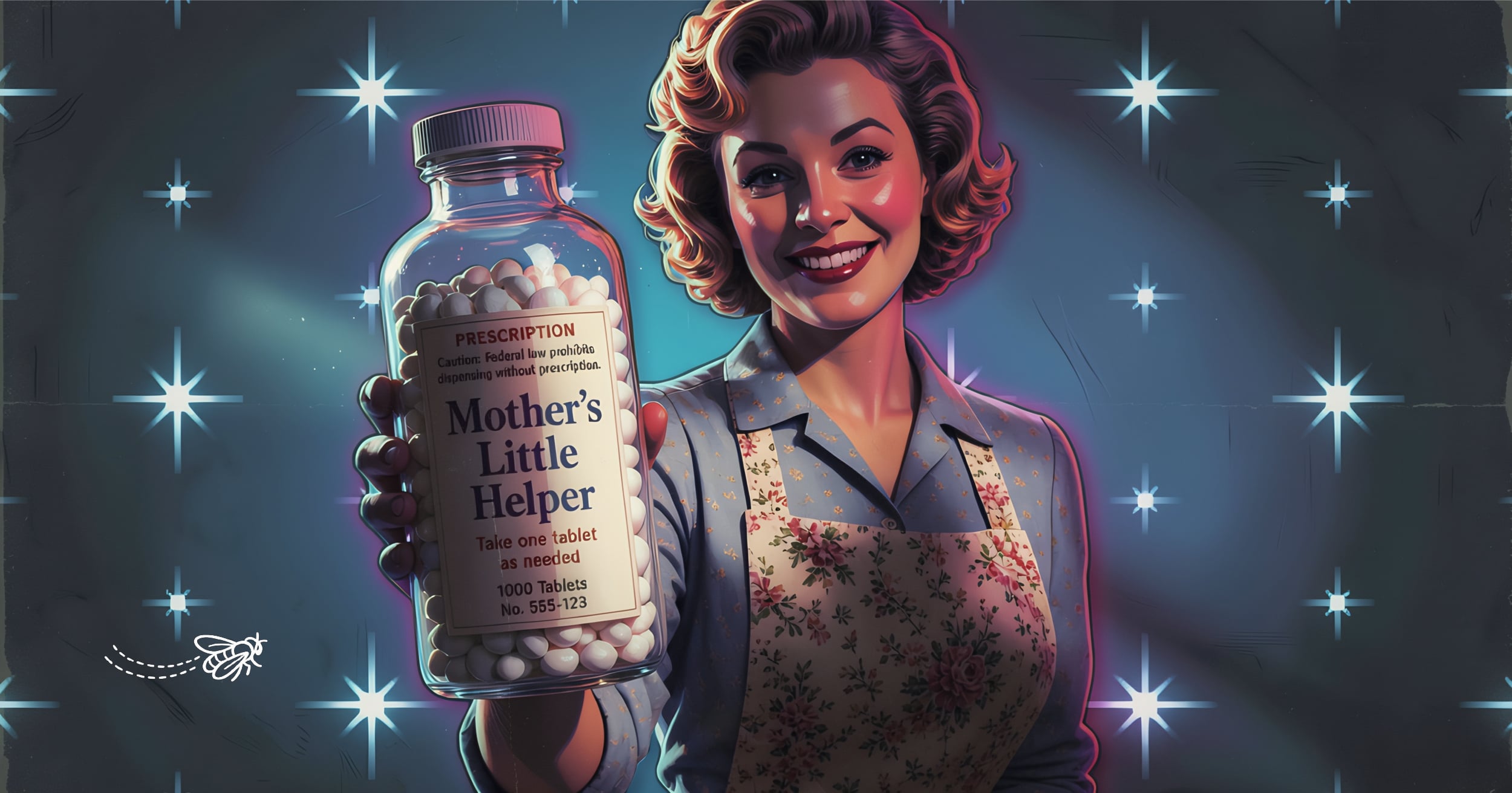
🪰 Mother’s Little Helper: The Creepy Pill 1950s Wives Took to Be Perfect
THE BUZZ
- Perfect wife? There was apparently a pill for that.
- Pharma sold women calm in a bottle.
- Then the miracle cure showed its claws.
Being a housewife in postwar America came with one hell of a performance review.
The house was supposed to look good, dinner was supposed to be piping hot and taste good, the children were supposed to behave, and somehow Mom was expected to pull the whole production off while remaining pretty, pleasant, and deeply fulfilled by the whole experience.
And if she wasn’t?
Well, Big Pharma had a pill for that.
By the mid-1950s, tranquilizers were becoming very big business in America. In 1955, a little pill called Miltown hit the market, promising to take the edge off anxiety and tension. A few years later came Valium, the blockbuster drug that would become the poster girl for the medicated suburban housewife.
Back in the day, when an unhappy woman walked into a doctor’s office carrying the stress of children, marriage, money, loneliness, boredom, impossible expectations, or all of the above, she’d walk back out with a prescription designed to make the whole thing feel a little more manageable.
Sure, the impossible standards stayed exactly where they were, but Mom got chemically calmer.
And it didn’t take long for Big Pharma to figure out that this market was enormous.
Because the pressure on women wasn’t just to run a household. A “good” wife was expected to make the entire thing look effortless, and if she struggled under that load, plenty of people were willing to suggest that the problem might be her nerves rather than the job description.
Then, right on cue, the drug companies showed up, and “Mother’s Little Helper” was born.
@historyegghead In the 1950s, millions of housewives were prescribed “Mother’s Little Helper” to cope with impossible expectations. #1950s #MothersLittleHelper Valium #WomensHistory #HistoryTok
What makes this story so creepy isn’t that doctors prescribed medication for anxiety. Anxiety is real, and some of these women probably needed help. It’s the way normal human distress could be folded into a marketing pitch with such ease.
Women who were overwhelmed, unhappy, or just plain exhausted were a perfect market for drug companies selling one little pill that promised to make everything easier.
You didn’t necessarily need a different life… maybe you just needed to become easier to live with, ma’am.
Before Valium, There Was Miltown
But the tranquilizer craze didn’t kick off with Valium.
Miltown arrived in 1955 and quickly became one of America’s first celebrity pharmaceuticals, offering something that sounded almost too good to be true… relief from anxiety without the scary reputation attached to those older sedatives. That bad reputation came from barbiturates, which had already shown Americans exactly how dangerous sedative drugs could be. They were effective, but overdoses could be deadly, and a lot of high-profile people were dropping like flies (pun intended).
Valium entered the picture, and this magic pill seemed to solve that problem beautifully.
It calmed people down, helped with anxiety and insomnia, and seemed way safer than the old stuff. At the time, that looked like a medical home run.
Then came the advertising.
And boy, did the advertising know exactly who it wanted to target.
Apparently, the Problem Was the Woman
Drug ads from the 1960s and ’70s can look almost unbelievable now because they weren’t especially subtle about the women they were going after.
One 1970 Valium ad introduced a 35-year-old woman named Jan as “single and psychoneurotic” and walked readers through years of failed relationships before suggesting that her low self-esteem had kept her from finding a man who measured up to her father.
Back then, being single at 35 was a pharmaceutical emergency.
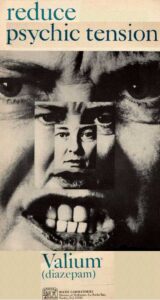
Another ad showed a middle-aged teacher struggling with symptoms associated with menopause. After Valium entered the picture, readers were assured she was once again “trim and smartly dressed,” even prompting her students to do a double-take.
There’s something almost impressive about the efficiency of that sales pitch. The woman feels lousy, society is judging her looks, and somehow the answer ends with a prescription pad.
But Valium wasn’t just being sold as a medication. It was being sold as a pathway back to the woman you were supposedly meant to be.
Preferably one who smiled more, for crying out loud.
By the time the Rolling Stones released “Mother’s Little Helper” in 1966, the medicated-housewife image was popular enough to become part of pop culture.
That song helped give the phenomenon its lasting nickname, but the market was already thriving. Valium had become a literal sensation, and the advertisements aimed at women were painfully blunt about what was supposedly wrong with them and what a little chemical assistance could do to help.
Valium was hailed as a wonderdrug and instantly tapped into a huge market: as a treatment for anxiety and anxious insomnia, it provided an ostensibly risk-free cure for the two most common causes of GP visits. Even better, it was effective and appeared to have no side effects.
Unlike barbiturates, which served a similar market, it was impossible to overdose on Valium. Indeed, barbiturates were widely viewed as dangerous due to the prevalence of high-profile deaths involving them. A year before Valium was launched Marilyn Monroe had died of acute barbiturate poisoning.
Marketing undoubtedly played a big part in Valium’s enormous success. The tone was quickly set and clearly targeted a very specific customer: the sort of lonely, anxious housewife portrayed in the lyrics of Mother’s Little Helper. Advertisements for Valium and other benzodiazepines in the ’60s and ’70s were, by today’s standards, shockingly brazen in their depiction of stereotypical women who might be saved from their disappointing lives by popping pills. Valium was touted as a drug that would sweep away your depression and anxiety, allowing you to be your ‘true self’.
The approach is typified by a 1970 ad that introduces Jan, a “single and psychoneurotic” 35-year-old, and presents a series of snapshots spanning 15 years of failed relationships, culminating in a picture of a matronly woman standing alone on a cruise ship. We’re told that Jan’s low self-esteem has prevented her from finding a man “to measure up to her father.” The message it obvious: maybe Valium can save her from her lonely fate.
Another ad from the same year features a middle-aged teacher who had been debilitated by “excessive psychic tension and associated depressive symptoms accompanying her menopause.” But fear not! Thanks to Valium, she’s now “trim and smartly dressed, the way she was when school began.” The ad’s title reads “Mrs. Raymond’s pupils do a double-take”.
Despite such shocking sexism, the aggressive advertising campaigns clearly worked. Valium was America’s best-selling medication between 1968 and 1982, with sales peaking in 1978, when 2 billion tablets were sold in the United States alone.
Two billion tablets in a single year tells you this wasn’t some quirky corner of medical history. Valium was everywhere. And when a drug becomes that normal and popular, the lines start getting really blurry.
And the marketing tells the story. Because Big Pharma knew that millions of women were exhausted, unhappy, lonely, or overwhelmed, and instead of asking too many uncomfy questions about why, advertisers just told her that a better version of herself was waiting at the pharmacy.
The Miracle Pill Starts Looking Less Miraculous
For a while, Valium looked almost perfect.
It worked. It seemed safer than older sedatives. Doctors were comfortable prescribing it, patients were delighted to take it, and society was really comfy with Mom and her little helper.
Unfortunately, the drug had one really big flaw.
It was addictive.
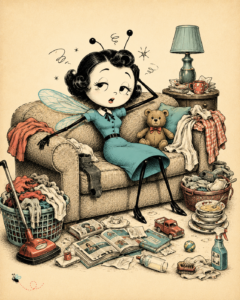
As hectic moms kept popping Valium, the supposedly harmless wonder drug began developing a bad rap, thanks to stuff like dependence, withdrawal, and the risk of becoming a hardcore addict. By the 1980s the carefree attitude about “Mother’s Little Helper” was cracking.
It gradually emerged that Valium wasn’t quite as risk-free as everyone had hoped. In fact, it’s highly addictive and because its effects are non-specific, acting on multiple subunits of GABA, which govern different actions such as anxiety, restfulness, motor control and cognition, coming off Valium can have unpredictable side-effects, including panic attacks and seizures.
By the 1980s it was clear that the normalised use of Valium that had emerged in the 1960s was problematic and attitudes to the drug began to change.
What feels creepy now is how easily society treated a woman’s distress as something to medicate away instead of asking whether the life she was living might have something to do with it.
For drug companies, that made for a simple sales pitch that they still use to this day: if life feels unbearable, the problem might not be the life. It might be you. And if you’re the problem, well, there’s a pill for that…
The 1950s housewife has been polished into such a tidy image that it’s easy to forget how much pressure sat underneath her apron.
She was supposed to have the home, the husband, the children, and the shiny new appliances, all the ingredients that were supposedly proof of a wonderful life.
Yet millions of women still felt anxious, unhappy, restless, or simply worn out.
Instead of asking why they felt that way, the answer was, “Give Mom something to take the edge off.”
And millions of prescriptions later, “Mother’s Little Helper” became part of American life.
STAY CURIOUS
Three more stories worth your curiosity.





1 comment