🪰 Drunk History: Our Ancient Ancestors Were Constantly Hammered
THE BUZZ
- Our alcohol-soaked story may be 10 million years old.
- We can thank beer for farming.
- Civilization got social long before it got sober.
Humans definitely have a thing when it comes to alcohol. It’s consumed constantly and for various reasons. Celebration, boredom, stress, relaxation… the reasons to kick back with a cold one are long and ever-growing.
Many of us think our history around the bottle began when somebody randomly figured out how to make alcohol. So somewhere around ancient times. But as it turns out, that’s about several million years off.
This deep dive started with a video from Before Civilization making one hell of a claim: humanity’s relationship with alcohol didn’t begin with taverns, breweries, farming, or even humans deliberately fermenting anything. It may reach all the way back to our primate ancestors picking up overripe fruit from the forest floor.
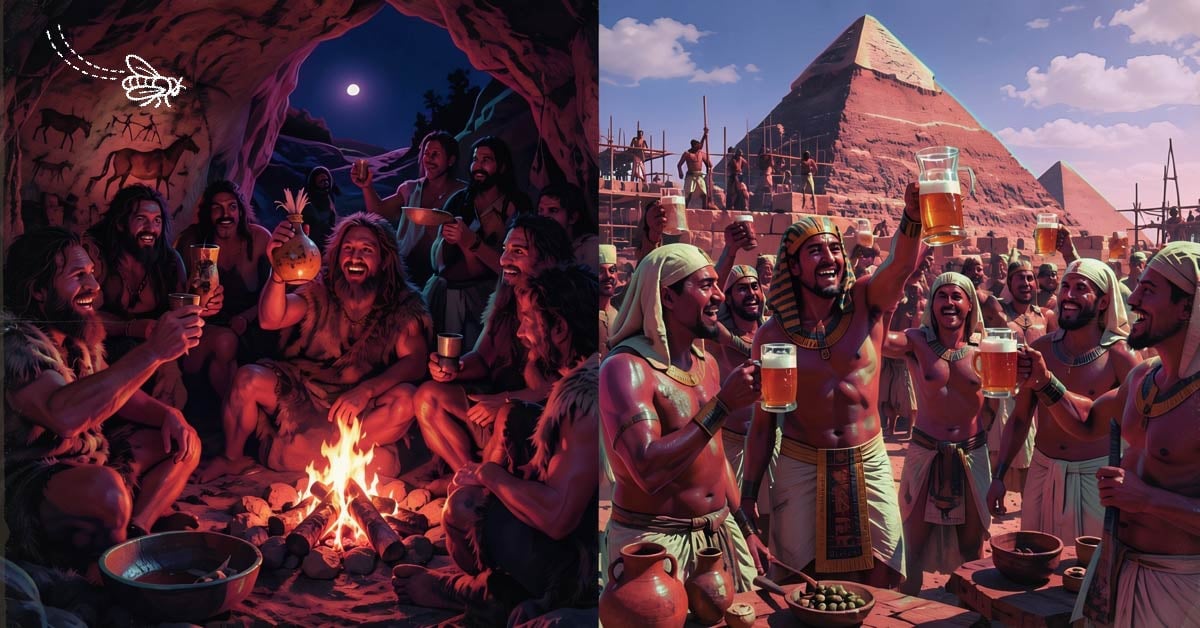
From there, the video goes big. Ancient genetic mutations. Beer before bread. Pyramid workers drinking daily rations. A Sumerian beer goddess. Even the possibility that gathering around fermented drinks helped humans cooperate closely enough to build civilization in the first place.
Some of those ideas have surprisingly good evidence behind them. Others are still being argued over by archaeologists. And a couple may’ve had a few too many…
Before Beer, There Was Rotten Fruit
Of everything in that video, the part that sounds most like somebody made it up after a six-pack is actually one of the better-supported pieces of the story.
About 10 million years ago, an ancestor shared by humans, chimpanzees, and gorillas appears to have undergone a genetic change that made it dramatically better at metabolizing ethanol.
Researchers figured this out by doing something wonderfully strange: they reconstructed ancient versions of an enzyme called ADH4, which helps break down alcohol in the digestive tract, and tested how well those ancestral enzymes could process ethanol.
The older versions were lousy at it.
Then, somewhere around the period when our ape ancestors were spending more time on the ground, ADH4 changed. The newer version became roughly 40 times more efficient at metabolizing ethanol.

Fruit hanging safely in a tree generally isn’t sitting around fermenting for very long. But fruit that’s fallen to a warm forest floor is another story. Yeast gets to the sugars, fermentation begins, and suddenly dinner comes with a tiny dose of tipsy juice.
The researchers proposed that being able to tolerate that ethanol may have given our ancestors access to a food source that other animals had a lot more difficulty with. After all, fallen fruit was still carrying calories, and an ape that could eat the slightly boozy stuff without getting sick had one more option when fresh fruit was scarce.
So yeah, there wasn’t a troop of prehistoric apes staggering around the jungle looking for happy hour.
What happened was sheer evolution.
Our bodies literally started preparing for alcohol millions of years before humans learned how to make a drink.
Did Beer Come Before Bread?
Once humans figured out that fermentation could give us more of the “good stuff” than what was lurking inside a piece of rotten fruit, somebody eventually had to make the leap from finding alcohol to making alcohol on purpose.
And that raises one of archaeology’s more entertaining arguments: what if grain didn’t lure humans toward farming just because it could make bread?
What if it was the little “beer goblin” all along?
Versions of the “beer before bread” hypothesis have been kicking around archaeology since the 1950s. The idea is that early humans may have valued wild cereals not only as food but also because those grains could be malted and fermented. If beer became important enough for feasts, rituals, or social gatherings, having a reliable supply of grain suddenly becomes a pretty good reason to start paying much closer attention to where the stuff grows.
There is, however, a problem with the catchphrase.
The oldest bread found is currently older than the oldest beer that’s been found.
At Shubayqa 1 in northeastern Jordan, archaeologists identified charred remains of bread-like food made by Natufian hunter-gatherers around 14,400 years ago, thousands of years before agriculture became established. These people were grinding wild cereals and other plants into something resembling flatbread without having fields of domesticated wheat waiting outside.
So bread gets the point on the archaeological scoreboard.
But worry not. Beer wasn’t far behind.
At Raqefet Cave in what is now Israel, researchers studied 13,000-year-old stone mortars used by another Natufian hunter-gatherer community. Microscopic starch residues, wear patterns on the tools, and experimental brewing led the team to conclude that the mortars had been used to make a cereal-based fermented drink from wheat or barley.
So yeah, make no mistake. These folks were drinking the good stuff along with their funky bread.
The Prehistoric Kegger That Might Not Have Been
Göbekli Tepe in southeastern Turkey is exactly the kind of place that shows prehistoric history isn’t always what it seems.
Beginning roughly 11,000 years ago, people without cities, writing, or a fully developed agricultural economy gathered there and constructed enormous monumental structures filled with carved stone pillars. Whatever was happening at Göbekli Tepe required organization, labor, food, and a reason for people to show up.
Then archaeologists found some enormous stone troughs and… I think we all know where this is going…
A few could hold around 160 liters, and early chemical testing found calcium oxalate deposits, which can occur during grain soaking, mashing, and fermentation. Suddenly an inevitable theory emerged: maybe people gathering at Göbekli Tepe were brewing beer for enormous communal feasts.
You can see why that theory caught fire.
Monumental construction. Giant gatherings. Huge vats.
Humanity’s first work party may have had refreshments.
Unfortunately for the prehistoric kegger, later research complicated things.
A much more extensive 2020 analysis looked at the troughs using residue analysis, wear patterns, archaeological context, and experimental reconstruction. Taken together, the evidence pointed more strongly toward the vessels being used to cook cereal porridge than to brew beer. Researchers studying thousands of grinding stones from the site likewise found overwhelming evidence that cereals were being processed there, particularly into coarse flour and porridge-like foods.
Unfortunately, it’s not likely that everyone was getting turnt at Temple Hour.
So while a lot of the statements in Before Civilization’s video can be argued, one big fact still stands: alcohol shaped a huge part of who humans are. Physically, psychologically, and in civilization as we know it.
THE LANDING
Civilization may not have been built solely on beer, but booze was apparently never very far from the construction site.
STAY CURIOUS
Three more stories worth your curiosity.








1 comment