🪰 Your Dishwasher Has a Brain Now… And It’s Pretty Dirty

THE BUZZ
- Turns out your dishwasher has been quietly judging all along.
- The key really is “less is more.”
- The dirtier the better.
There are two kinds of people in this world: those who rinse the dishes and those who don’t. There is no middle ground.
We all know those people who heavily sanitize every dish before they load the dishwasher. They have the precision of a heart surgeon, not leaving one speck of food behind, and they load that dishwasher up like a perfect little Tetris puzzle, giving a smug, self-satisfied grin as they close the door.
But we have some bad news…
Turns out those people who are basically washing their dishes before then having them washed again have, indeed, been wrong this whole time. It’s the slobs who throw everything in without a care in the world who have truly won the dishwasher game.
Modern dishwashers aren’t necessarily just spraying hot water around willy nilly and hoping for the best. Many of them are actually watching what happens inside the machine, measuring how dirty the wash water gets and using that information to decide what your dishes actually need.
That’s right, our dishwashers have achieved intelligence.

What brought this entire revelation to the surface was a claim from an appliance use-and-care specialist named Renee. She has really shown us all “the light.”
Renee spent six years as an appliance repair technician before moving into appliance use and care, and her rule is surprisingly simple: scrape the big stuff off, but don’t scrub a plate so much that you can start to see your reflection.
Why?
Because, she says, your dishwasher might actually be looking for the dirt.
*MIND-BLOWN*
And then she does something that would make every compulsive pre-rinser in America cringe in disgust: she takes a glass casserole dish covered in baked-on cheese and pasta sauce and puts the thing straight into the dishwasher.
No soaking. No scrubbing. No ceremonial rinse under the faucet.
Just… in it goes. Craziness.
@renduhDishwasher and dishwasher detergent manufacturers agree–rinsing your dishes before loading them in to the dishwasher is NOT recommended! If you feel like your dishes aren’t getting cleaned even when following this information, make sure you’re: 1. Preheating the water at your sink before running the dishwasher, 2. Loading the dishwasher correctly according to your manual (especially making sure you’re not blocking the spray arms or detergent dispenser!), 3. Using a good quality dishwasher detergent (yes, it can make a difference!), and 4. Keeping your dishwasher clean (refer to your manual, but this usually means cleaning the filter and running a dishwasher cleaner through at least once a month). If you’re doing all that and your dishes STILL aren’t getting cleaned, that’s when it’s time to call an appliance repair tech! #dishwasher #ApplianceRepair #cleaning #kitchen #dishes♬ original sound – Renae
Okay, So Does Your Dishwasher Actually Have a Brain?
Well, not exactly.
Your dishwasher isn’t sitting there developing opinions about the mug you’ve been using since 2007.
But Renee is onto something…
Many modern machines use what’s commonly called a soil sensor or turbidity sensor. Turbidity is simply a measure of how cloudy water is because of particles floating around in it. Inside a dishwasher, that gives the machine a way to gauge how much food and grime is being washed off the load.
Bosch, for example, says its “Auto” cycle uses turbidity sensors to measure the soil level in the water throughout the wash. If the machine detects more soil, it can extend the cycle; if the water looks cleaner, it can shorten it.
@bluelandYour dishwasher works best when your dishes actually go in dirty 🍽️ Meet the turbidity sensor. It tracks how murky the water gets and adjusts the cycle in real time! So next cycle, skip the pre-rinse for cleaner dishes with less water and energy✨💧♬ original sound – noahksticks
Then Whirlpool describes essentially the same idea. On models equipped with its soil-sensing system, sensors measure things, including soil level during the wash, and adjust the cleaning action accordingly.
So the dishwasher isn’t thinking about your dishes.
It’s gathering evidence.
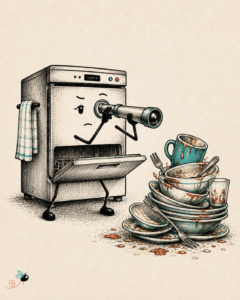
And that’s where the pre-rinsing question suddenly gets much more interesting.
Because if one of the signals your machine uses to determine how aggressive a wash needs to be is how dirty the water becomes, handing it a load of dishes you’ve already rinsed nearly spotless can remove some of the information it was designed to use.
And the manufacturers themselves are surprisingly united on what they’d rather you do instead.
Scrape. Don’t rinse.
But Is This for All Dishwashers?
Here’s where the answer gets slightly less tidy and a little annoying.
Not every dishwasher has a little electronic detective watching the wash water. Soil and turbidity sensors are extremely common in newer machines, but whether your dishwasher has one, and which cycles actually use it, depends on the model.
Bosch says its Auto cycle uses turbidity sensors to measure how dirty the water is and can lengthen or shorten the cycle accordingly. Whirlpool uses similar technology, but even its own guidance says “on models equipped with a sensor cycle,” which is an important distinction. Some Whirlpool machines also use a separate soil sensor during the Normal cycle to adjust the wash based on how dirty the dishes appear to be.
So if you’ve got a fairly modern dishwasher with an Auto, Sensor, Smart Wash, or similar setting, there’s a good chance some version of this technology is hiding behind the door. But an older machine, a very basic model, or even a different cycle on the same dishwasher may behave differently.
So Why Did We Start Washing the Dishes Before Washing the Dishes?
This is the part that made the whole thing click, because pre-rinsing isn’t some bizarre behavior millions of people independently invented.
For a long time, it just made sense.
Consumer Reports says that until roughly the last decade or so, pre-rinsing dirty dishes was often necessary if you wanted older dishwashers to reliably get everything clean. As machines improved, electronic soil sensors became far more common, and the advice changed, but the habit didn’t disappear with the old appliances.
Basically, a lot of us are using yesterday’s dishwasher rules on today’s dishwasher.
You learned to rinse because your parents rinsed, and they learned from their parents, who oftentimes didn’t even have a dishwasher. And all of these practices were likely picked up because an older machine really did leave dried spaghetti welded to the plate if you didn’t give it some help first.

Modern detergent has also moved in the same direction. Cascade, for example, specifically tells users to scrape off chunks but skip the pre-rinse and says the enzymes in its newer detergents are designed to latch onto food residue and break it down during the wash.
So the way we wash dishes has technologically improved, much like everything else around us. But a lot of us just simply didn’t get the memo.
STAY CURIOUS
Three more stories worth your curiosity.









3 comments