🪰 You’ve Been Lied to About Recycling. Now What?
THE BUZZ
- Was all that careful sorting worth it?
- Plastic and aluminum deserve separate conversations.
- Even good intentions come with manufacturing costs.
Give us an empty yogurt cup and two bins, and suddenly we’re making decisions that basically impact the entire future of the planet. So we do our due diligence: we rinse that little plastic container, put it in its appropriate bin, and see it off with a salute when the garbage truck comes by to pick it all up.
We’ve done our part, the truck will take it from here…
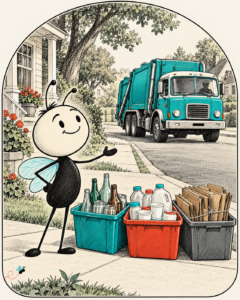
You know, it’s easy to understand the appeal in all this. You get to fuss over all your little containers, sort out the glass and the plastic, and get everything all neat and organized. It’s a simple household chore that supposedly serves a much greater good.
But really, what happens when that truck drives off with all of our carefully sorted containers? Well, that’s where things get complicated, and honestly, it’s not the beautiful “saving the planet” story we all would like to believe.
TikTok video creator Jason Pargin has been dissecting the whole recycling process, and his argument goes considerably further than wondering whether we’re using the right bin. He’s asking whether the effort spent sorting household trash might accomplish less than we think and whether properly managed disposal processes, like landfills, deserve a less villainous reputation.
In his video, Pargin works through plastic, a notorious garbage barge, modern landfills, and the shopping bags we buy with such good intentions. By the time he reaches the bags, that yogurt cup has become the least of anyone’s concern.
The Plastic Promise
Pargin begins by stating that the plastics industry has encouraged the public to believe in recycling, even while knowing its limitations. Basically, they sold us a bit of a dream. It’s a lot of marketing that’s used to make single-use plastic feel more acceptable: use the packaging, put it in the right bin, and then down the line it’ll be reborn again.
It’s a great idea on paper: your little yogurt container doesn’t go to rot in the ocean or a landfill. However, that’s not always the clean reality of what’s happening…
It’s one thing to look at aluminum or cardboard recycling, but the process for those materials doesn’t translate cleanly onto plastic, unfortunately. For example, a scrapyard paying for cans has a financial reason to want them, while a grocery store receiving goods in thousands of boxes can bundle its cardboard for collection. With both, there’s a practical reason for someone to take the stuff.
But all of our little plastic containers don’t have the same appeal. Someone has to actually want what it can become, and they have to take into account all the work of getting from our kitchen to a processing facility. You can clean and sort it all you want, but that doesn’t magically make the plastic more simple to process.
You also have to factor that there’s many different types of plastic: different thicknesses, additives, colorings, etc. Sometimes a certain type of plastic can work beautifully and be reused. Other times it’s just useless landfill material.
The Garbage Barge That Wouldn’t Go Away
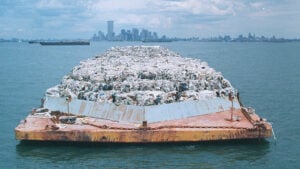
For this part of the story, Pargin takes us all back to the garbage barge that became a huge news event in 1987. Back in the day, millions of pounds of New York City trash were floating around while everyone scrambled, trying to figure out where it all could go.
Really think about some of the junk you throw away, and let’s be honest, it’s typically junk. An old holiday sweater you never wear, a broken toy, a flashlight that stopped working, an old rusty pair of scissors… it all gets bagged up and thrown in the dumpster. Then you watch the dump truck come by, pick up your bag of random useless stuff, and go about your day. But in the case of the 1987 garbage barge, now there’s a boat involved, the trash keeps turning up on television, and apparently nobody actually figured out what to do with all of this miscellaneous junk. So instead it just sits there out in the middle of the water, a reminder to us all that we can throw out our stuff, but it still ends up somewhere.
Pargin connects this whole mess with the mountains of waste in the Pixar movie WALL-E. Once you put together that movie along with real-world examples like the NYC garbage barge, you start to realize that separating some containers is only a small part of a really big problem.
The Six-Pack Rings We’re Still Cutting
Then Pargin brings us to those little plastic rings around six-packs, and I’m sure plenty of you guys can already see the scissors coming out. It’s a pretty simple process: you just cut the loops so an animal won’t become trapped in them. So unlike the mysteries of industrial processing, this was a danger you could actually solve at home, all by yourself.

It’s really an earnest effort to help our planet and all the little creatures that inhabit it, but again, this is only one small solution to a way bigger problem.
You can cut up all the six-pack rings you want, but when you see a beach absolutely littered with trash, you realize that these little bits of plastic are the least of our concerns.
It’s one thing to throw away a bottle on the beach or make sure a larger piece of plastic is cut up so it’s less hazardous. But really zoom out and look at the big picture here: these acts, while impactful, are only slightly chipping away at bodies of water that are literally overflowing with plastic.
So What’s Actually Under The Landfill?
There’s another big misconception that Pargin dissect too: the modern landfill.
Just the word “landfill” sounds terrible. For most of us, we just picture this massive hole in the ground, filled with all kinds of garbage, just sitting there, taking up more and more space every day.
But really, the landfill gets a bad rap, as it’s actually doing some good, namely, keeping trash out of groundwater. Also, the processes involved in a modern landfill are more sophisticated than a lot of us would’ve thought. There’s actually a method to the madness here…
Pargin points to systems intended to keep waste from contaminating groundwater and to collect the methane it produces, then describes covering a full site and then putting that land to another use.
Beneath the surface, modern landfills include advanced environmental protection systems. To help protect groundwater and surrounding ecosystems, they are built with multiple layers of protection, including engineered liners, drainage layers collection pipes and protective materials. Every component is designed with long-term environmental performance in mind.
Leachate management is another essential part of daily landfill operations. Leachate is the liquid that forms when rainwater moves through waste. Instead of allowing that liquid to reach the environment, modern landfill systems collect this liquid through engineered drainage networks and send it for proper treatment. This helps protect nearby groundwater and keeps the landfill in compliance with strict environmental requirements.
Landfill gas control is an area where modern engineering makes a meaningful impact. As organic material naturally breaks down, it produces methane and other gases. Modern landfills use collection wells and piping systems to capture and manage those gases. These landfills are often equipped with gas recovery systems that turn decomposing waste into a renewable energy source.
Stormwater management is also considered in the landfill design. Drainage channels, ponds and erosion-control systems help manage rainfall and runoff, keeping stormwater away from coming into contact with waste, while helping to protect nearby waterways and surrounding natural ecosystems.
All of these systems are required and are closely regulated. Federal, state and local rules guide everything from landfill construction and environmental monitoring to daily operations and long-term care. Landfills are regularly tested, monitored and inspected to make sure they meet strict environmental laws.
And if reading isn’t your thing, here’s a handy-dandy video that lays out the whole landfill process and the surprising amount of engineering that goes into them.
The Tote Bag Has Some Explaining To Do
So there’s been a lot of demonizing around the plastic shopping bag. Really, it’s probably the number one nemesis in the whole “plastics are evil” story, right along side it’s chunkier and perhaps more useful relative, the plastic bottle.
Thus came the rise of the shopping tote!

Now a shopping tote isn’t a new invention, but now it’s become a sort of status symbol. Or more accurately a mark of good or evil. Say you show up to a store without your reusable tote, and you’re preparing yourself for a day of embarrassment and SHAME.
And yeah, the reusable bag is great in theory, until you show up like the schmuck above without said bag, because honestly, shit happens.
Pargin uses cloth shopping bags to illustrate the cost of making something more substantial in the hope that it will last. His argument is that the extra resources involved have to be justified by enough actual use. Which is the crux of the reusable tote: you have to actually remember to bring it and use it. Otherwise, you’re grabbing one of the store’s paper or *gasp* plastic bags, and then we’re back at square one.
Final Thoughts
Pargin’s whole argument on the recycling system ends with one simple but poignant word: convenience.
This is a system that depends on people repeatedly choosing the harder or more inconvenient option, which is sometimes asking a lot out of us ordinary humans. Take someone rushing through the supermarket after working a 10-hour shift, with a bunch of hungry kids waiting at home. Their priority is getting food on the table, not contemplating the ecosystemic impact of the plastic bag.
Now, this isn’t to say that recycling is worthless or some task that requires endless sacrifices. Depending on where you live, the systems in place, and just your own personal lifestyle, recycling is a natural, effortless thing you can do to help the environment.
But what needs to be put in proper perspective is how much of an impact all of these little tasks have on the bigger problem at hand. Because I think it’s easy to vilify others or even ourselves for not “doing what’s right for Mother Earth.” But in the story of recycling, there’s not really any heroes or villains here… instead it’s a bunch of humans trying to figure out where to put all their junk.
In a nutshell, it’s pretty much that simple…
Now let’s go back to our little yogurt cup. It’s still sitting there, waiting for a decision: to be recycled or not to be recycled? That is the question.
Although, I suspect most of us will still take the extra 5 to 10 seconds out of our day to give the little guy a proper send-off, because yeah, why not?
THE LANDING
We’re all happy to do our part, but we’d still like to know what happens after the truck leaves.
 Every Gen X Kid Knows This Mysterious ‘S’ Doodle. But Nobody Knows Where It Came From






1 comment