🪰 So, You Want A Pet Dragon? Here’s How Much It’ll Cost You To Feed The Big Guy
THE BUZZ
- Dragons are expensive as hell to feed.
- Science says most of them couldn’t even fly.
- And fire breath? Weirdly, that part might be possible.
So, you want a dragon, eh?
I get it.
They’re majestic. They fly. They breathe fire. And bonus… nobody’s stealing your Amazon package when there’s a 40-foot reptile sleeping on the roof.
So yes, there are some serious modern advantages.
Unfortunately, there are also a few practical considerations nobody seems to mention when they’re handing out free dragons on TV.
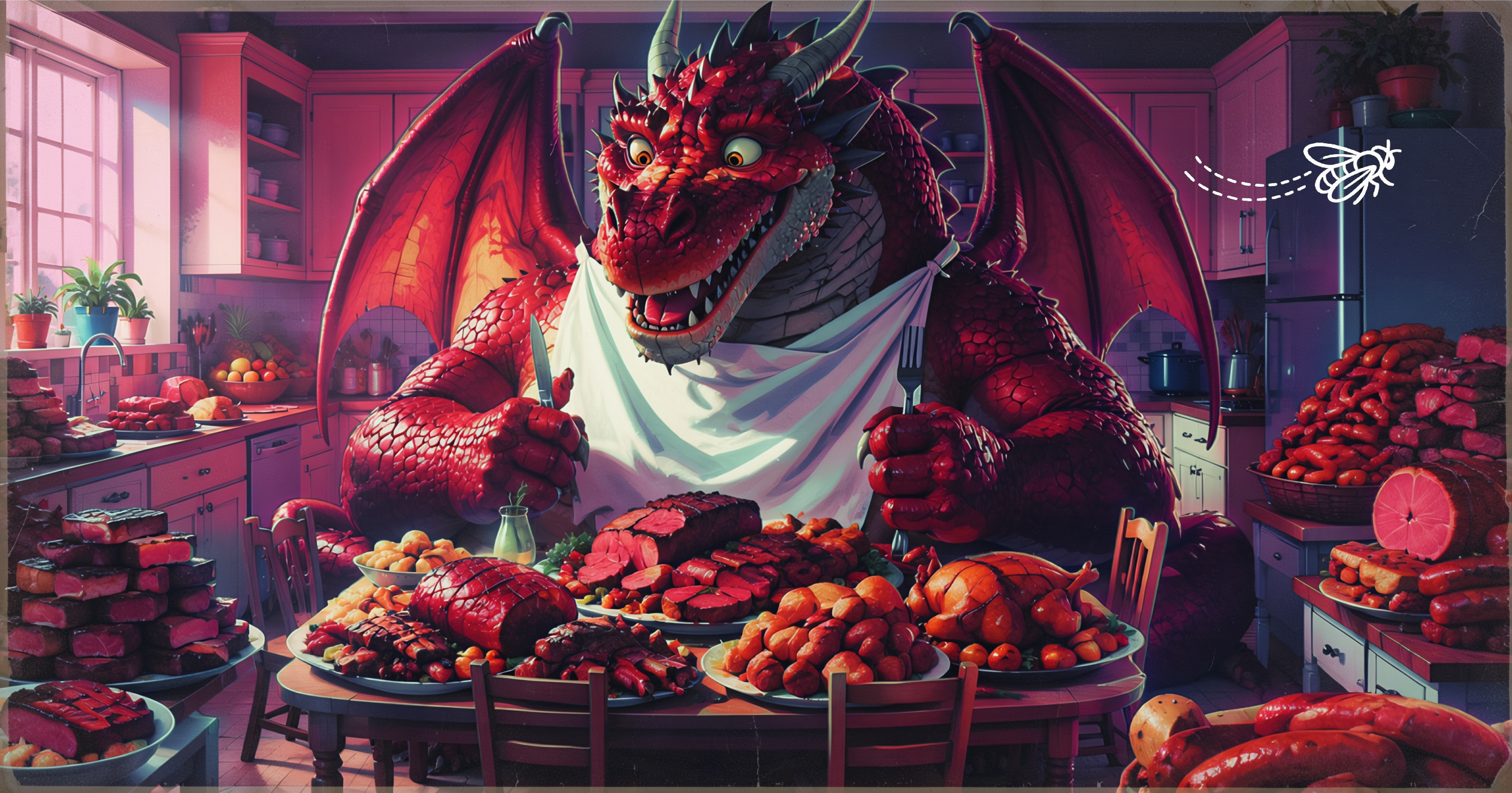
Like food. A lot of food.
Because sure, Daenerys Targaryen gets to stand there looking fabulous while Drogon torches an army, but somebody still has to keep the pantry stocked. And when your pantry has hooves, horns, and a breeding cycle, that gets complicated fast.
And once you start doing the math, owning a dragon looks like the biggest Costco membership kerfuffle in human history.
First problem: the grocery bill
Nobody knows exactly how much a fictional dragon would eat because, minor inconvenience here, dragons aren’t real.
But that hasn’t stopped people from trying to figure it out.
One particularly entertaining analysis looked at the dragons from House of the Dragon and tried to calculate their food intake using information from George R.R. Martin’s world, estimates of medieval livestock weights, and the appetites of modern reptiles.
The result is that these suckers would eat like there was no tomorrow.
The video I found focuses on Caraxes, Daemon Targaryen’s extremely long, extremely angry flying noodle.
Using crocodiles as a biological stand-in, the creator estimates Caraxes at around 550 tons, with a weekly appetite in the neighborhood of 7 million calories.
And apparently Caraxes likes pork.
Why settle for rats when you’re an aristocratic dragon? 🐉
Based on the video’s calculations, keeping Caraxes fed for one week could require roughly 29 pigs, or about 10 cows, or an absolutely horrifying 100 sheep.
At that point, you don’t own a dragon.
You own an agricultural crisis. The dragon gets the cows, the pigs, and the sheep. Everybody else gets lentils.
Here’s the video that sent me down this particular rabbit hole:
Turns out, dragons are horrible roommates
Obviously, those numbers are built on assumptions.
Caraxes doesn’t exist, and nobody put Vhagar on a scale.
Still, this little thought experiment reveals a problem fantasy stories tend to skip right over.
Huge predators require huge amounts of energy.
Even if we scale things down considerably and imagine a dragon weighing more like a very large elephant, you’re still talking about an animal that could feasibly need hundreds of pounds of food a day, depending on its metabolism, activity level, and if it spends Tuesday afternoon torching villagers.
And flying would make everything way worse.
Flying around is expensive… not airline-ticket expensive, but biologically expensive.
Keeping a massive body airborne requires enormous muscles, huge wings, and a steady supply of energy. Add hunting, constant growth, and whatever biological nightmare powers the fire-breathing, and the calorie bill gets ridiculous real fast.
And speaking of breathing fire, which I’m guessing is not powered by positive thoughts… suddenly, the ol’ goat budget has gone completely off the rails.
Congratulations, your dragon just ate the county
Let’s forget Westeros for a minute and just consider what would happen if you plopped a giant predatory dragon into an actual ecosystem.
Bad things, I’m guessing.
A large dragon would sit at the tippy top of the food chain with basically nothing interested in eating it except another dragon.
If our dragon needed livestock-sized meals on a regular basis, local deer, cattle, pigs, sheep, and anything else slow enough to become lunch could disappear pretty quickly. That means farmers are unhappy, and wildlife populations get hammered and dwindle. How are we going to keep feeding the dragons? A human hoagie?
And if dragons reproduced?
Well, congratulations, sir, you’ve just invented an invasive species with wings.
But before we worry about the ecological collapse caused by your new pet, science has an even more annoying question: Could the damn thing fly in the first place?
Science would like a word with your dragon
This is where fantasy starts getting slapped around by physics.
Many classic Western dragons have four legs plus two wings, meaning six limbs total, and that’s the first problem.
Earth’s land vertebrates inherited a four-limb body plan from ancient fish ancestors, and that blueprint is baked pretty deeply into how our skeletons, muscles, nerves, and joints develop. Birds didn’t grow two extra wings. Their front legs became wings. Same with bats.
For a dragon to have four walking legs plus a completely separate pair of wings, evolution would have to build an entirely new set of limbs, along with the bones, muscles, nerves, and support structures to operate them. That’s not a little tweak. That’s basically rewriting the vertebrate instruction manual.
Fantasy doesn’t care about evolution, of course, but science is standing in the corner going, “Cute dragon. Where the hell did the extra arms come from?”
A more believable Earth dragon would look like a bat or pterosaur, with the front limbs modified into wings.
Basically, a wyvern.
I can already hear the fantasy people sharpening their swords… but wait, it gets worse.
The bigger the animal, the more wings you need to lift it. And some of our favorite fictional dragons are absurdly enormous.
MinuteEarth ran the numbers on several famous dragons to see which one had the best shot at surviving an encounter with actual physics.
Spoiler alert: it wasn’t pretty.
The winner, hilariously, was the Hungarian Horntail from Harry Potter and the Goblet of Fire.
It had one of the more plausible combinations of body structure, wings, and weight among the fantasy contenders.
Most of the others would need such ridiculous flight speeds or such enormous wings that the whole arrangement starts collapsing under its own nonsense.
Which brings us to the obvious conclusion… If dragons were real, they’d probably be smaller, lighter, and considerably less impressive than Hollywood promised us.
Okay, but what about the FIRE?
Now we get to the really fun part.
You’d assume this is where science finally throws the entire dragon debate in the dustbin of history.
Flying gigantic reptile? Questionable. Six limbs? Very questionable. Breathing fire? Maybe not completely insane.
Nature has already created animals capable of producing some shockingly nasty chemical weapons.
The best example is the bombardier beetle, an adorable little bug that woke up and chose violence.
When threatened, it mixes chemicals stored separately inside its body, triggering a rapid reaction that blasts a hot spray at predators.
No, it’s not breathing fire, but it is firing near-boiling chemical misery out of its butt.
Nature is magnificent, right?
So if evolution can build that, could some hypothetical animal evolve a system capable of producing a combustible fuel and ejecting it?
Maybe.
One idea is methane.
Digestion already produces methane in plenty of animals. So give our theoretical dragon some specialized internal storage, pressurize the gas, and bada bing, bada boom, we’ve got fuel.
Of course, fuel without ignition just gives you an enormous flying reptile with really bad gas.
So now we need a spark.
Dragon teef suddenly becomes very important
One theory is that dragons could have evolved some kind of hard mineralized structure that produces a spark.
Maybe specialized teeth, perhaps something flint-like inside their mouth.
Maybe the dragon intentionally swallows particular minerals, the way some birds swallow stones to help with digestion.
Another possibility is chemical ignition.
Instead of storing one dangerous flammable substance, a dragon might store two relatively stable compounds separately, only mixing them immediately before firing, kinda like our friend the violent beetle.
That would make the dragon have less “Bic lighter” vibes and more like a flying chemical weapons factory.
Perfect family pet.
Kyle Hill explored several of these ideas in “Because Science,” including methane storage and a bombardier-beetle-style chemical system.
And somehow the fire-breathing part ends up sounding more plausible than anything else.
So what would a real dragon actually look like?
Probably nothing like Drogon.
A biologically plausible dragon would likely need to be far smaller, with a much lighter skeleton and enormous wings relative to its body.
It probably wouldn’t have four legs plus wings.
Its metabolism would need to support extraordinary energy demands. Its feeding territory would probably be enormous.
And if it really had some kind of combustible defense system, you definitely wouldn’t be keeping it in a suburban garage next to your lawn mower. There’s also a good chance a dragon would behave less like a loyal flying horse and more like what it actually is: a giant predator.
Your dog gets excited when you come home. Your dragon might notice you contain calories and eat you.
Totally different relationship.
And we haven’t even discussed the insurance yet
Imagine calling State Farm. It’d go something like this:
“Yes, hi. I’d like to add a pet to my policy.”
Breed?
“Dragon.”
Weight?
“Somewhere between an elephant and the US Capitol building.”
Any history of biting?
“Define biting.”
Fire damage?
“Occasional.”
At that point, your monthly premium is close to our national debt.
And then there’s the rest of the nightmare: zoning, airspace rules, livestock permits, furious neighbors, noise complaints, and whatever the EPA has to say about a 40-foot reptile torching everybody’s backyard.
I’m starting to understand why the Targaryens lived in remote castles. No HOA, looky-loos.
So, can you afford one?
If we accept the “House of the Dragon” video’s assumptions, feeding a large dragon could easily run into hundreds of thousands or even millions of dollars per year, depending on what you fed it.
And that’s before veterinary care, property damage, the 700-acre enclosure, and the inevitable lawsuit when Gary next door gets flambéed while getting his mail. At that point, the real fantasy in “Game of Thrones” isn’t the dragons. It’s affordable dragon ownership.
Still want one?
Yeah. Me too.
THE LANDING
Turns out, the hardest part of owning a dragon wouldn’t be surviving the fire. It’d be surviving the grocery bill.
STAY CURIOUS
Three more stories worth your curiosity.







Post Comment