🪰 How Bonanza’s $2.79 T-Bone Dinner Helped Define America’s Steakhouse Glory Days
THE BUZZ
- $2.79 once bought a full T-bone dinner
- America turned steak into a national obsession
- Somehow, well-done is still winning
Every once in a while I find an old menu item that makes me want to crawl through the screen and order dinner… from 1977.
This is one of those menus.
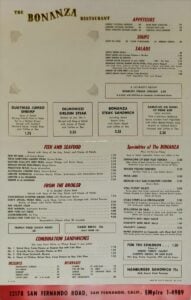
Back in the good ol’ days, Bonanza was advertising a T-bone steak dinner for $2.79.
Not $2.79 for the potato or a sad little side salad. The whole shebang.
You got an eight-ounce T-bone steak, a baked potato, Texas toast, and unlimited trips to the Bonanza salad bar, plus coffee or tea with free refills.
What the actual F…
Now, I know inflation exists, and I understand how time works. But please allow me to be butthurt anyway.
Because even beyond the price, there’s something wonderfully old-school about the whole deal. At Bonanza, steak wasn’t treated like a luxury experience. It was dinner. You showed up hungry, ordered your T-bone, hit the salad bar HARD, and got on with your evening.
It was steak for regular people, and America absolutely loved it.
$2.79 AND THEY THREW IN THE SALAD BAR
And that salad bar was like 5 miles long and had everything from those weird little baby corn things to bacon bits.
Bonanza’s whole personality revolved around making steak feel accessible.
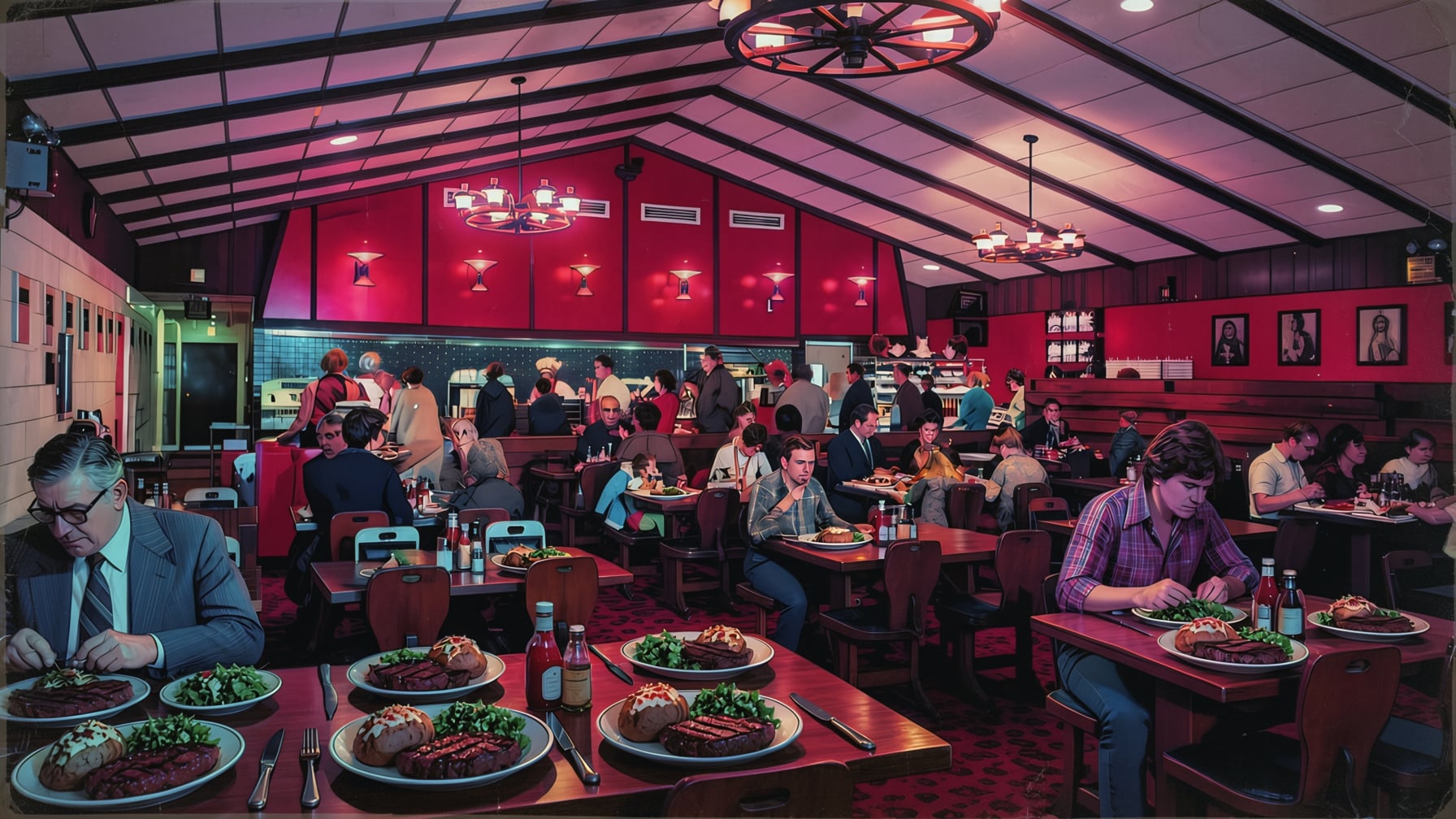
The restaurant had that classic Western steakhouse energy, where the food was hearty, the room was casual, and nobody knew what “dry-aged” meant. They even had a wagon-wheel chandelier, for crying out loud.
Then came this 1977 special…
A T-bone already has a little drama built into it because you’re getting two kinds of steak separated by that famous T-shaped bone. Add a baked potato, Texas toast, unlimited salad, and bottomless coffee or tea, all for $2.79. I paid more than that for a tube of no-name toothpaste the other day.
And this old Bonanza commercial I happened upon is a tiny time capsule from the good ol’ days gone by.
There’s no elaborate sales pitch because there didn’t need to be one. The deal itself did all the hard lifting.
BOOM, shakalaka.
@70sglowbellbottoms 🥩✨ 70s Glow & Bell-Bottoms Memory Lane! ✨🥩 Remember Bonanza Steakhouse? 🍽️❤️ Back in the 70s, it was all about a good steak, baked potatoes, salad bars, and that classic Western-themed atmosphere. 🤠🥔🥩 For many families, a trip to Bonanza was a special night out—and somehow the food just tasted better when you were a kid! 😋 Did your family eat at Bonanza Steakhouse in the 70s? What did you always order? 👇 #70sNostalgia #BonanzaSteakhouse #70sKids #RetroMemories #70sGlowAndBellBottoms
Today, a dinner at a typical chain steakhouse runs around $35 to $55 per person.
Yeah, yeah, I know, costs change, portions change, restaurants change, and nearly fifty years have passed. Got it.
But still, looking at that Bonanza meal makes the modern steakhouse check sting a little more… especially when some joker at the table orders an appetizer.
BEFORE BONANZA BECAME NOSTALGIA
Bonanza wasn’t some tiny roadside steak joint. It became a massive chain and really helped define America’s love affair with steakhouses.
Its roots went back to actor Dan Blocker, who played Hoss Cartwright on the television series Bonanza. I bet you didn’t know that. I sure didn’t. He opened the original Bonanza Sirloin Pit in 1963 with a Western theme and an idea that feels a bit radical now: make steak cheap enough that ordinary families could go out and eat it regularly.
As you can imagine, the concept caught on real quick.
After Blocker sold the growing business, Bonanza expanded like gangbusters, eventually reaching hundreds of locations and becoming one of the country’s most well-known family steakhouse chains.
Then came Ponderosa, another Western-themed steakhouse inspired by the same Western television, and the two eventually wound up under the same corporate roof.
The story after that is the all-too-familiar restaurant-chain roller coaster ride: huge growth, ownership changes, mergers, bankruptcy, and locations slowly disappearing off the map.
This short video walks through the whole rise-and-fall story, including one particularly funny chapter where Bonanza and Ponderosa managed to get into a trademark mess that turned into a real-life sitcom moment.
What I love about early Bonanza is how ordinary and honest the mission was. Their mission was to get beef onto the table at a price families could handle. And Bonanza arrived when America was at the peak of her steak obsession.
AMERICA AND STEAK: A LOVE STORY WITH BUTTER
Steak feels so thoroughly American now that it’s easy to forget there was a time when fresh beef was way harder to get depending on where you lived.
But our relationship with steak changed as the country did.
This history of America’s beef obsession puts it beautifully.
The tale of beef in these United States has always been a love story. In 1812, seeking to portray himself as a man of the people, Presidential candidate William Henry Harrison said that he had simple tastes: unsalted raw beef. Steak is the American dish. With all due respect to vegetarians, whom I admire if for no other reason than for the discipline it must take not to give in and have the big, pink ribeye of their dreams, steak is perhaps our nation’s most significant food contribution to the world. And while a strong case could be made for the hamburger, I think we all know that the hamburger is a great backyard barbecue staple, but when the occasion calls for serious beef consumption, the steak is the only way to go.
How did it happen? We might as well ask how it didn’t happen sooner – and the answer to that lies in a horrible can of stringy roast beef. Before refrigeration, the methods employed to preserve meat were either curing or canning. And while pork can be cured in a variety of palate-pleasing ways, not to mention processed and canned into dubiously tasty products like Spam, similarly preserved beef failed to make much headway in 19th century America. Probably because canned beef was decidedly gross.
Thus, beef remained a seasonal treat for much of the country, only available in the proximity of the herds of cattle themselves. Indeed, before the Civil War, most of the beef in the United States was raised, slaughtered, and eaten at most a couple of hundred miles away from where it was born.
Then, to make a very complicated story much shorter than it deserves, a bunch of stuff happened that made it much easier to get your hands on fresh beef.
For one, the decimation of the bison on the continent’s prairies had opened up a whole lot of grazing land, not to mention clearing the way for a transcontinental railroad. Then, technological advances such as refrigerated train cars meant that beef, alive or slaughtered, could be easily transported anywhere in the country. A cow that had grown fat munching Montana grass might find its way onto a New York City steakhouse plate by way of a Chicago stockyard.
Refrigeration and transportation changed the geography of dinner. Beef raised hundreds or thousands of miles away could now quickly end up on a plate in a city where there were no ranches for a zillion miles.
From there, America did what America does when she finds something delicious…
She built an entire culture around it. Right down to our little steakhouse rituals, like dark booths, giant stuffed baked potatoes, martinis, creamed spinach, sizzling plates, and enormous cuts and servers asking the most important question of the evening:
“How would you like that cooked?”
Which brings me to some rather disturbing information, folks.
WE NEED TO TALK ABOUT WELL-DONE STEAK
Apparently, well-done is the most popular steak temperature in America, with medium-rare running very close behind.
I needed a minute after learning this.
Hold on…
Okay. Are some of you people nuts? Medium-rare gives you that warm red center and juicy texture steak people get misty-eyed over.
Well-done gives you plenty of time to finish your tax returns while the steak is cooking and ends up tasting like shoe leather.
I’m kidding.
Not really.
But however you order it, order it medium rare, for the love of God. For some reason, Americans have developed some very clear preferences around their beef.
Grilling over an open flame, especially charcoal, is the #1 favorite cooking method. Traditional favorites cuts are T-bones and porterhouses, with ribeyes and filet mignon close behind. And seasoning favorites are simple: good ol’ salt and pepper. And please, for the love of steak, put the bottle of A1 down.
And when the steak hits the table, what do Americans want beside it?
A baked potato.
Of course we do. Damn, we’re good.
Which makes that old Bonanza special even more perfect. T-bone, baked potato, bread, salad bar.
They really understood the assignment, guys.
FROM $2.79 BONANZA TO THE BIG-LEAGUE STEAKHOUSE
At the opposite end of the steak spectrum sits a place like Peter Luger Steak House in Brooklyn.
It’s one of those names that comes up constantly when people argue about America’s great steakhouses, and the experience is a long way from the bargain-family-steakhouse world Bonanza was built around. A meal there can run roughly $100 to $150 per person, before tax and tip.
Ouch.
That’s not really an apples-to-apples comparison with Bonanza, obviously, but we’re just talking about steak at this point.
But when you put them side by side, it actually tells you something about how vast America’s steak obsession really is.
We want the $2.79 special… and we also want the legendary Brooklyn steak that costs more than your electric bill.
Apparently, our commitment to beef contains many layers.
THE STEAKHOUSE WAS NEVER JUST ABOUT STEAK
I think that’s why these old Bonanza menus hit such a nostalgic nerve.
It isn’t only because everything looks absurdly cheap. Places like Bonanza turned steak dinner into something ordinary families could do together. You could pile everyone into the car, hit the salad bar, order your baked potato, and feel like you were having a proper night out without needing to take out a second mortgage.
The steakhouse gave Americans a little luxury without requiring a luxury wallet.
You got a hearty dinner, without all the fuss or those tiny artistic puddles of sauce.
Just a piece of beef occupying a fairly respectable percentage of the plate.
There’s something kinda nice about that.
And no, I’m not expecting somebody to reopen Bonanza tomorrow and hand me a T-bone dinner for $2.79.
Although if anyone wants to, I’ll clear my schedule.
What I love about that old special is what it represents. Steak had become this quintessential American meal, and chains like Bonanza figured out how to take something that once felt elite and make it available to regular Joe’s.
So, in the end, Americans never fell out of love with steak.
We just got a much bigger bill…
THE LANDING
America’s love affair with steak survived just fine; the $2.79 dinner is the part we lost.

Post Comment