🪰 The Human Superpower We Barely Think About

THE BUZZ
- Your shoulder came with some impressive equipment.
- A chimp won’t be stealing your pitching job.
- Suddenly, “throws like a human” sounds pretty intimidating.
Your Dog Thinks You’re a Wizard
Throw a tennis ball across your lawn, and your dog will chase it down, bring it back, and demand another round. Meanwhile, the biggest thing on your mind is how much slobber will be on the ball.
But that casual little throw deserves some more appreciation. Sending an object flying toward a chosen target, with both speed and accuracy, is something humans are exceptionally good at. In fact, we’re one of the only species that’s especially skilled at it. It’s literally what separates us from animals.
The video below explores that overlooked talent and how it may have helped our ancestors become more effective hunters. Basically, without the skill we’ve acquired over the ages with throwing, we’d likely still be drawing doodles on cave walls with rumbling tummies.
Other animals do throw things, including chimpanzees. But what sets us apart is how much power and precision we can put behind a throw. Researcher Neil Roach, who studies the evolution of this ability, points out that chimps’ anatomy limits their throwing performance, despite their strength.
A chimp has plenty going for it, but a promising baseball career probably isn’t one of them.
Your Shoulder Came With a Slingshot
Watch a pitcher in slow motion and you’ll notice how much happens before the ball leaves the hand. The body turns, the arm draws back, and everything seems to unwind into the release.
@mlb Paul Skenes throwing some absolute fiiiiiilth 🤢 #WorldBaseballClassic #mlb #baseball #TeamUSA #pitcher ♬ original sound – MLB
There’s a reason a powerful throw involves all that movement.
In a study published in Nature in 2013, Roach and his colleagues tracked 20 male throwers, most of them college baseball players. They used motion-capture equipment and braces that restricted movement to investigate how different parts of the body contributed to a throw.
They found that drawing the arm back stretches tissues crossing the shoulder, storing energy that can then be released rapidly. Think of pulling back a slingshot: your muscles help set everything up, and that stored energy adds power as the arm comes forward.
Turns out, the windup is doing more than making the pitcher look cool.
Our mobile waist, shoulder position, and upper-arm anatomy help make this possible. The researchers say that the key features first appeared together in Homo erectus roughly two million years ago, creating the physical setup for powerful throwing.
That doesn’t mean every person automatically has a fastball worth scouting. Basically, the “equipment” comes standard, but learning to use it is another matter.
A Rock Changed the Negotiations
Now put all of this throwing ability somewhere less common than a modern baseball field.
Being able to reach something like an animal with a projectile changes how close you have to get to it. That’s a useful option when the other party comes equipped with self-defense features like horns and has absolutely no interest in becoming someone’s dinner.
Roach and his colleagues propose that throwing helped early humans hunt more effectively, and the timing of the anatomical changes lines up with evidence of increased hunting, although exactly what our ancestors were throwing two million years ago remains a bit of a mystery.
Later, wooden weapons give researchers something more tangible to test.
In a 2019 experiment, six trained javelin athletes threw replicas of a prehistoric wooden spear found in Schöningen, Germany. They managed to hit a target at distances of up to 20 meters, roughly 66 feet. Accuracy dropped with distance, and plenty of throws missed, but the results showed that these spears could function as long-distance weapons in skilled hands.
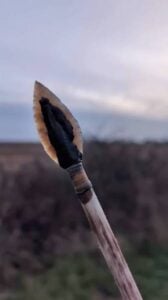
That’s quite a capability for a sharpened piece of wood, and it also helps explain why practice mattered. Having the right shoulders wouldn’t make someone an expert hunter any more than owning running shoes gets you into the Olympics.
And distance didn’t make hunting risk-free. It simply gave hunters more options, which could matter a lot when getting too close came with consequences.
All That Evolution. Now Go Fetch.
The first video takes the evolution of the human throw all the way from imagination, mathematics, and modern warfare. It’s a fascinating timeline, but connecting throwing to the origins of civilization requires bit more evidence than demonstrating how a shoulder works.
Still, the physical ability is impressive enough on its own.
Humans can launch objects beyond their reach and, with practice, send them toward remarkably specific places. Nowadays, most of us learn that skill through backyard games rather than survival, so it’s easy to overlook what a unique skill it is.

So the next time you’re standing in the park with a soggy tennis ball, there’s a little evolutionary history in that familiar windup. But don’t ponder for too long. Your dog would just appreciate it if you’d stop thinking about it and throw the damn thing.
THE LANDING
We keep imagining what it would be like to have a superpower, then casually throw a ball across a field.
STAY CURIOUS
Three more stories worth your curiosity.

 Your Brain Could Be Fighting a ‘Turf War’ Every Night While You Sleep





Post Comment