🪰 Your Brain Could Be Fighting a ‘Turf War’ Every Night While You Sleep
THE BUZZ
- Your brain may have a squatter problem.
- Those bizarre dreams could be pulling security duty.
- Apparently, brain space is prime real estate.
You’re Asleep. The Neighbors Have Plans.
You know those wild dreams where you’re back in high school, but your boss is teaching algebra and somehow you’ve arrived without pants? Then you wake up, wondering what the hell that was about, and go make some coffee.
Well, neuroscientist and author Dr. David Eagleman has a theory that gives the whole “wild dream” phenomenon a pretty practical purpose: your brain could just be defending its territory.
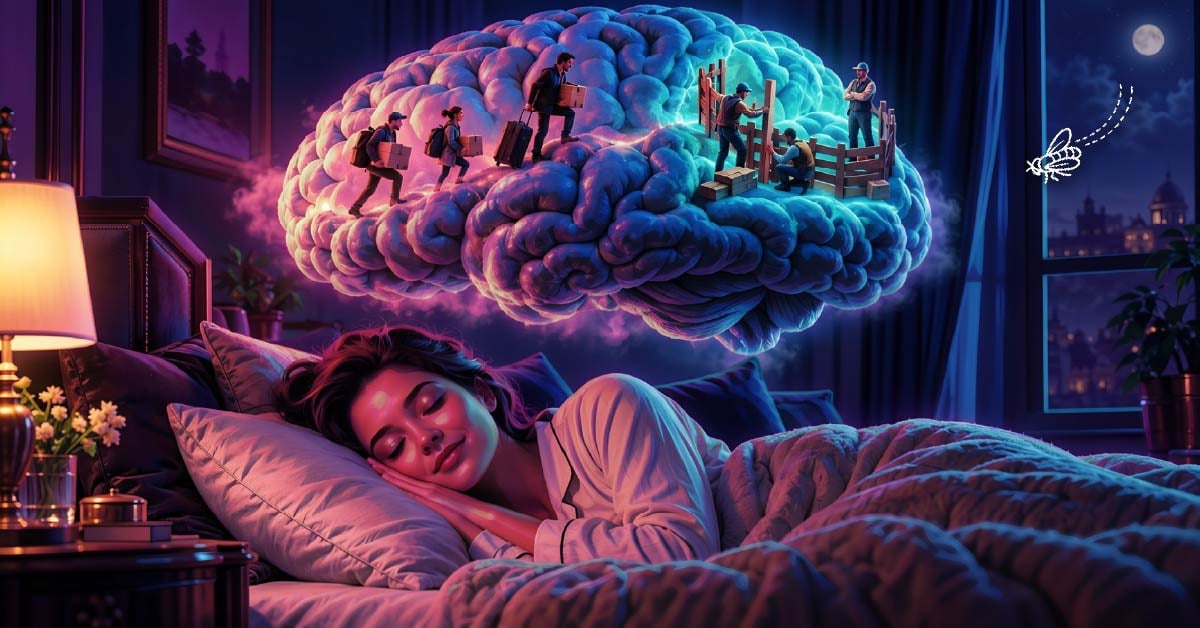
Speaking with Steven Bartlett on The Diary of a CEO, Eagleman describes a possible “turf war” inside our sleeping brains. How he explains it is that our visual systems get less outside input when it’s dark, while hearing and touch can keep picking things up. His theory is that dreaming helps the visual system stay active so the other senses don’t start moving in.
Apparently, even inside your own head, you can’t simply leave a part of it unattended.
@thelasttape_ You should know about this #expert #podcasts #diaryofaceo #sleep #brain ♬ original sound – The Last Tape
Eagleman and researcher Don Vaughn published this idea as the defensive activation theory in 2021. It’s a proposed explanation for the function of REM sleep. This isn’t a conclusive solution to some kind of mystery, but it’s their theory that the brain is using REM to repurpose space.
Apparently, Brain Space Is Prime Real Estate
We tend to picture the brain as having neat little departments. Vision works over here. Hearing has an office down the hall. Everybody knows their job and its location.
But apparently, the actual arrangement is a lot more flexible.
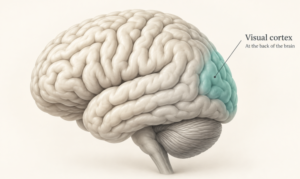
Research on blindness shows that regions ordinarily associated with vision can help process information from other senses. And some changes can happen surprisingly quickly. In a study involving sighted, blindfolded participants, researchers detected activity in the primary visual cortex during touch-based tasks. The researchers later reported that they observed this activity after just 40 to 60 minutes of blindfolding.
Then a separate study involved five days of blindfolding and intensive tactile training. Participants’ visual brain regions became more responsive to touch, but that increased response was no longer present 24 hours after the blindfold came off. The researchers claim that during this experiment, existing connections were being revealed or strengthened, rather than it being an entirely new network being built overnight.
This isn’t necessarily evidence that wearing a sleep mask starts permanently affecting your eyesight, but it shows how adaptable the brain can be when its usual input changes.
Your Weird Dream Has Picked Up a Security Shift
Here’s where Eagleman’s theory comes into play and connects that visual cortex flexibility to when our heads hit the pillow.
In his explanation, periodic bursts of activity stimulate the visual system during REM sleep. That activity could help it hold onto its territory while outside visual input is reduced.
Meanwhile, as he puts it in the clip, the brain is “a natural storyteller,” so it turns the activity into a visual experience, drawing on whatever was spinning around inside your noggin from the day.
Which might explain why this supposed “security system” comes with a super random subplot involving your former boyfriend dressed up as Little Miss Piggy.
It’s an interesting observation: Eagleman is showing there’s a reason for all this nighttime activity, rather than offering a secret translation of every dream. With his theory, the visual system staying busy matters more than whether your dream makes any sense.
@funiser.com REM vs Non-REM Sleep Explained What’s the real difference between REM and deep sleep? One restores your body. The other refreshes your brain. Learn how both stages work together for better rest. #SleepFacts #BetterSleep #WellnessTok #SleepHealth #HealthyHabits #AdultSleep #sleepbetter #neckpain #cervicalpillow #sleephealth #bettersleep #insomnia #whitenoise #fallasleep #sleeptips #bedtimeroutine #mentalcalm #nighttime #QualitySleep ♬ 原声 – funiser
A Good Theory Still Has to Show Its Work
To investigate their theory, Eagleman and Vaughn compared 25 primate species. They looked at how quickly the animals grew up as an indicator of how flexible their brains might be, and the species that reigned supreme tended to be the ones that got more REM sleep.
That all ties into the idea that a more flexible brain might need extra help keeping its visual space occupied. But the researchers weren’t actually watching dreams to see when dreaming stopped other senses from moving in on their turf. Obviously that’s not possible. But still, they found a pattern worth investigating, and they’re going to keep researching until their theory holds up.
So when Bartlett asks whether dreaming keeps us from going blind, and Eagleman agrees, that’s getting a wee bit ahead of what this research can tell us. It’s an interesting theory, yes. But ironclad proof that your eyesight depends on tonight’s weird dream? We’re not there yet.
THE LANDING
We still don’t know exactly why we dream, but “keeping the neighbors out” is a pretty good plot twist.
STAY CURIOUS
Three more stories worth your curiosity.








1 comment