🪰 Real Girl Bosses: When US Switchboard Operators Ruled the World
THE BUZZ
- Before algorithms ran the world, these women did.
- These dames ran America one cord at a time.
- Then Bell automated the girl bosses right out.
There was a time when you couldn’t call your mother across town, ring a doctor two states away, or conduct business across the country without a woman sitting somewhere in a giant room full of blinking lights willing to make it happen.
There weren’t apps or touchscreens, and definitely no invisible iClouds hovering around, doing all the heavy lifting.
Back in the good ol’ days it was just a headset, a switchboard, a fistful of cords, and one seriously busy dame…
These were the glory days, when the US switchboard operator ruled the world.
And these women were good.
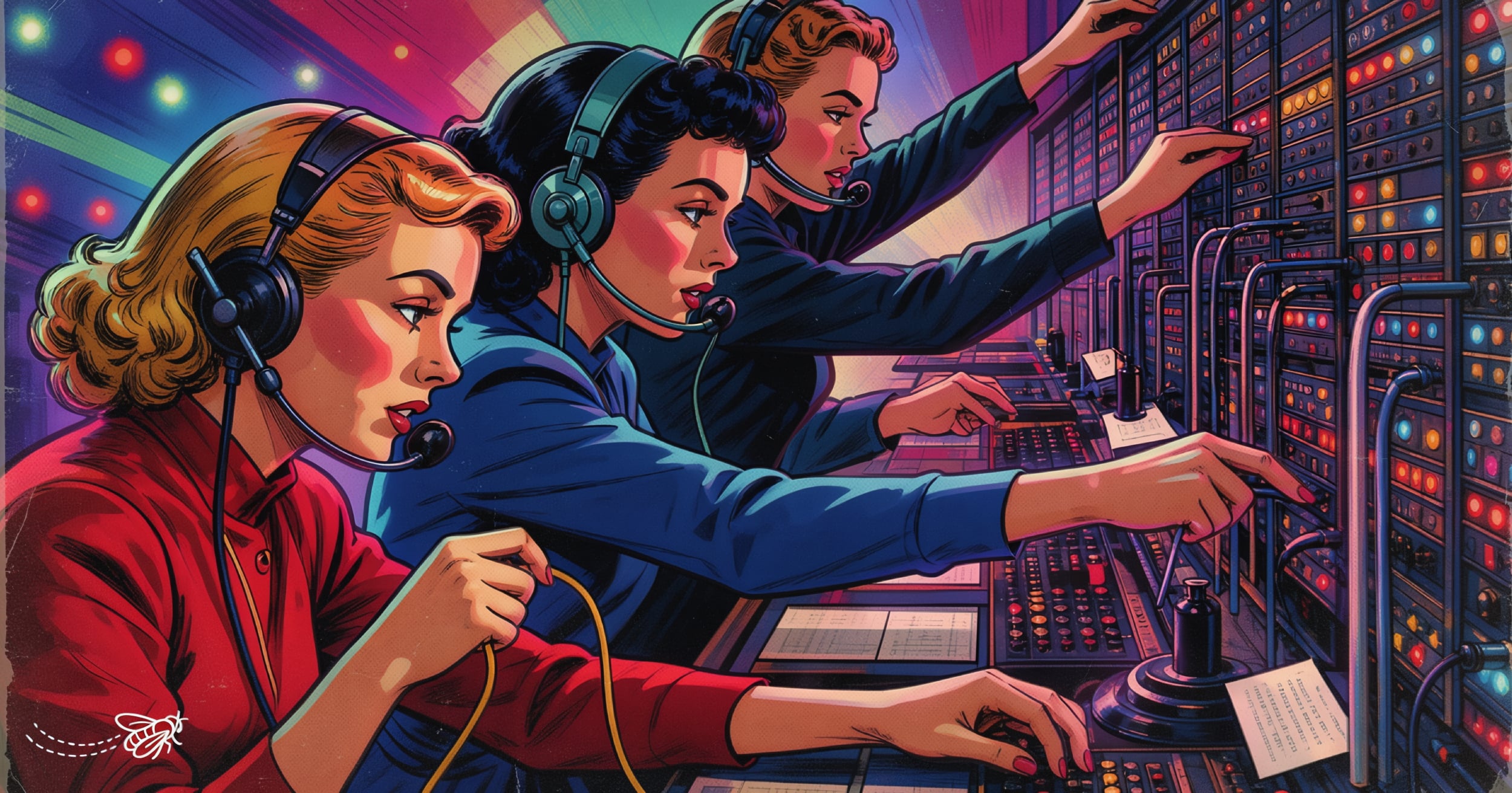
By the early 1950s, switchboard operators had become one of the most vital parts of the American telephone system. By the early 1950s, these women were smack in the middle of how America communicated. In big city phone offices, they sat shoulder to shoulder in front of giant switchboards, yanking cords, connecting calls, and keeping up with walls of blinking lights that never stopped blinking.
If America wanted to talk, somebody had to make the connection… and for a really long time, that somebody was her, the OG “girl boss.”
But there was a catch. These women weren’t just operators. They had to operate with the precision of a machine, way before the machines got good enough to replace them. Back in the day, operators weren’t just taught how to connect calls. Everything they said, and even how they said it, was scripted. The fine folks at Ma Bell even monitored their posture. Was this a switchboard or a catwalk? Their timing was measured, supervisors could secretly listen in while they worked, and even something as ordinary as taking off a headset to scratch your ear could require permission.
Suddenly your annoying Zoom meeting that you do in your pajama bottoms doesn’t seem quite so oppressive, right?
And all of this was happening while the technology that would eventually wipe them out was already being installed across the country.
That’s what makes this story so damn fascinating.
The women running one of the most important communication networks on Earth were being trained to behave like machines at the exact moment machines were learning how to do without them.
“Number, Please.”
The video below takes us straight inside that world through the story of a young Illinois Bell operator in 1953 and the rules that governed every movement she made at the board.
Some of the rules sound like normal workplace stuff, but others sound completely bonkers.
And when you get to the reason Bell cared so much about all that discipline, the whole thing gets even more interesting.
Bell Owned the Voice, Too
What makes the switchboard era so fascinating to me is that Bell wasn’t satisfied with teaching women how to operate the equipment. The company wanted control over the voice coming through it, too.
The video described operator manuals that limited women to a specific vocabulary of approved expressions, right down to how certain phrases were supposed to sound. “One moment, please” wasn’t something you tossed out in whatever tone matched your mood that morning. Bell cared about the wording, the enunciation, the pace, and even the warmth behind it, which is where the company’s famous idea of “the voice with a smile” came in.
Operators were trained to smile while they spoke because callers could hear the difference, and Bell figured if America was going to spend half its day asking a woman to connect it somewhere, she better sound pleasant while doing it.
But seriously, imagine keeping that charade up for hundreds of calls while wearing a metal-and-cloth headset against your ear, watching the board light up in front of you like a Christmas tree, and knowing that somewhere behind your chair a supervisor was probably listening to every syllable you “smiled” out.
Your Boss Could Literally Drop Into Your Headset
Supervisors could plug into an operator’s line without warning and listen while she worked, checking whether she was fast enough, polite enough, and sticking to Bell’s rules. The video described operators becoming so familiar with the system that some figured out the tiny click that suggested the boss had joined the call.
And the scrutiny didn’t stop with the voice. Bell had rules for how operators sat, where they looked, how they held a plug, where the headset rested near the mouth, and whether they could chat with the gal sitting one seat over. Even something as ridiculous as taking an aspirin could require being relieved from your post. Because God forbid you took your eyes off the board for .2 seconds.
If you needed to get up, somebody else had to take over your position, and the handoff could be so literal that the incoming operator took the connecting cord before the other woman left the chair. I think by now you can tell Bell wasn’t running a casual office full of ladies answering phones. It was running a living communications machine, and every woman sitting at that board was one of its moving parts… for better or worse.
These Women Were the Network
Old photographs don’t really do this job justice. They make switchboard rooms look strangely calm, with rows of nicely dressed women sitting in front of giant boards that now seem almost quaint.
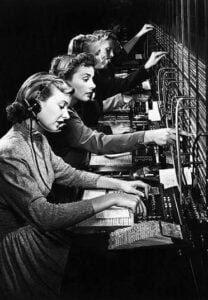
But the actual work wasn’t quaint. It was controlled chaos.
According to the history discussed in the video, a busy operator could handle an enormous number of calls while keeping track of lights, cords, voices, connections, and whatever was coming next. Her hands were constantly moving while her eyes scanned the board and her headset kept feeding another call directly into her ear.
There was no software sorting out the mess for her. The board gave her the tools, but the woman sitting in front of it still had to understand what was happening and move fast enough to keep everything flowing.
That’s why the “girl boss” thing actually fits these dames better than it does half the people hijacking the title today. They weren’t posing next to a laptop with a motivational coffee mug. They were sitting inside one of the most important communication systems in the country and making the whole thing work.
And some of them knew a helluva lot more than which hole the cord went into.
In a Small Town, the Operator Knew EVERYTHING
Bell operators were forbidden from listening to conversations they connected. And repeating something they overheard could cost a woman her job. That makes sense when you consider how much private information passed through those headsets every day.
But small-town switchboards had their own reality.
The video takes us to Bryant Pond, Maine, where the old-school switchboard somehow hung on until 1983. And in little towns like that, the woman working the board didn’t need caller ID. She already knew who you were. She knew which doctor could be dragged out of bed at four in the morning, which family had somebody sick at home, and whose kid was serving overseas. That wasn’t just small-town nosiness, either. Knowing everybody and everything actually made her damn good at the job.
That kind of operator wasn’t just routing calls. She was woven into the town.
Of course, I would’ve been very careful about discussing anything scandalous over the telephone. There’s privacy, and then there’s handing your neighborhood business directly to the woman who knows your mother, doctor, and probably what time your husband gets home.
No thanks.
All That Responsibility for $1.55 an Hour
Here’s where our girl-boss fantasy starts running out of gas. The women doing all this thankless work weren’t exactly being paid like the communications backbone of America.
The video cites a 1956 Bureau of Labor Statistics study showing roughly 159,000 experienced women working as switchboard operators, making them the largest single group of telephone workers covered by the study. Their average pay was just $1.55 an hour, or about $57 a week on the average schedule described there. Adjusted for inflation, that works out to roughly $19 an hour today, or about $702 a week.
For women carrying that much responsibility, it wasn’t exactly girl-boss money.
And the fight over telephone work had been brewing long before those 1956 numbers were collected. Nearly a decade earlier, in 1947, around 350,000 telephone workers walked out in the first nationwide telephone strike, shutting down much of the system for five long weeks. Apparently the smile had limits.
The strike became its own major chapter in telephone history and helped lead to the creation of the Communications Workers of America.
Bell Was Picky About Who Got the Headset
Getting into one of those chairs wasn’t just a matter of knowing how to plug in a cord.
The video described voice auditions used in hiring and cites AT&T archival material showing that clear enunciation was considered an important qualification. That preference for a neutral “Bell voice” could work against women with strong regional accents, immigrant accents, or other speech patterns the company didn’t want coming through its telephone system.
Bell was cultivating a particular sound, and it started deciding who fit that sound before the woman ever got a headset.
The control followed her inside… her clothing was expected to meet company standards, hair had to look appropriate, and supervisors could enforce a dress code, even when operators weren’t wearing an official uniform.
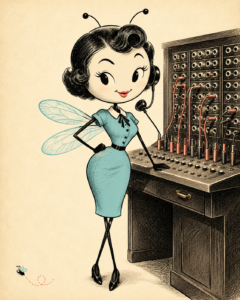
There’s something almost bizarre about how carefully Bell engineered the entire human package. It selected the voice, trained the smile, watched the posture, monitored the calls, and regulated the woman sitting in the chair with astonishing precision.
Which, as I mentioned earlier, becomes a whole lot more interesting once you realize that Ma Bell was already figuring out how to get rid of the chair.
Then the Telephone Learned to Bypass the Girl Boss
On November 10, 1951, the mayor of Englewood, New Jersey, picked up a telephone and dialed the mayor of Alameda, California, directly.
No operator had to make the connection.
The call went through in about 18 seconds using a new system called direct distance dialing, and suddenly one of the most important jobs in American communications had an expiration date looming.
By the time our 1953 operator was sitting at her board, that technology was already spreading through the Bell network. The video notes that Bell’s operator workforce fell from a 1950 peak of roughly 342,000 to fewer than 250,000 by 1960, while researchers studying cities that switched to dialing found especially steep drops in employment among young women who had been working as operators.
There’s no need to romanticize the job to appreciate what those women were doing before that happened. The rules could be suffocating, the surveillance was intense, the pay wasn’t particularly impressive, and the company controlled parts of their workday that would make most of us laugh today.
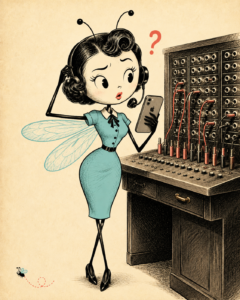
But while they were there, they mattered, and they ruled the world.
Before the Cloud, There Were the Ladies at the Board
For decades, an incredible amount of American life traveled through rooms full of women wearing headsets.
A business deal headed across the country might pass through their hands. So could news of a birth, a death, a sick parent, a stranded traveler, a doctor needed in the middle of the night, or two people who simply missed each other and wanted to hear a familiar voice.
The technology kept shrinking after that. Switchboards gave way to dialing, dialing gave way to computers, and eventually almost the entire process disappeared into systems most of us never think about these days.
But there was a time when making America feel connected required an actual person sitting on the other end of the line, watching for your light and reaching for the cord that would send your voice where it needed to go.
And that person was one seriously capable dame.
THE LANDING
Before America put its connections in the cloud, it put them in the hands of women.
STAY CURIOUS
Three more stories worth your curiosity.







1 comment