🪰 If You Don’t Cook This Mushroom Thoroughly, You’ll See ‘Tiny People’ Dancing on Your Dinner Plate
THE BUZZ
- Eat it too soon. Hello, tiny dancers.
- Scientists still don’t know what causes it.
- People keep eating it anyway.
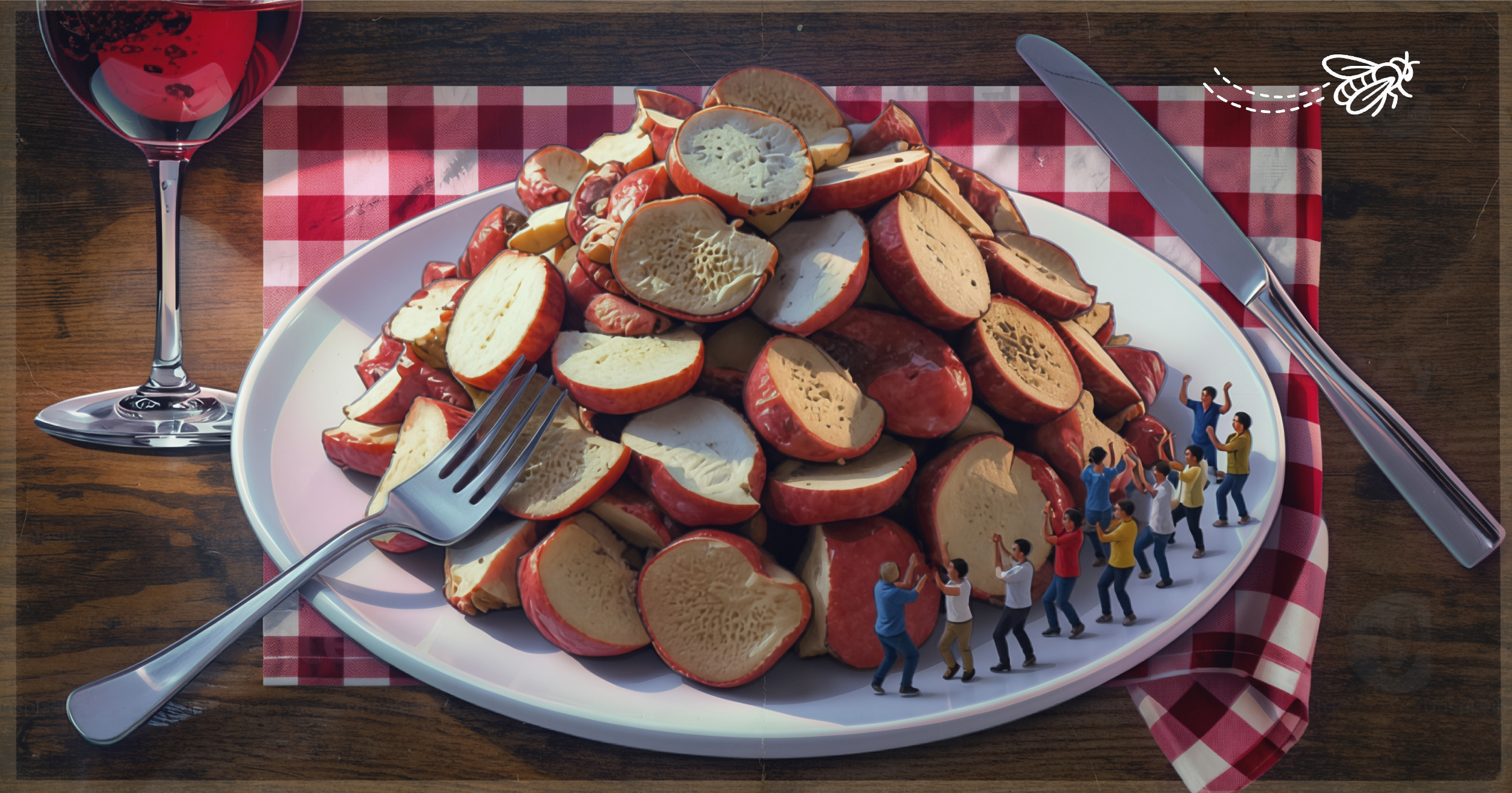
Imagine you’re sitting in a highly rated restaurant in China. You order mushroom hot pot, and the waiter sets a timer beside your bowl for about 15 minutes.
Why?
Because if you dive in too soon, you may spend the next few hours watching tiny fairy-like people dance across your plate, climb the salt shakers, or take a swim in your soup.
Welcome to dinner in Yunnan, China.
The mushroom behind this little dinner-table dance party is called Lanmaoa asiatica. It’s a meaty, reddish wild mushroom found in southwest China. Locals call it jian shou qing, which roughly translates to “turns blue in the hand” because the flesh quickly changes color when it’s touched or cut.
But here’s the really wild part: scientists didn’t formally describe the species until 2015, even though people in Yunnan had been buying, cooking, and eating it for decades.
And here’s another twist: it’s more closely related to your friendly neighborhood porcini than it is to the psychedelic, hallucinogenic mushrooms.
Researchers have confirmed through DNA sequencing that the same species of mushroom is also eaten by communities in the northern Philippines, where people also reported the same bizarre side effect: little humanlike happy, dancing figures appearing before their eyes. A 2026 University of Utah study confirmed the China and Philippines mushrooms were both Lanmaoa asiatica.
But again, these fungi aren’t the usual psychedelic fireworks, breathing walls, or “I have become one with the universe” sorta thing.
People describe dozens or even hundreds of tiny little people, sometimes looking like elves, clowns, or other colorful mini characters, dancing and walking around like it’s no big deal. Researchers say the figures can appear roughly 1 inch to about a foot tall. They fall off tables, climb around furniture, throw a dance party on your plate, and interact with whatever happens to be in front of the person seeing them. One person told researchers they saw tiny people jumping from a spoon into their bowl of soup, swimming around.
Undercook one of these suckers, and your dining room might turn into a scene from Honey, I Shrunk the Kids.
Scientists actually have a name for this bizarre little-people invasion: Lilliputian hallucinations, named after the tiny residents of Gulliver’s Travels.
So… was Gulliver undercooking his mushrooms?

But here’s where it gets even weirder. Researchers have dug through Lanmaoa asiatica looking for the usual “hallucinogenic” suspects, including psilocybin, and found nothing.
This is very interesting, because whatever is sending tiny people marching across dinner plates might be something scientists haven’t identified yet. This mushroom could be hiding an entirely new hallucinogenic compound.
But before we get too deep into the fungal weeds, this clip does a pretty spectacular job of explaining why a perfectly legal dinner mushroom has scientists chasing an unknown chemical while diners are apparently chasing tiny people off their plates.
@jasonkpargin
The wildest part of that video is that the little-people phenomenon isn’t some TikTok fairy tale. Scientists have documented it, and the mushroom has been DNA-confirmed in two distant regions where people independently reported weirdly similar experiences, and researchers still don’t know which compound is making the “magic.”
But there’s another part of this story that may be even harder to understand…
People keep eating the damn mushroom.
But it’s not because they’re trying to hallucinate. In Yunnan, this mushroom is a prized seasonal food sold in markets, served in restaurants, and cooked at home. But that’s the point. Like I said earlier, you have to cook it thoroughly, or dinner will become quite a show.
Which has me wondering… how good does a mushroom have to taste before “might cause tiny dancing elves” becomes a normal cooking instruction?
Food writer Hannah Che has eaten jian shou qing many times and describes something that sounds really tempting.
The caps are buttery and almost meltingly soft, while the stalks stay firm and crunchy, with a clean, savory flavor. Locals slice the mushrooms and stir-fry them with bamboo shoots, chiles, and pork belly, or drop them into hot pot.
So now I understand the situation… somebody hands you a plate of buttery, umami-packed mushrooms and says, “These are fantastic. Just make sure they’re cooked properly or the salt shaker might start crawling with little people.”
And somehow, that’s not enough to scare Yunnan off mushrooms.
Quite the opposite, actually. The region takes its wild fungi very seriously. Kunming’s massive Mushuihua Wild Mushroom Market handles hundreds of varieties during mushroom season, and for locals, wild mushrooms aren’t some weird delicacy tourists order on a dare. They’re a beloved part of the food culture.
The BBC spoke with Colin Domnauer, the University of Utah researcher who’s been chasing the mystery behind Lanmaoa asiatica, and perhaps the strangest part of his story is just how completely normal this crazy mushroom is to the people who eat it.
Only recently described by science, the mysterious mushrooms are found in different parts of the world, but they give people the same exact visions.
Every year, doctors at a hospital in the Yunnan Province of China brace themselves for an influx of people with an unusual complaint. The patients come with a strikingly odd symptom: visions of pint-sized, elf-like figures – marching under doors, crawling up walls and clinging to furniture.
The hospital treats hundreds of these cases every year. All share a common culprit: Lanmaoa asiatica, a type of mushroom that forms symbiotic relationships with pine trees in nearby forests and is a locally popular food, known for its savory, umami-packed flavor. In Yunnan, L. asiatica is sold in markets, it appears on restaurant menus and is served at home during peak mushroom season between June and August.
One must be careful to cook it thoroughly, though, otherwise the hallucinations will set in.
“At a mushroom hot pot restaurant there, the server set a timer for 15 minutes and warned us, ‘Don’t eat it until the timer goes off or you might see little people,'” says Colin Domnauer, a doctoral candidate in biology at the University of Utah and the Natural History Museum of Utah, who is studying L. asiatica. “It seems like very common knowledge in the culture there.”
That’s what makes this whole story so wonderfully bizarre.
We’re not talking about some goof wandering into the woods, licking a polkadot mushroom, and spending Wednesday afternoon talking to a lamp.
This is a really beloved and popular food. Families cook it at home, and doctors know what happens when somebody gets the preparation wrong. And all the restaurants know how to handle the fungi.
Set a timer. Wait. Avoid elves.

Simple enough, right?
Apparently, China and the Philippines don’t have a monopoly on tiny dinner guests.
There are also old reports from Papua New Guinea involving a wild edible mushroom called Nonda and a very similar “tiny-person” experience, but researchers haven’t established that Nonda is the same species. So we’re not going to shove every elf-producing mushroom on Earth into the Lanmaoa asiatica family just because they all know the same Macarena dance.
Naturally, I had to check Italy
Because if this thing is hanging around the porcini side of the family tree, I needed to know whether Italians have been quietly hiding hallucination mushrooms beside the tagliatelle.
Sadly, no tiny Tuscan dinner guests.
Lanmaoa asiatica hasn’t been confirmed as an Italian food mushroom. Italy does, however, have an edible relative called Lanmaoa fragrans, including specimens documented in Calabria. It belongs to the same genus and was originally described by Italian mycologist Carlo Vittadini back in 1835.
But L. fragrans is a different species, and there’s no evidence that eating a plate of it properly prepared is going to result in six-inch Italians dancing around your glass of Chianti.
So Florence can stand down.
For now…
Fresh, dried, or delivered by a tiny mushroom courier?
In Yunnan, L. asiatica is primarily a wild, seasonal mushroom, with fresh specimens openly sold in markets during the summer mushroom season. Researchers buy fresh mushrooms there for study. It can’t be cultivated under controlled conditions the way supermarket mushrooms can, so what reaches the market has been collected from the wild.
Dried jian shou qing is also sold in markets and online.
And that’s where this story takes one final, kinda alarming turn…
Domnauer’s research team bought packages online that were labeled as dried jian shou qing and DNA-tested what was inside.
They found multiple poisonous mushroom species.
And they found no trace of the psychoactive Lanmaoa asiatica the packages were supposedly selling.
Oh, good… so not only can the real mushroom make you see tiny people when not cooked enough, the fake mushroom might kill you.
This is why I’m not putting a cheerful little BUY NOW button here, folks.
I respect the commitment. 🍄🟫
THE LANDING
The difference between dinner and a tiny-person dance convention is about 15 minutes of cooking time.
STAY CURIOUS
Three more stories worth your curiosity.

 It’s 2026. Why Can’t Women Open a Damn Pickle Jar?


Post Comment