🪰 The 1950s TV ‘Clicker’ Was Basically Witchcraft. No Batteries, No Lights, No Cord. How the Hell Did It Work?
THE BUZZ
-
No batteries, no charging, just a mysterious CLICK
-
Your TV listened for sounds you couldn’t even hear
-
And sometimes, jingling car keys changed the channel
Picture yourself sitting in an American living room sometime around 1957.
Dad’s relaxing in his favorite armchair, smoking a cigarette like a chimney, Mom’s in her pretty house dress, sitting on the sofa, the kids are sprawled across the carpet, and everybody’s gathered around a television that’s the size of a commercial washing machine.
The family’s enjoying their favorite show when Dad decides he wants to change the channel.
But instead of getting up, walking across the room, and twisting one of those enormous knobs on the television, he reaches for a handheld device.
CLICK.
The television changes channels.
WHAT THE HELL?
Now, this might not seem particularly impressive to those of us living in 2026, when we can practically tell our televisions what we’re thinking and have them recommend twelve movies we’ll never actually watch.
But back in the 1950s, this was witchcraft.
And here’s the part that absolutely blows my mind, guys…
The freaky device had no batteries, no charging port, no electronic circuitry, and didn’t send out a beam of light.
It wasn’t even connected to the television by a wire.
It just CLICKED.

Somehow, from across the living room, the television understood exactly what you wanted it to do.
So what kind of sorcery were the engineers at Zenith cooking up in the 1950s?
Well, it turns out this ridiculously clever little invention used something way more cool and interesting than electronics.
And the best part is that this technology was so damn simple that a tiny mechanical hammer did most of the work.
THE LITTLE DEVICE THAT MUST HAVE LOOKED LIKE MAGIC
Before we get into the history, you have to see how this thing actually worked.
The remote was called the Zenith Space Command, introduced in 1956, and it became famous as the original television “clicker.”
And when you look inside, the whole invention seems almost too simple to be real.
This short video breaks down the ingenious mechanism and explains how something that didn’t even require a battery could control a television from across the room.
It’s one of those inventions that makes you wonder why nobody thought of it sooner.
WAIT, IT WAS BASICALLY A LITTLE METAL XYLOPHONE?
Okay, can we appreciate the absolute genius of this contraption for a minute, please…
Inside the Space Command remote were specially tuned aluminum rods and tiny spring-loaded hammers.
When somebody pressed a button, the hammer struck one of those rods, producing a distinctive ultrasonic sound.
Think of it like a miniature xylophone.
Except instead of producing musical notes that your ears could hear, the metal rods vibrated at extremely high frequencies, around 40,000 cycles per second. That’s roughly 40 kilohertz, well above the range most humans can hear.
But the television could hear it.
Well, not literally hear it, of course. It had an electronic receiver designed to recognize those specific frequencies.
Each tone corresponded to a different command, allowing the television to change channels, adjust certain functions, or switch on and off, depending on the model.
And the energy required to produce that sound came entirely from your finger pressing the button.
No battery required. No electrical connection. Just one tiny hammer smacking a piece of aluminum.
Good Lord, that’s clever!
The audible click came from the mechanical action, which is how the device earned its famous nickname, “Clicker.”
And here’s what I really love about this magical TV wand… it was a commercially successful invention that was in use for decades.
Millions of ultrasonic remotes eventually made their way into American homes.
But before Zenith perfected this little miracle, engineers had already tried a couple of ideas that were way less elegant.
And one of them was practically begging to send somebody to the emergency room.
BEFORE THE CLICKER, THERE WAS THE LIVING ROOM TRIP WIRE
We tend to think of the television remote as one of those inventions that simply appeared one day and created a bushel of couch potatoes.
But like most technological breakthroughs, it took a few wonderfully awkward experiments to get there.
The first remote controls weren’t very convenient, and one early wireless model had a rather hilarious problem involving sunlight.
This next video walks through the history of television remotes, from those first clunky devices to infrared technology and the smart remotes we use today.
And while there’s a lot of interesting technology packed on there, what I find most entertaining is just how many different ways engineers tried to solve one very simple problem: Americans didn’t want to get off the couch.
THE GREAT AMERICAN QUEST TO NEVER LEAVE THE SOFA
The history of the remote control is basically a wonderful little story about human laziness inspiring technological greatness.
In 1950, Zenith introduced the “Lazy Bones,” an early television remote that allowed viewers to change channels from their seats. And oh holy hell, I love that product name.
But there was just one tiny problem.
It was connected to the television by a long, thick cable.
Imagine the convenience of changing channels without standing up, followed by the inconvenience of Grandma tripping over a wire stretched across the living room and breaking both her hips.
Not exactly an ideal arrangement.
So engineers went back to work.
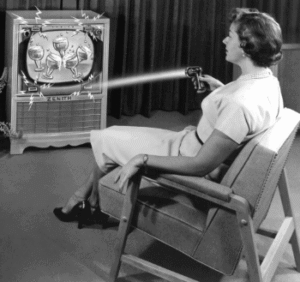
In 1955, Zenith introduced the Flashmatic, developed by Eugene Polley. This one was genuinely wireless and used a beam of visible light aimed at sensors on the television.
Now we’re getting somewhere!
Except the television sometimes had trouble distinguishing the remote’s light from other bright light sources. So when sunlight hit the sensors just right, the television would start responding without anybody touching the remote.
Imagine trying to watch your favorite program while the afternoon sun decides it would rather see what’s happening on Channel 7.
So Zenith had another problem to solve.
Enter engineer Robert Adler, who developed the ultrasonic Space Command in 1956.
Finally, a remote that didn’t need a wire, didn’t depend on a flashlight-like beam, and didn’t require batteries. Yes, unlike today’s electronics, the clicker didn’t need periodic charging, software updates, or somebody turning the house upside down looking for fresh AAA batteries.
For a simple device, it was remarkably ingenious.
Of course, it wasn’t completely foolproof.
As Americans soon discovered, the television could occasionally get a little too enthusiastic about listening to things.
WHEN YOUR CAR KEYS CONTROLLED THE TV
Now, here’s where the whole story gets wildly funny.
The clicker was designed to produce ultrasonic frequencies that would tell the television what to do.
But the TV wasn’t sophisticated enough to know whether that sound came from the official remote or something else producing a similar frequency.
And that led to some pretty hilarious household surprises.
A Facebook post explains how the Space Command worked, including a few peculiar quirks that made the technology sometimes behave like it was possessed by a demon from the bowels of hell.
HISTORY IN HUES:
In the 1950s and 60s, changing the TV channel felt a little like using magic.
The Zenith Space Commander was one of the first remote controls ever made—and it didn’t even need batteries.
Instead of electronics, it worked using sound.
Inside the remote, a tiny hammer would strike aluminum rods when a button was pressed. Each strike created a unique ultrasonic tone, too high for most people to hear.
The television would detect that sound and respond—changing the channel, muting the volume, or turning the set on and off.
Each button had its own tone, allowing the remote to control different functions with surprising accuracy for its time.
It was simple, clever, and far ahead of its era.
People even gave it a nickname—the “clicker”—because of the sharp sound it made with every press.
But the system wasn’t perfect.
Sometimes, everyday sounds like jingling keys or other high-pitched noises could accidentally trigger the TV.
Even with its flaws, the Space Commander changed how people interacted with their televisions.
It turned a simple device into something you could control from across the room something we now take for granted every day.
And today, even though remotes are fully electronic, the name “clicker” still lives on.
In the 1950s and 60s, changing the TV channel felt a little like using magic.
And like we mentioned earlier, people even gave it a nickname… the “clicker,” because of the sharp sound it made with every press.
And today, even though remotes are fully electronic, the name “clicker” still lives on.
THE TELEVISION HAS APPARENTLY DEVELOPED A MIND OF ITS OWN
I’m sorry, but the idea that somebody could accidentally change the television channel by jingling a set of car keys is absolutely fun.
Imagine Dad sitting in his favorite chair, enjoying a perfectly good episode of Gunsmoke, when Mom walks past carrying her keys.
Suddenly, the television switches channels.
Dad looks at Mom.
Mom looks at Dad.
Nobody has touched the clicker.
And somewhere inside that enormous wooden television cabinet, a little electronic receiver is congratulating itself on another job well done.
And think about how different that is from the remote controls we use today.
Modern infrared remotes send specially coded patterns of invisible light, making it much easier for the television to distinguish an actual command from random noises around the house.
The ultrasonic clicker wasn’t quite so discerning.
But honestly, I find something rather charming about an invention that was so clever and yet occasionally so hilariously imperfect.
It worked without batteries, for crying out loud. I’d be willing to forgive the occasional surprise channel change.
And now that we understand the technology, I think we need to spend a moment appreciating the world it arrived in.
Because the 1950s living room was an entirely different universe.
WHEN THE WHOLE FAMILY GATHERED AROUND ONE TV
One thing I love about old television footage is how completely different everyday life looks.
The furniture, the clothes, those god-forsaken enormous televisions, and the wonderful way people went about their lives.
Back then, television was still a new centerpiece of American home entertainment. Families would gather together to watch the same program, on the same screen, at the same time.
There were no smartphones competing for attention, no endless streaming menus, and no kids disappearing into their bedrooms to watch completely different shows or doom scroll and sulk.
And apparently, nobody thought twice about Dad lighting up a cigarette right there in the living room.
This next little clip gives us a wonderful glimpse into that world.
BACK WHEN THE TV WAS PRACTICALLY A PIECE OF FURNITURE
Oh, I love this footage!
Look at that television!
The screen is so small, but the contraption is enormous, inside that great big wooden cabinet.
And there’s Dad, casually enjoying his cigarette while everybody watches the same screen and inhales his second-hand smoke.
Today, we’d probably have six separate devices playing six different things while somebody complained that the Wi-Fi wasn’t working fast enough and told Dad to have his cig break on the porch, for crying out loud.
But there was something wonderfully communal and simple about those early television days.
The family gathered around a single screen. There were like 3 channels, and changing the program involved actual physical effort until the remote control came along. Think about what a big a deal that little clicker invention must’ve been.
Suddenly, whoever possessed the remote could control what the entire family watched without getting out of their chair.
Oh, the power…
And thus began one of the great domestic struggles of the twentieth century.
Who gets control of the remote?
I suspect there are marriages that still haven’t fully recovered from that little invention.
But while the remote was becoming an essential household accessory, the technology behind it continued evolving.
And eventually, the old mechanical clicker gave way to something completely different.
FROM INVISIBLE SOUND TO INVISIBLE LIGHT
By the early 1980s, infrared remote controls were becoming the standard.
Instead of striking metal rods to generate ultrasonic tones, these devices used electronic components to send coded pulses of infrared light toward a receiver in the television.
You couldn’t see the light with your eyes, but the television could detect the signal and interpret the commands.
And because manufacturers could create numerous distinct codes, the number of available functions expanded dramatically.
Suddenly, remotes could handle far more than changing channels.
Volume controls, input selection, VCR functions, and eventually elaborate cable television menus all became accessible from the comfort of the couch.
Then came the universal remote, promising to replace the growing collection of 6 devices scattered across American coffee tables.
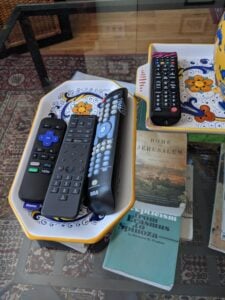
You’d spend half an afternoon entering mysterious manufacturer codes from a tiny instruction booklet, hoping the remote would finally learn how to communicate with your television and VCR.
And sometimes it actually worked!
Then came DVRs, streaming devices, Bluetooth connections, and voice-controlled smart remotes.
Today, you can ask your television to find a particular movie, pause a program, open an app, or recommend something new.
It’s all rather incredible.
But here’s the funny thing…
We’ve made television remotes way more sophisticated, yet I sometimes wonder whether we’ve made the experience of watching television any simpler.
Now you can spend twenty minutes navigating streaming menus, searching for a show, and arguing with a voice assistant that seems convinced you asked for Herder The Goat, not Murder She Wrote.

And don’t even get me started on the disappearing remote.
Somehow, despite decades of technological advancement, we still haven’t solved the mystery of how those little bastards keep ending up between the couch cushions.
But there are people who haven’t forgotten the wonderfully simple machines that started all this.
And some of them are doing extraordinary work to keep that history alive.
BRINGING A PIECE OF THE 1950s BACK TO LIFE
I have a real soft spot for people who restore old technology.
There’s something fascinating about watching somebody take an obsolete, neglected piece of machinery and carefully bring it back to working order.
Especially when the device comes from an era when electronics were assembled using components, materials, and techniques that look almost prehistoric by today’s standards.
Old televisions are particularly interesting because they weren’t simply screens mounted on the wall.
They were complicated pieces of equipment built into large cabinets, filled with tubes, wiring, circuitry, and mechanical components that required real technical expertise to service.
And finding somebody today who knows how to work on one is almost an art form in itself.
This final video features a young man restoring a vintage 1950s television, carefully preserving a piece of technological history that most people would’ve thrown away decades ago.
And I think it’s a wonderful way to finish our little journey.
SOMEBODY PLEASE SAVE THESE BEAUTIFUL OLD MACHINES
I absolutely love watching this kind of work.
There’s something satisfying about seeing somebody take an old machine seriously enough to understand how it was built and what it takes to bring it back to life.
We live in an era where so many electronic products are designed around compact components, sealed housings, and replacement rather than traditional repair.
And here’s this young guy working on technology from seventy years ago, preserving the knowledge needed to keep it functioning.
It’s a reminder that these old televisions weren’t just disposable consumer products.
They represented extraordinary engineering achievements for their time.
The wooden cabinets, glass picture tubes, electrical components, and intricate internal mechanisms were all part of an industry that was changing how Americans experienced the world.
And the remote control was one of the inventions that helped change that experience.
It’s easy to laugh at those enormous old televisions and their limited picture quality, but the people designing them were doing something remarkable.
They were creating technologies that future generations would take completely for granted.
And one of the cleverest examples was a little handheld device that used nothing more than the mechanical force of a button press to send an invisible signal across the room.
Sometimes the simplest inventions are the most fascinating.
You know, I think that’s what makes the original Zenith clicker so interesting.
We’ve become so accustomed to electronic wizardry that it’s almost difficult to imagine an invention doing something extraordinary without requiring a battery, microchip, or some complicated digital system.
But back in 1956, engineers figured out how to control a television using little hammers and vibrating aluminum rods.
And it worked!
Sure, the occasional jingling keys might have confused the television, and the device couldn’t do a fraction of what today’s smart remotes can accomplish.
But that’s hardly the point.
It was simple, clever, and genuinely revolutionary for its time.
It also introduced an idea that would become such a normal part of everyday life that most of us barely think about it anymore.
The ability to control something across the room without physically touching it.
And there’s something wonderfully nostalgic about knowing that the technology began with a distinctive little sound.
CLICK.
Which is why, decades after the mechanical mechanism disappeared from our living rooms, so many people still call the television remote a clicker.
THE LANDING
Before we needed batteries to change channels, all it took was a little click and a whole lot of genius.
STAY CURIOUS
Three more stories worth your curiosity.







Post Comment