🪰 The Term ‘100% Linen’ is 100% Bullshit
THE BUZZ
- Your sheets’ backstory deserves more than “European.”
- Same plant, wildly different checkout experience.
- That luxury price tag owes you an explanation.
Same Label. Very Different Checkout.
Linen has this really snooty reputation, and not only that, but it also has a way of making even a mundane purchase feel like some kind of “upgrade.” You’re buying sheets, but the whole word “linen” suggests you might also be inheriting a sun-drenched villa, complete with an Aperol spritz sitting on your nightstand.
It’s quite a tempting image, but then you get smacked with the price.
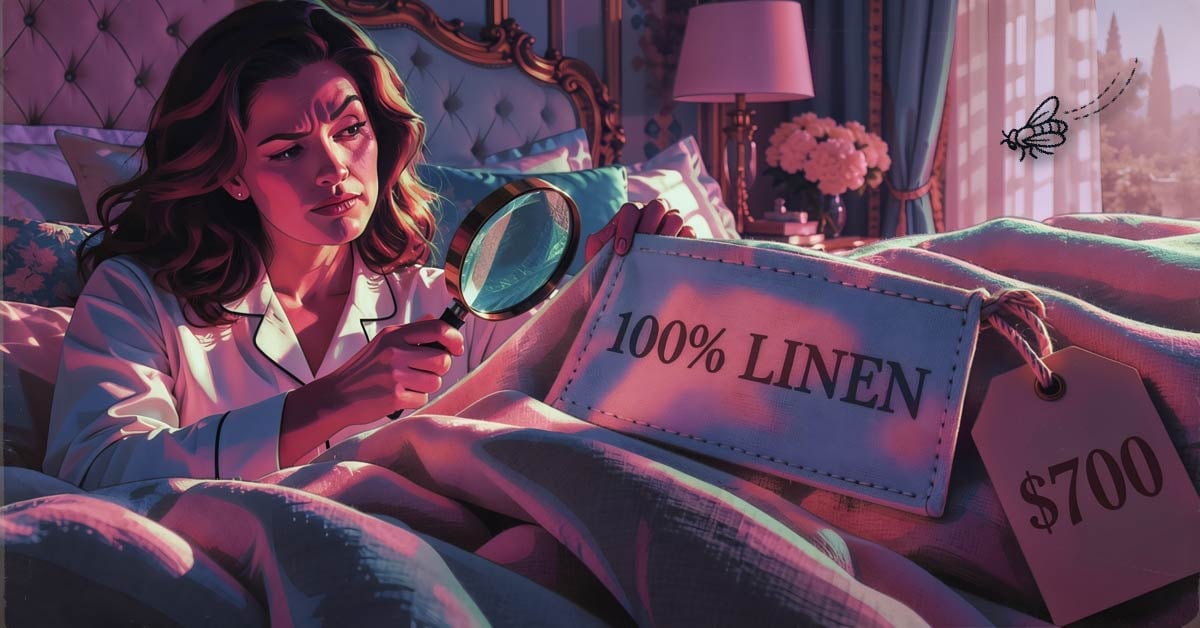
In this TikTok video, creator @finthebuilder compares a $30 shirt with a $350 one, followed by $90 sheets and a set costing over $700. According to their labels, everything is 100% linen.
That’s quite a price range for something that apparently comes from the same plant.
The catch is that “100% linen” describes the fiber content. It doesn’t tell you how carefully that fiber was processed or how the finished fabric will hold up. U.S. textile labeling requirements cover composition, manufacturing origin, and business identification, rather than awarding your sheets a quality score.
But the bullshit really begins when we treat that percentage as proof that we’re buying something exceptional.
Apparently, that little tag has been getting a bit too much credit…
@finthebuilderAll linen is the same right? Then how can two linen products be priced so differently…?♬ original sound – Fineas | Lighthouse ♾️
Your Sheets Have a Backstory
Let’s start with what happens before the fabric gets its tasteful beige packaging.
Processing flax separates the longer fibers, called “line,” from the shorter fibers known as “tow.” Belgian linen manufacturer Libeco explains that line is used for its finest textiles, while tow goes into coarser yarns. Both still come from flax, which is why the same basic fiber label can cover very different results.
Then there’s the spinning. Wet spinning passes the fibers through heated water, helping them slide against one another as yarn is formed. It suits clothing and household linen, while dry spinning produces thicker, more rustic yarns.
So the old phrase “it’s all the same plant” loses some of its sparkle when you see exactly how the sausage is made.
Where that plant grew matters, too. France, Belgium, and the Netherlands produce roughly three-quarters of the world’s long flax fibers. It’s basically Europe’s “flax belt.”
In this region, harvested stalks lie in fields while microorganisms loosen the fibers through a process called dew retting. Timing takes expertise: Libeco notes that insufficient retting makes extraction difficult, while leaving the stalks too long can reduce fiber strength.
“Buttery Soft” Has Entered the Chat
Of course, most of us aren’t standing inside Target wondering about flax extraction. We’re rubbing a pillowcase between our fingers and deciding whether it feels good and, most importantly, if the exhorbinant price is justified.
And manufacturers have several ways to create that softness…
One is called biopolishing, which uses cellulase enzymes to break down exposed cellulose and remove surface fuzz. The treatment can improve the fabric’s feel, but excessive enzyme activity can also cause unwanted weight and strength loss.
There’s also a legitimate question out there about how aggressively a fabric has been treated. The TikTok video’s claim that softening consumes half a sheet’s useful life, however, goes a bit beyond the evidence.
Softening methods also vary. Italian machinery manufacturer Biancalani makes equipment that uses airflow and mechanical action to soften fabric, including treatments without added softening chemicals.
So a soft finish alone doesn’t tell you which process was used or how much wear the fabric can take.
“Buttery soft” makes a lovely first impression, but unfortunately, your fingertips can’t conduct a five-year durability test in the bedding aisle.
Make the Price Tag Explain Itself
This is where all the boring (or interesting) details of linen making come together. Especially when you’re considering taking out a small loan for new bedding.
Take GSM, or grams per square meter. It measures how much a given area of fabric weighs. A higher number means more weight over the same area; it doesn’t measure fiber quality or seam strength. Fabric weight has its own testing methods precisely because it’s a specific property.
The original TikTok video suggests 170–230 GSM for sheets. That’s definitely something that can be further investigated, but as of now, there’s no universal pass-or-fail test. The number just gives you something concrete to compare alongside the construction and finish.
And that whole “origin” thing deserves a closer look as well. The Alliance’s Masters of FLAX FIBRE certification, formerly European Flax, provides verified European fiber-origin traceability. All that mumbo jumbo answers questions around sourcing, but it doesn’t promise that a fitted sheet will survive a particular number of years.
So really, before dropping the big bucks on a hunk of linen, it’s best to start by researching the product weight and how it was softened. Then you can dive a little further, looking into the specifics about where the flax was grown and where it became fabric. If you’re able to get your hands on a sample, pay attention to the weave and stitching as well as that seductive first touch.
Because once a sheet set costs several hundred dollars, just slapping a “linen” label on it feels like a remarkably lazy sales pitch.
THE LANDING
If the price tag is telling you a luxury story, the fabric should be able to back it up.
STAY CURIOUS
Three more stories worth your curiosity.

 Turns Out Fame is a ‘Rich Kids Only’ Club



Post Comment