🪰 Where Does All the Food Go After the Cooking Competition Shows End?
THE BUZZ
- The judges eat. But who gets the leftovers?
- Giant edible monsters have a disturbing afterlife
- One TV supermarket has a surprising secret
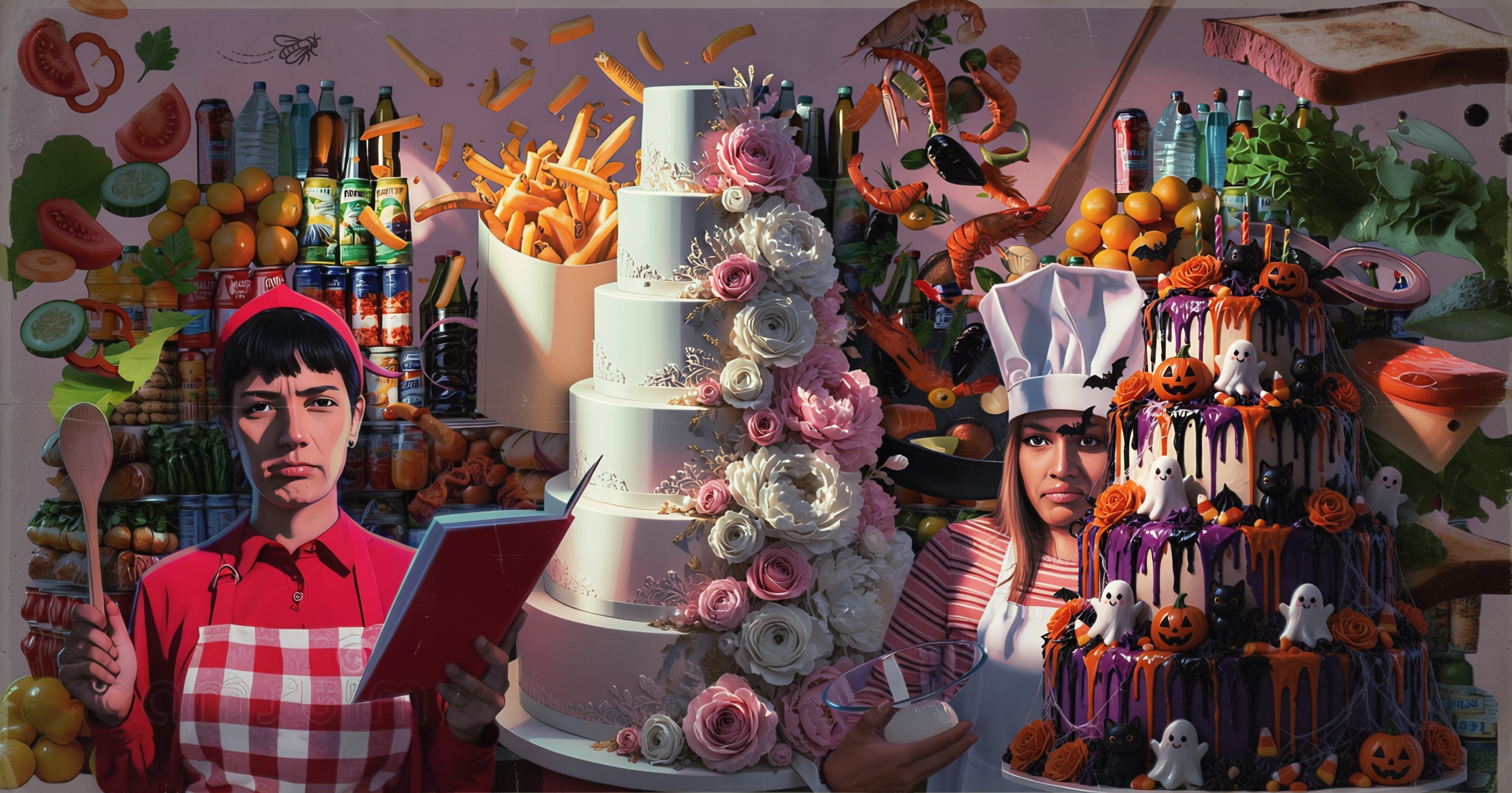
I’m sitting here watching Holiday Baking Championship, minding my own business, enjoying the beautiful cakes, the holiday decorations, and the occasional contestant having a meltdown over broken buttercream. I love these shows. I really do.
But between all of these elaborate desserts and the judges taking their dainty little bites, my brain wandered off in a completely different direction.
What the hell happens to all this leftover food?
Think about it. Sometimes you’ve got 16 contestants baking their damn hearts out, assembling desserts with enough frosting, chocolate, cake, and fillings to keep the dental industry in business until the sun burns out. Then comes the grand finale, where four or five finalists might each put out a magnificent four-tier cake.
That’s like 20 tiers of cake before we even get to the frosting, decorations, fillings, or whatever architectural engineering was required to keep them standing.
And the judges taste a little here, poke a fork into something there, offer some constructive criticism about the texture, and then some poor sap gets sent home.
But the cake stays behind.
So of course, I started wondering who eats all that freaking cake? The camera crew? The contestants? Some incredibly fortunate security guard? Or does a perfectly beautiful dessert eventually meet its maker in a dumpster?
I went looking for answers and discovered a surprisingly complicated world of television supermarkets, enormous food inventories, elaborate edible sculptures, generous donation programs, and some waste that really deserves a raised eyebrow or two.

How Did Cooking Turn Into a Contact Sport?
Before I started following the leftovers, I became curious about how we got here in the first place.
Food Network launched in November 1993, back when television cooking was mostly about teaching regular folks how to make something delicious without grossing out their spouse or setting their kitchens on fire.
There were chefs explaining recipes, demonstrating techniques, and showing viewers how to make dinner. Emeril Lagasse brought the energy, Rachael Ray made meals feel manageable, and suddenly people who didn’t know what a shallot was were now spending their evenings watching professional chefs work.
Then somebody realized that cooking was even more entertaining when you added a ticking clock, a cash prize, and public humiliation.
By the mid-2000s, shows such as Iron Chef America and The Next Food Network Star were helping turn the channel into a competitive entertainment powerhouse. Chopped arrived in 2009, and cooking was now a sporting event where the game equipment was whisks and frying pans.
Food Network’s rise was enormous. Parent company Scripps reported that the channel was reaching more than 91 million American households by 2006.
And I get the appeal.
I’m not sitting on my couch watching Holiday Baking Championship because I desperately need instructions for building a seven-layer gingerbread carousel. I’m watching because I want to see whether somebody can actually pull it off.
There’s even research behind this food TV fascination. Studies of reality television viewers have found that entertainment, relaxation, curiosity, and the excitement of competition all help attract audiences. We like watching people attempt difficult things, especially when there’s a chance everything could go spectacularly wrong.
The producers understand this, too. Give contestants a limited amount of time, throw in an unexpected ingredient, make them share equipment, and suddenly preparing dessert feels like defusing a bomb.
It’s wonderfully ridiculous and delicious.
And it takes an astonishing amount of food to keep the whole operation running.

Before the First Egg Cracks, Somebody Has to Buy a Small Grocery Store
This was my first major discovery. The kitchens we see on television are only the finishing line of a much larger food operation behind the scenes.
Somebody has to decide what ingredients will be needed for every single challenge, how much to purchase, where everything will be stored, and how to keep fresh food available throughout filming.
And television kitchens don’t always shop like normal kitchens.
Chef Priyanka Naik, who has competed on Food Network, described to The Guardian how producers may purchase far more ingredients than a recipe needs just to have backup supplies available.
“there might be 15 bunches of basil purchased to make a recipe that only requires one”
Fifteen bunches of basil!
If I’m making pesto and discover I bought 14 extra bunches, I’m going to assume I suffered some kind of neurological event in the produce department and seek help.
But on TV, those additional ingredients are “insurance” against mistakes, ruined dishes, and the chaos of cooking under a clock. Sometimes food also becomes part of the scenery, making a kitchen look abundantly stocked for the cameras.
And once all those ingredients arrive on set, someone has to organize them, refrigerate them, replenish them, and keep track of what gets used. The pantry staff can have as much stress as the contestants.
Which brings me to one of the most fascinating examples I uncovered.
Wait, Guy Fieri Has an Actual Supermarket?
If you’ve watched Guy’s Grocery Games, you know the setup. Contestants race through a supermarket collecting ingredients, sometimes while Guy throws increasingly bizarre obstacles into their shopping plans.
What I didn’t appreciate was just how real that supermarket operation actually is.
The show’s first season was filmed inside a functioning grocery store. When production moved to Santa Rosa, California, for its second season, it created a real supermarket set inside a 15,500-square-foot warehouse.
And that store contained more than 20,000 actual products.

This wasn’t a collection of empty cereal boxes pretending to be groceries. The operation had real inventory tracking, barcode systems, deliveries, produce inspections, stock replenishment, and a staff responsible for keeping everything ready for the contestants.
Food Network even described how a local bakery supplied bread throughout the week, with additional orders placed whenever supplies ran low.
But here’s the part that impressed me.
The production also developed arrangements for handling the food after it had served its television purpose.
“Products that are still good are donated to local food banks.”
Kitchen scraps are also sent to a local farm for animal feed.
Now that’s clever.
They’ve essentially built a supermarket for a television competition, complete with systems for finding another use for the food.
It’s the kind of behind-the-scenes detail I wish more shows would share. I love seeing an operation this elaborate, particularly when somebody has clearly thought about what happens once the contestants stop running through the aisles.
Unfortunately, not every edible creation has such a promising future.
The Judges Take Three Bites. The Camera Gets Its Own Dinner.

Here is where my original question about leftover food got an interesting answer.
On Chopped, contestants prepare four plates of food, even though there are only three judges.
Why four?
Because the television production needs an extra, untouched plate for close-up photography and the famous elimination reveal.
Host Ted Allen explained the arrangement in an interview reported by E! News.
“We need the fourth plate, because if someone gets chopped I have to have a plate underneath the cloche”
That fourth plate gets its own little moment of television glory.
The problem comes afterward.
According to Allen, by the time the crew finishes using it for filming, the plate has been sitting at room temperature for approximately two and a half hours. Nobody eats it.
I found myself doing the math.
A standard Chopped episode begins with four contestants. Three survive to the entrée round, and two reach dessert.
That’s nine extra camera plates per episode.
Many seasons of Chopped have 13 episodes, which means we’re looking at 117 additional plates in a single season.
ONE HUNDRED AND SEVENTEEN!
And that’s just the food prepared for the cameras. We’re not even counting the leftovers on the judges’ plates, unused ingredients, cooking mistakes, or anything else that gets tossed.
Now multiply those 117 plates across 10 seasons, and you’ve got 1,170 beautifully prepared meals whose primary purpose was to look pretty on television and then get tossed in the dustbin of history.
I don’t know about you, but that’s an awful lot of food just to get a close-up of somebody’s risotto.
I suppose the camera really does eat first.
And then there’s the food the judges actually taste. Depending on how long production takes, what’s in the dish, and how it’s been handled, leftovers may not be suitable for feeding other people.
The result is a peculiar contradiction. A chef can prepare a beautiful meal, execute it perfectly, and have part of that work rendered useless simply because television production takes time.
But even this is small potatoes (pun intended) compared with what I discovered about the giant edible creations.
The Unfortunate Afterlife of a Giant Edible Monster
If you think a four-tier holiday cake is extravagant, allow me to introduce you to Halloween Wars.
This show takes talented cake decorators, sugar artists, and pumpkin carvers and asks them to create enormous, terrifying edible displays.
I’m talking monsters, haunted houses, gigantic carved pumpkins, and elaborate characters that look capable of coming alive and eating the judges.
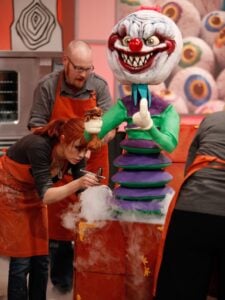
The sculptors are incredibly talented. Some of these things look like they belong in a museum, provided that museum is willing to exhibit a six-foot demon made from chocolate and Rice Krispies treats.
But what happens after the judges admire them?
Former Halloween Wars host Justin Willman answered that question in a 2014 interview with the News-Sun.
“Sadly, I think they do (wind up in the Dumpster)”
And Willman’s explanation got even more extraordinary.
Some of the pumpkins used in the final rounds weighed as much as 1,000 pounds. The displays were so massive that forklifts were needed just to move them around the studio.
Imagine spending hours carving a monstrous pumpkin face, constructing a gigantic edible creature, and carefully arranging every decorative detail, only to discover your masterpiece requires industrial machinery and has nowhere useful to go.
Willman said the creations remaining at the studio while the crew packed up basically rotted before being tossed out.
What a depressing little afterlife for something that took a lot of food and an entire team of people to build.
And here’s another interesting twist: On Halloween Wars, teams also prepare a separate tasting element specifically for the judges, while the enormous display is the big centerpiece.
So the audience gets a magnificent food sculpture, the judges get an actual dessert, and the edible monster gets to spend its retirement decomposing backstage.
I can admire the artistry while still wondering whether we’ve lost our minds a little.
So, Does Anybody Actually Eat the Leftovers?
Thankfully, my investigation took a happier turn.
Because while a lot of food ends up in the trash, quite a bit also makes its way into the mouths of people who work on these productions.
Former Top Chef culinary producer Lee Anne Wong discussed this in a 2007 post for Bravo, and the behind-the-scenes picture was surprisingly lively.
She described preparing leftover proteins for crew meals, putting together snacks, distributing supplies to contestants, and allowing production assistants to take home certain ingredients.
But she also explained that food left out too long had to be tossed.
Anything that sits out for an extended period of time (like the fresh foie gras left on the counter by one very irresponsible contestant) gets pitched for food safety reasons.
Apparently, even professional cooking competitions have contestants who leave expensive food lying around like a random package of bologna.
At the end of filming, the production also arranged for remaining pantry supplies to go to a local food shelter.
Then there’s The Great British Bake Off…
Former contestant Kim-Joy Hewlett explained that crew members eat the finished bakes after judging. Apparently, the people working behind the cameras are perfectly aware of which cakes received the most enthusiastic reactions.

And they move accordingly.
I love the thought of an exhausted camera operator silently keeping tabs on which contestant made the best lemon drizzle cake, then positioning himself for the post-judging buffet.
But seriously, how are these crew members not 700 pounds each and battling raging diabetes? That’s a hell of a lot of cake to put away every day during filming.
Noel Fielding also said that judge Prue Leith sometimes took leftover cake home for her pigs.
But still, how much food is actually getting tossed out? We don’t really know. What we do know is that somewhere in England, a very happy pig is enjoying the remains of a nationally televised baking competition while I’m sitting here eating crackers.
MasterChef Australia Has Turned Leftovers Into Something Much Bigger
Another encouraging discovery came from MasterChef Australia, which has a longstanding partnership with the food-relief organization SecondBite.
The show’s producers told New Idea that surplus pantry ingredients are donated to the organization, which redistributes food to people who need it.
“MasterChef’s donations provide the equivalent of over tens of thousands of meals each season for people doing it tough”
That’s a great use for ingredients that might get tossed or go bad on shelves.
The production has also provided extra pantry items to contestants so they can practice cooking where they’re staying.
So, what I’ve discovered is that some productions throw away enormous amounts of food, others feed their crews, some donate leftovers to charities, and a few have figured out clever ways to put nearly everything to use.
And I love hearing about those efforts. But I can’t help thinking about those giant edible displays sitting around until they rot. All that time, talent, money, and perfectly good food, destined for a dumpster because it was created to entertain us for a few minutes.
Which got me thinking about something a little bigger. Here we are in a world where we have so much food that we can turn it into television props, build enormous edible monsters, and award prize money for the most spectacular creations. Meanwhile, millions of people around the world are struggling just to put dinner on the table.
It’s a pretty strange contrast when you think about it.
Meanwhile, in Another Part of the World…
I started this whole investigation because I was enjoying a baking competition and wondering where all those cakes ended up, for crying out loud.
But the more I looked into it, the harder it became to ignore the bigger picture.
We live in a world where some people have enough food available to build enormous edible monsters for shits and giggles, while millions of others are struggling to find their next meal.

According to the United Nations’ 2026 food-security report, an estimated 645 million people experienced hunger in 2025.
And the United Nations Environment Programme estimated that the world generated approximately 1.05 billion tonnes of food waste in 2022.
That is a staggering amount of food.
I’m certainly not suggesting we should stop enjoying cooking competitions. I’m watching one right now, remember? And I have absolutely no intention of giving up my seasonal tradition of watching talented bakers desperately attempt to keep an elaborate dessert from collapsing.
I love the competition, the creativity, the personalities, and the extraordinary skill involved.
But there’s something unsettling about an edible sculpture being so large that a forklift is needed to move it, while elsewhere in the world (or here at home) a family is struggling to put dinner on the table.
Sometimes abundance makes us a little careless about the stuff somebody else would treasure.
The Great Cooking Show Mystery Isn’t Entirely Solved
After digging into all of this, I’m convinced that the food we see on television has a much more complicated journey than most of us realize.
It begins with producers planning challenges and food teams purchasing ingredients, often in quantities that would make an ordinary grocery shopper faint. Then come the stocked pantries, refrigeration, contestant preparations, practice attempts, elaborate creations, judging plates, beauty shots, and production delays.
Afterward, the food can take any number of paths.
But a fair amount does end up in the garbage.
What I’d like to see is more transparency from the networks and shows. With all the extraordinary planning that goes into these competitions, why not tell the audience how much food gets purchased, how much is donated, and how much is tossed?
Imagine a little closing credit telling us that the episode’s surplus ingredients helped feed 200 people. That’s a behind-the-scenes detail I’d actually stick around to watch.
Until then, I’ll keep enjoying these ridiculously entertaining cooking competitions, admiring the incredible talent, and occasionally wondering about the fate of a cake that looks as though it could feed an entire wedding reception.
THE LANDING
I just hope somewhere out there, a very happy pig is enjoying a five-tier masterpiece that lost a television baking competition.
STAY CURIOUS
Three more stories worth your curiosity.

 The Pickled Vegetable Bottles That Took Over The 90s





Post Comment