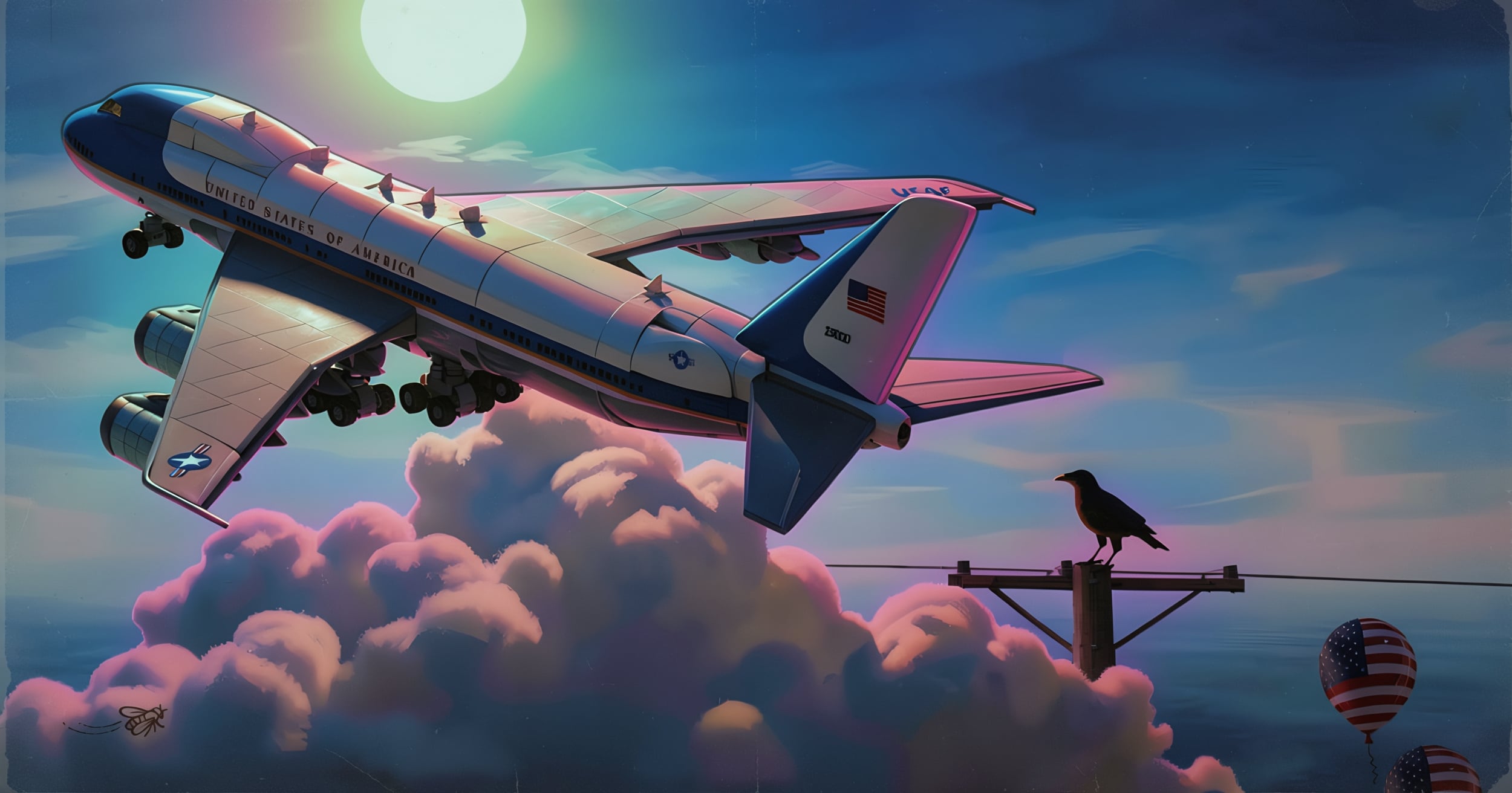
🪰 80+ Years and Air Force One Has Never Crashed. How the Heck Is That Possible?
THE BUZZ
- Eight decades in the sky, and not one single crash
- Commercial airlines haven’t been quite so lucky
- Are they hiding some aviation magic up there?
I was sitting around the other day when a strange question popped into my head. Has Air Force One ever crashed?
I don’t mean an emergency landing, a little turbulence, or somebody spilling the president’s Chianti. I mean an actual crash. A plane falling out of the sky or plowing into a runway with the president aboard.
So I started looking into it, and I’ll be damned. I couldn’t find a single documented crash involving the dedicated presidential aircraft fleet going all the way back to the 1940s.
Now, that’s quite a record, especially considering these planes have hauled American presidents through wars, international crises, nasty weather, and just about every corner of the world.
But how the heck have they pulled it off?
Naturally, I turned to my handy-dandy AI research buddy, because if I’m going to investigate 80 years of aviation history, I’d prefer not to spend the next three months buried alive in government manuals. And I wanted to know something specific: What does Air Force One have going for it that the rest of us don’t?
And no, I’m not looking to bash commercial airlines, although they do kinda suck. But truth be told, they’ve got a pretty remarkable safety record as well. I just wanted to understand what happens when the passenger list includes the most powerful person in America, and the people responsible for getting him home have an entire military operation at their disposal.
Turns out, there’s a lot more going on behind that famous blue-and-white paint job than I realized.
First, Air Force One Isn’t Even a Plane
Well, this is embarrassing. I hadn’t gotten very far into my investigation before discovering that Air Force One isn’t technically the name of an airplane.
It’s a radio call sign. Any U.S. Air Force aircraft carrying the sitting president actually becomes “Air Force One.”
The president could climb aboard one of those enormous presidential 747s or a smaller Air Force jet, and the name follows him.
The dedicated presidential airlift operation goes all the way back to 1944, when Franklin D. Roosevelt’s administration established a special aircraft operation to transport the commander-in-chief. The first plane was a modified Douglas C-54 nicknamed the Sacred Cow.
Please tell me that at least once, somebody looking for the president asked, “Where’s the beef?”
But since then, we’ve gone through generations of propeller planes, sleek Boeing 707s, and the giant 747s most of us picture today.
And speaking of the big boys, those famous presidential 747s first rolled out in 1990. They’re old enough to remember when everybody was wearing Hammer-pants, but they’re still flying presidents around the world.

Has keeping these things in the air become a full-time mechanical obsession?
Well, yeah, pretty much.
The Flying White House Has a Few Tricks Up Its Sleeve
Before we start comparing Air Force One to the airlines the rest of us fly, you’ve got to see what kind of airplane we’re talking about.
For starters, the two traditional presidential 747s aren’t just luxury jets with bigger seats and a presidential seal slapped on the door.
They have their own retractable staircases, baggage-handling equipment, secure communications, and the ability to refuel in midair. The president has an office, private quarters, a conference room, and access to medical facilities.
There’s enough room for senior staff, security personnel, and reporters, along with two kitchens capable of preparing meals for a crowd.
So while I’m sitting in seat 23B, wondering whether I’ll get a second bag of peanuts, the president can hold a national security meeting, take an important call, and have someone bring him a full-blown gourmet lunch.
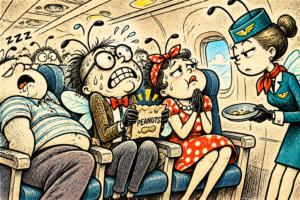
Not quite the same flying experience…
This first video gives you a look at the astonishing operation behind the presidential aircraft. Some of its claims are a little, uh, overexcited, but the actual features are cool and fascinating enough without turning the airplane into a superhero.
What interests me most isn’t even the lush interior. It’s the amount of independence built into the airplane… you know what I mean? This plane can bring its own personal boarding stairs. It carries equipment that reduces its dependence on unfamiliar airports. And the military has specially trained people responsible for maintaining and operating it.
That’s when I began to suspect the answer to my crash question might have more to do with the extraordinary amount of prep surrounding every single flight.
Imagine Having an Entire Military Wing Looking After Your Ride
I found out that Air Force One is maintained and operated by the Presidential Airlift Group, part of the Air Force’s 89th Airlift Wing at Joint Base Andrews in Maryland.
The larger wing has more than 1,800 personnel supporting executive airlift, communications, logistics, training, and other missions. They’re not all standing around hand-washing the presidential 747, of course, but it gives you an idea of the size of the operation.
There’s even a dedicated Executive Airlift Training Center.
And I gotta say, I love the wing’s motto: Perfection is OUR Standard.
I’d like to see that printed over the entrance to my local airport baggage claim. Can you imagine? No, I didn’t think so…
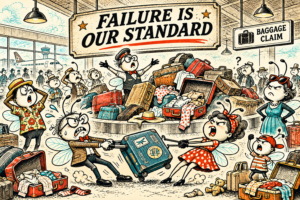
Now, just to be clear, commercial airline pilots and maintenance crews aren’t amateurs. Most are highly trained professionals working under super strict federal safety rules. But the presidential operation has a different assignment.
It’s not trying to transport thousands of people through a busy route network every day. Its job is to get the president wherever he needs to go, safely, securely, and with the ability to keep doing his job when he arrives.
The NatGeo documentary I found really brought this whole shebang home…
The maintenance crews are dealing with aircraft that have been flying for decades, and one of the technicians actually compares looking after them to maintaining a classic car. The problem is that manufacturers don’t keep making every part forever.
At one point, a crew member discusses how difficult it’s become to find vendors who still repair certain components. Another describes the challenge of keeping the aging aircraft looking and operating like new.
That’s a pretty revealing glimpse into the job. These people aren’t maintaining some indestructible wonder machine. They’re keeping an extraordinarily complicated, aging aircraft ready for an exceptionally demanding mission.
And watching them work, I got the impression that nobody wants to be the person who says, “Eh, that should be fine.”
The President Doesn’t Have to Fight for a Place in Line
Here’s another interesting difference I discovered.
Air Force One doesn’t fly around ignoring air traffic controllers or making up its own rules. It still operates within the aviation system, communicating with controllers and following the procedures needed to keep aircraft safely separated.
But when the president travels, the surrounding operation becomes a very different affair.
The FAA can establish temporary flight restrictions around presidential destinations. Those restrictions can limit which aircraft are allowed in certain areas, and security planning may affect ordinary flights at surrounding airports.
Some presidential restrictions use an outer zone extending about 30 nautical miles, with tighter restrictions closer to the protected location. The exact arrangements depend on the trip.
Imagine having enough influence over an airport that the government can rearrange a chunk of the surrounding airspace before you arrive… I would do a lot of damage with that kind of power.
We’ve all spent more time than we care to admit sitting on commercial flights waiting for permission to push away from a gate. Meanwhile, the presidential travel operation has teams coordinating security, airport access, ground movements, and flight planning before the president even gets near the airplane.
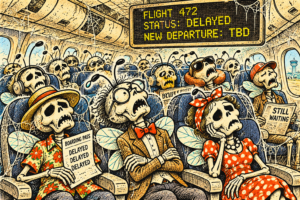
That doesn’t mean the president gets to land in dangerous weather or skip aviation safety procedures. But it does mean the flight can be planned around an unusually specific mission, with security and coordination that ordinary scheduled passengers don’t experience.
Now Let’s Look at the Rest of Us Poor Slobs
This is where my research got really interesting.
I asked AI to find a recent month of actual commercial aviation data.
We went to the U.S. Department of Transportation’s Air Travel Consumer Report and chose August 2026.
Here’s what the government recorded for the domestic operations of three major U.S. airlines:
| Airline | Scheduled flight records | Diverted flights |
|---|---|---|
| American Airlines | 84,271 | 449 |
| Delta Air Lines | 91,186 | 308 |
| United Airlines | 74,078 | 545 |
| TOTAL | 249,535 | 1,302 |
Read that total again, guys…
Almost a quarter of a MILLION scheduled flight records in ONE MONTH.
And that’s just three airlines, not including regional partners and international flights not covered by these particular figures.
The 1,302 diversions caught my eye, too, although a diversion doesn’t mean the plane was in danger. It means the flight landed somewhere other than its scheduled destination. Weather, airport conditions, medical emergencies, and equipment problems can all play a role in that.
Still, I found those numbers astonishing.
Airlines are running enormous transportation networks every single day. Their aircraft are taking off, landing, being serviced, loaded with passengers, and sent back into the sky over and over again.
The president’s aircraft are operating on an entirely different scale.
And this is where I had to be careful with my original question.
I wanted to compare one month of Air Force One flights directly with one month of American, Delta, or United flights. Unfortunately, the government doesn’t publish an equivalent monthly operating report for Air Force One, complete with every flight, mechanical issue, and diversion.
Some presidential travel is publicly documented. Other operational details aren’t.
So we can see exactly what the airlines reported for August 2026, but we can’t calculate a fair Air Force One accident rate for that same month from the public information available.
That was slightly disappointing. I had visions of putting everybody’s numbers side by side and discovering some extraordinary presidential aviation secret.

But I realized something important.
Even if we found a perfectly quiet month for Air Force One, comparing it with nearly 250,000 commercial flight records would be ridiculous without accounting for how much flying each operation actually does.
You can’t compare the number of scratches on two cars without asking whether one drives 500 miles a month and the other drives 50,000.
The same logic applies to airplanes, only the consequences are considerably more expensive.
Even the Hawaiian Airlines Comparison Surprised Me
While investigating long-running airline safety records, I came across Hawaiian Airlines.
Founded in 1929, Hawaiian built a rather impressive reputation for avoiding fatal crashes and aircraft hull losses.
At first, I wondered whether I’d found a commercial airline with the same never-crashed record I was investigating…
Not quite.
On August 8, 1996, a Hawaiian Airlines DC-9 had trouble with its nose landing gear. The crew returned to Honolulu, and the nose gear collapsed during landing.
All 76 people aboard survived without injury, and the airplane sustained minor damage.
So Hawaiian’s famous record didn’t mean it had never experienced a crash-like landing accident. It meant something more specific: that it had avoided losing an aircraft in a catastrophic or economically irreparable accident.
There’s an important lesson buried in there… A plane can have a frightening accident without being destroyed. Another plane can experience a mechanical problem and land safely without having an accident at all.
I was starting to appreciate why the aviation industry is so picky about these definitions.
And why my simple question had turned into a whole lot more homework than anticipated… by this point, I needed a snack.
An Airplane That Can Protect Itself? Now We’re Getting Somewhere.
Then I stumbled into the stuff that makes Air Force One feel like something out of a James Bond movie.
The presidential 747s have special defensive systems designed to help protect against hostile threats. The aircraft also have hardened electronics and advanced communications, allowing the president to keep working during certain national emergencies.
Some capabilities are public. Others are classified.
Obviously, the government doesn’t publish a handy illustrated manual explaining precisely how every defense works… but still, knowing that a giant passenger aircraft has been modified to protect itself against military threats is pretty damn cool.
One of the videos I found goes deep into this side of Air Force One, including missile defenses, restricted airspace, and the military personnel responsible for protecting presidential travel.
Bottom line, this sucker is nearly impossible to shoot down.
Now, I’m not ready to declare any airplane fully “impossible” to shoot down, no matter how impressive its equipment is. And some of the video’s technical claims go way beyond what the government publicly confirms.
But I still came away very impressed by how many different forms of protection are involved.
There’s the airplane itself, the people aboard it, airspace security, military surveillance, emergency planning, and coordination among agencies.
I also discovered that fighter jets don’t routinely fly in formation beside Air Force One, despite what you might expect from the movies.
The protection doesn’t always look like some dramatic high-flying military parade.
All these security measures are mostly designed to protect the aircraft against deliberate threats. They’re not what prevents an ordinary mechanical failure, a runway accident, or a dangerous weather encounter.
For my original crash question, the less glamorous stuff, like maintenance, pilot training, flight planning, and operational decisions, is just as important.
Air Force One Has Had Its “Oh-Crap” Moments
Now, don’t get the idea that the presidential fleet has spent eight decades floating peacefully around the world without a single problem.
It hasn’t.
On September 11, 2001, President George W. Bush was aboard Air Force One while the country was under attack. The aircraft became an airborne refuge during a national emergency, but the experience also revealed serious communications difficulties.
The NatGeo doc describes how the president’s team struggled to communicate effectively during the crisis. Those problems became part of the reason for later improvements.
Then there’s a much more recent example.
On January 20, 2026, Air Force One departed Joint Base Andrews with President Trump aboard, headed for Switzerland.
Shortly after departure, the crew detected a minor electrical problem.
And what did they do?
Well, they turned around.
The airplane returned safely to Andrews, and Trump continued his trip aboard another Air Force aircraft.
Even Air Force One can develop mechanical problems.
The crew still has to assess what is happening, decide what the safest course of action is, and respond accordingly.
And in this case, the decision was to return and use another aircraft.
There’s something reassuring about knowing that a presidential airplane can be equipped with extraordinary systems and still have people willing to say, “Nope. Screw it, we’re going back.”
That’s a lesson that belongs in aviation generally, not just presidential flying.
The National Geographic Rabbit Hole
If you’ve made it this far and you’re as fascinated by this subject as I am, that NatGeo doc I keep talking about is really interesting.
It’s a real behind-the-scenes look at the engineers, maintenance personnel, pilots, and security teams who make the entire operation work.
The documentary also follows the transformation of newer Boeing 747 aircraft into specialized presidential transports, a project involving everything from redesigning the inside to replacing electrical systems and making space for classified equipment.
I was blown away by the amount of work that goes into this. You’re talking about engineers removing equipment, cutting into the aircraft’s structure, installing entirely new systems, and figuring out how to accommodate technology that wasn’t even remotely part of the original commercial airplane.
Apparently, you can’t just order a presidential 747 with the deluxe package and have Boeing throw in the missile defenses for another $499.
There’s also something really human about watching the people who look after these aircraft.
They know the planes so intimately. They’ve traveled with presidents, witnessed major historical events, and spent years keeping the flying White House safe.
At one point, a crew member talks about the attachment that develops after working with the same aircraft for so long.
To the rest of us, Air Force One is this really famous airplane. To the people who maintain and operate it, it’s something they’ve devoted a substantial part of their careers to keeping safe.
And I think that’s really cool.
So Have I Finally Solved the Mystery?
Well, I started this whole thing convinced that there must be one enormous secret behind Air Force One’s extraordinary record.
Maybe it was some special Boeing technology. Maybe presidential pilots were trained in techniques nobody else knew. Maybe the airplane was practically indestructible.
After digging through the history, government records, commercial airline statistics, and all those videos, I came away with a different appreciation for the question.
Yes, the presidential fleet has specialized crews, ridiculous levels of mission planning, dedicated support, specially equipped aircraft, and an operating model that’s nothing like a commercial airline network.
But the other side of the coin matters, too.
Commercial airlines fly way more often. Every takeoff and landing is another flight operation, and their safety records have to be understood against that massive volume.
Air Force One has an extraordinary documented history, but we don’t have enough comparable operating data to prove that each individual presidential flight is statistically safer than a flight on Delta, American, or United.
And that’s okay. I didn’t start this investigation looking for a winner or a loser.
What I wanted to know was how presidential aviation works, why it operates so differently, and what might explain a record that’s lasted through generations of aircraft and American presidents.
I found much more than I expected.
I also came away with a newfound appreciation for commercial airline crews, who manage to transport millions of people safely without having an entire military wing assigned to each passenger.
So the next time I see that famous presidential airplane lifting off, I’ll probably think about all the people, equipment, planning, and preparation behind the scenes.
And then I’ll go right back to wondering why I can’t get a decent sandwich on a three-hour commercial flight.
THE LANDING
Air Force One gets the royal treatment. I’d settle for legroom and a sandwich.
STAY CURIOUS
Three more stories worth your curiosity.

 Are We All Just Living on a Pile of Ancient Junk?







1 comment