🪰 Bluetooth Is Our Modern-Day Egyptian Pyramids Moment

THE BUZZ
-
Our modern wonder spends half its life between sofa cushions.
-
Your phone and earbuds have a surprisingly complicated relationship.
-
Somehow, all this ingenuity still gets a one-star review.
A lot of us can sit around marveling at the ingenuity of the Egyptian pyramids. They are truly a marvel of human innovation. But then, a moment later, we’ll pop in our wireless earbuds, wait a whopping three seconds for it to connect, and then declare that technology has let us down.
The pyramids have the advantage of being enormous. You really can’t not recognize the majesty of the pyramids. But poor little Bluetooth goes practically unnoticed. It’s just this “invisible” technology that hides its engineering inside something we occasionally send through the washing machine because we forgot to check a pocket.

But give that little device a moment of our attention, and the same question starts creeping in: how on earth did people figure this out?
That’s the reaction TikTok creator “TylerRoan” had after watching an explanation of Bluetooth. His reaction is sheer awe, and thus his attempt to describe it gets a little tangled, but the astonishment of this little piece of technology is well earned. We’ve been using the thing for years without really considering what has to happen between pressing play and hearing a song.
The music takes a detour through the invisible
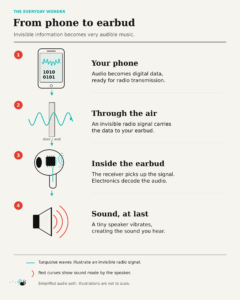
When we open Spotify and press play, our phone all of a sudden has audio information to deliver. Its electronics encode that information into a radio signal, which the earbuds receive and process. Their tiny speakers then produce the sound we hear. It’s an intricate little sequence that a lot of us take for granted every single day.
Radio waves and visible light belong to the same electromagnetic spectrum. Our eyes pick up only a small portion of that spectrum, which leaves plenty happening in the realm that we can’t see.
Intel, “How Does Bluetooth Technology Work?”:
Bluetooth devices communicate via short-range radio transmissions on the 2.4 GHz frequency range.
The 2.4 GHz frequency range offers numerous channels that Bluetooth devices can take advantage of for communication. Paired devices jump between these channels in lockstep, constantly seeking the least interference and best signal quality. This process, known as frequency hopping, helps Bluetooth devices deliver low-latency, consistent performance.
Using Bluetooth devices for the first time with your mobile device or PC requires an initial configuration process known as pairing, where each device exchanges essential information such as device IDs and security keys. Users often need to input a PIN or keycode on one or both devices to authenticate the pairing process. After the initial process, vital connection information is saved to streamline future pairings.
Currently, Bluetooth technology is offered in two distinct versions, Bluetooth Classic and Bluetooth Low Energy (LE). Bluetooth Low Energy is optimized for burst communications that preserve battery life, while Bluetooth Classic is used for applications that require more-frequent and persistent data transfer. Bluetooth Classic has up to 79 2.4 GHz channels at its disposal, while Bluetooth Low Energy has up to 40 channels to hop between.
This also explains the TikTok video’s closed-door example. Some of that radio energy can pass through the door and still reach our earbuds. How much gets through depends on the obstacle, including its material and thickness, as Bluetooth SIG explains in its guide to range.
This YouTube video also explains that invisible process with some more visual help, then moves into the coordination required to keep everybody’s music in clean, working order.
Its purple-and-green analogy gives us something to picture while thinking about radio signals. The antennas aren’t actually flashing colors; electronic circuits make and detect controlled changes in the signal to represent digital information. Then those frequencies carry the ones and zeros that eventually become the song. Absolutely incredible.
Now try that in a room full of people
Sending information across a room with just you in it is one thing, but then consider doing it in a busy gym or café where half the people in there are wearing earbuds and smart watches. It’s suddenly a room filled with various radio transmissions bouncing all over the place.
So how does Bluetooth technology keep all of these random threads of communication in place?
Well, for the Bluetooth Classic system described in the video, there are 79 radio channels, and a connection can hop between channels at a maximum rate of 1,600 times per second. That’s a channel-hopping rate, separate from how quickly data bits are transmitted. Then, Bluetooth Low Energy uses a different arrangement, so those numbers aren’t universal across everything carrying the Bluetooth name.
The really amazing part here is the coordination. A small connected group of Bluetooth devices is called a piconet, and its members have to agree on where and when to communicate. It’s honestly a really complicated little technological dance, with a cool Spanish name to boot.
The basic piconet physical channel is characterized by a pseudo-random hopping through all 79 RF channels. The frequency hopping in the piconet physical channel is determined by the Bluetooth clock and BD_ADDR of the Central. When the piconet is established, the Central’s clock is communicated to the Peripherals. Each Peripheral shall add an offset to its native clock to synchronize with the Central’s clock. Since the clocks are independent, the offsets must be updated regularly. All devices participating in the piconet are time-synchronized and hop-synchronized to the channel.
Imagine having a conversation while repeatedly moving to another room, with both people following the same schedule. Now speed that up until all those moves disappear into an uninterrupted listening experience.
Seriously, Bluetooth is performing some high-level coordination, all completely unbeknownst to us.
Our earbuds don’t need the neighbor’s playlist
Now, here’s the big question: if we’re listening to Shakira and the person beside us is listening to Taylor Swift, what keeps the two from becoming an unsolicited collaboration?
Devices recognize traffic belonging to their connection using identifying information in the transmissions. So, sharing a frequency doesn’t mean every nearby earbud accepts the same audio.
Pairing establishes a relationship between devices and the security information they need. On an encrypted connection, keys protect the data being exchanged. The YouTube video’s lock-and-key analogy is useful as a starting point, but this isn’t to say that the earbuds hand over a fresh secret key everytime. It’s a tad more advanced than that.
That brings us to frequency hopping and encryption, which play yet another role in this complicated dance. Hopping helps manage interference; encryption protects the stuff being played, and with all of this technology in place, rapid channel changes don’t cause the signal you’re receiving to be crossed or dropped.
Somebody had to solve all of that before we could sit beside a stranger and remain blissfully unaware of their questionable gym playlist.

Somebody had to sit down and invent this
We’re talking about all of this magical radio frequency song and dance, but really, who is the person behind all of this?
Enter the legendary Jaap Haartsen, a Dutch engineer who began formulating the system that became Bluetooth in 1994 while working at Ericsson. His work there centered around the practical challenge of short-range radio connections between devices, so you can start to see how his Bluetooth baby was born.

Getting systems to coordinate was only part of Haartsen’s job, as equipment from different manufacturers needed common rules if it was going to communicate. So, as a solution, Haartsen started the Bluetooth Special Interest Group in 1998 and worked on standardizing the radio interface.
Initially, Bluetooth was simply intended to be a more convenient alternative for wired voice calls, but with its continuous evolution, Bluetooth wireless connectivity grew from about 11 yards in its first generation to 262 yards in its fifth. This technology allows people to wirelessly connect devices that many use daily, including smartphones, laptops, headphones, keyboards, portable speakers and computer microphones. It has transformed the ways in which technology can be used to work, learn, communicate and access entertainment, often making everyday tasks easier. “To be honest, I did not have any idea of how big Bluetooth could become,” Haartsen said.
That last bit is honestly pretty interesting. Even someone deep inside this revolutionary invention couldn’t fully picture how much it would shape technology. Then the rest of us discovered its importance when we accidentally left our earbuds at home.
A surprising amount of civilization fits in an earbud
Now, comparing Bluetooth technology to the Pyramids of Giza might seem a little over the top, but stick with me here…
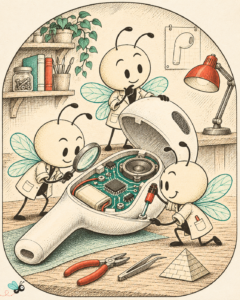
Just a simple earbud contains the results of thousands of discoveries and decisions that we rarely stop to consider. Its little radio has to communicate with another device, then its software has to interpret the information, and its audio circuitry has to turn that information into something we can hear. On top of all that, a Bluetooth device also needs power and a system small enough to sit comfortably in an ear.
It’s easy to see the grandeur and amazingness of human innovation with the pyramids, mainly because we have these enormous structures to gaze at. However, with Bluetooth, much of its wonder is in the coordination we never see, working inside equipment so small that your jean’s pocket can briefly conceal this engineering achievement.
We don’t need to understand every circuit to enjoy Bluetooth’s benefits of humming along to a song while folding laundry. The fact that all the complications just seem to disappear while using a product is really what good engineering is all about.
But, now that we know more about the intricacies of Bluetooth, perhaps we can catch ourselves in those familiar moments of irritation, frustratingly tapping an earbud because the music hasn’t started yet. Because, behind that small delay, is a system working to coordinate a conversation magically through the air, recognize the right device, and deliver the information that becomes our soundtrack or mundane Monday morning call.
Bluetooth gives us a little of that pyramid-sized astonishment in something we can carry with us at all times. We’ve just become so comfortable with the achievement that our main concern is whether it will last through our run on the treadmill.
THE LANDING
We’ll marvel at what ancient Egyptians built, then lose our own little engineering wonder in the washing machine.
STAY CURIOUS
Three more stories worth your curiosity.

 Michael Jordan, Usain Bolt, Wayne Gretzky? Nope. The REAL GOAT is Some Nerd Named Nigel Richards…






Post Comment